
The Blessed Night of Rabi-ul-Awwal
A heartwarming family story about faith, love, and the birth of Prophet Muhammad ﷺ

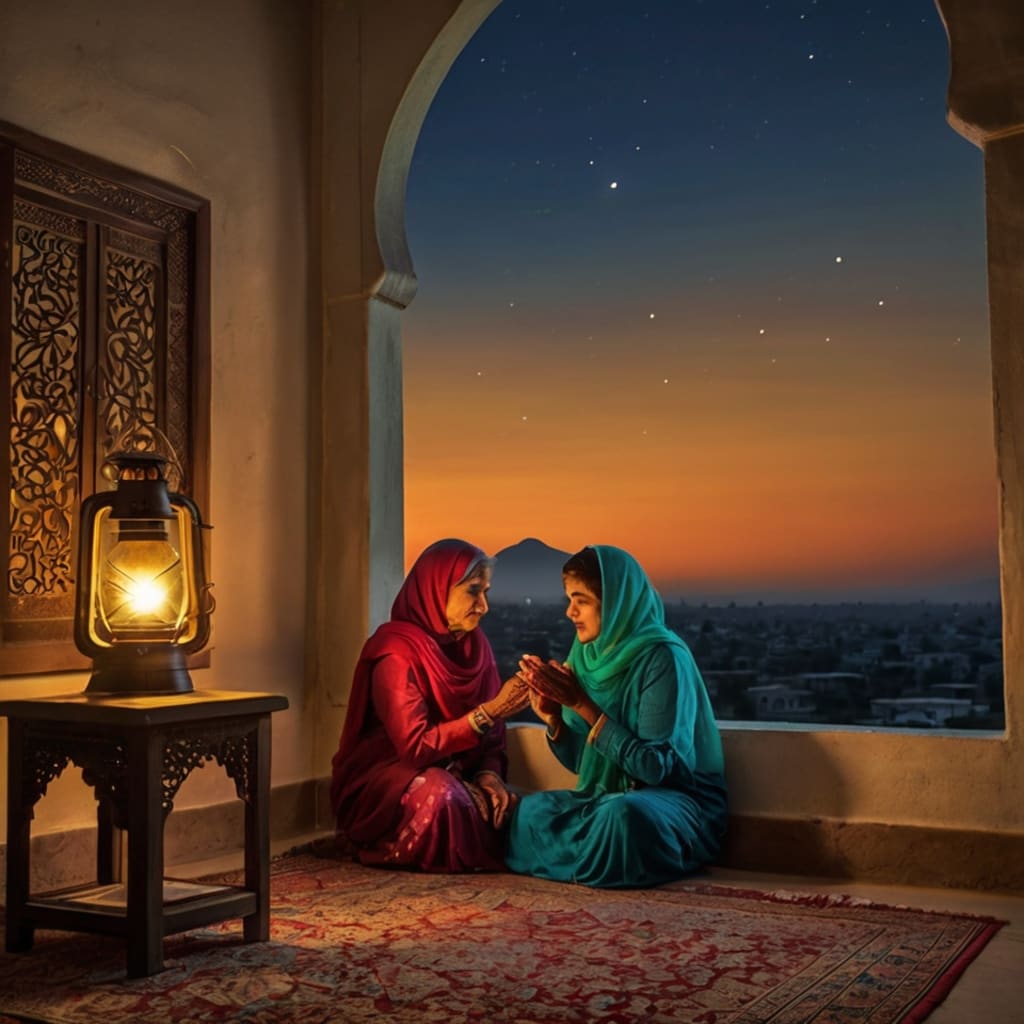
The Blessed Night of Rabi-ul-Awwal
BY:Khan
Shuaib’s mother paced anxiously near the window, her eyes repeatedly drifting toward the street outside. Noticing her unease, Shuaib’s grandmother finally spoke, “Daughter, why do you look so restless? Tell me, what worries you?”
“Mother, Shuaib went to the mosque for Maghrib prayer. He should have been back by now. I am getting worried. I feel like going to the mosque myself to see if he’s there,” replied his mother.
The elderly grandmother gently consoled her, “Wait ten more minutes, child. Perhaps he is on his way.”
Just then, the doorbell rang. Both women looked at each other, relief instantly washing over their faces. Shuaib’s mother hurried to the door, convinced it must be him. Still, she wondered why she had felt such a deep sense of unease. After all, her son went to the mosque every day for both Maghrib and Isha prayers.
The moment Shuaib entered the house, his mother could not hold back her concern. She bombarded him with questions: “Where were you? Why did you take so long?”
“Mama,” Shuaib replied calmly, “after Maghrib, the Imam Sahib and some people from the mosque went to the rooftop to sight the new moon of Rabi-ul-Awwal. I joined them. After seeing the moon, everyone made dua. That’s why I got delayed by fifteen or twenty minutes. You worried too much.”
His mother sighed with relief and smiled, “You’re right, son. I completely forgot tonight was the new moon of Rabi-ul-Awwal. I should go outside to see it as well.”
But Shuaib shook his head and said softly, “No, Mama, the moon has already set. We saw it for a few moments, then it disappeared.”
“All right,” she said, “then let me at least make a dua.” She raised her hands, remembering that Rabi-ul-Awwal is the blessed month when the Prophet Muhammad ﷺ was born.
At that moment, Shuaib’s grandmother joined them. She had overheard the entire conversation. Both women stood facing the Qibla, raised their hands, and prayed. Shuaib too lifted his hands respectfully, echoing “Ameen” to their supplications.
After the prayer, his grandmother wiped her face and spoke with gentle wisdom:
“My dear Shuaib, do you know that our beloved Prophet ﷺ was born about six thousand years after Prophet Adam (AS)? By that time, people had some understanding of good and evil, yet in Arabia many had fallen into idol worship. Their morals were poor. They fought over the smallest matters. If one tribe’s animals drank water before another’s, battles would erupt, taking many lives. People celebrated when sons were born, but when daughters arrived, they grieved. Some even buried newborn girls alive without shame. Inside the Kaaba itself, hundreds of idols were placed.
It was in such a time that Allah sent His final Messenger. Not long before his birth, a Yemeni king named Abraha marched toward Makkah with an army of elephants, intending to destroy the Kaaba. But Allah crushed his plans through flocks of tiny birds who dropped stones upon the invaders, leaving them defeated. Only a few months after this great incident, our Prophet ﷺ was born.”
Her voice grew more emotional as she continued, “When he was born, miraculous events took place. The eternal fire of the Zoroastrians, which had burned for centuries, suddenly extinguished. The royal palace of Persia shook with an earthquake, its tall towers collapsing. Idols in the Kaaba fell to the ground. His father, Abdullah, had already passed away before his birth. When news of the birth reached his grandfather Abdul Muttalib, he prostrated in gratitude at the Kaaba. The slave woman Thuwaybah was asked to nurse the child, and she was immediately freed in celebration. Later, Lady Halimah Saadia also took the infant to her village to nurse him, and her household was blessed with prosperity.”
Shuaib listened intently, his eyes wide. “Grandmother, I also know that the Prophet ﷺ was called Al-Sadiq and Al-Amin because of his honesty and trustworthiness. Even in a time when everyone worshipped idols, he never bowed to them. He always worshipped only Allah.”
The grandmother smiled warmly. “Yes, my son. Even in childhood, he never followed the false rituals of his people. He would begin meals by saying ‘Bismillah’ and end with ‘Alhamdulillah.’ He never lied, never mocked anyone, and always lived with simplicity. When he was twelve, he accompanied his uncle Abu Talib on a trade caravan to Syria. There, a Christian monk named Bahira saw the signs of Prophethood in him. He warned Abu Talib to protect the boy, for the Jews might try to harm him.”
Shuaib’s mother added, “Your grandmother has so much knowledge. I think she should give a talk about the Prophet’s blessed birth on the night of Mawlid, so both adults and children can benefit.”
“That’s a wonderful idea,” Shuaib’s mother agreed. “When your father comes home, we’ll plan it. On the eve of Eid Milad-un-Nabi, after Isha prayer, we’ll invite relatives and neighbors. We will recite the Qur’an, read naats in praise of the Prophet ﷺ, and listen to your grandmother’s beautiful words. We will avoid useless activities and celebrate in a pure way.”
Shuaib’s face lit up with excitement. “Mama, I’ll invite my friends and their families too. They’ll enjoy hearing grandmother’s stories, stay away from nonsense, and also taste the delicious food you’ll prepare!”
The grandmother smiled at her grandson’s enthusiasm. That night, the little family not only felt the blessing of Rabi-ul-Awwal but also planted a seed in Shuaib’s heart—a love for the Prophet ﷺ that would guide him for life.
About the Creator
Why Gen Z Is Having Fewer Kids — And What the Data Says About the Future of Birth Rates
Across the United States and much of the world, birth rates are falling—and Generation Z is at the center of that shift. For decades, starting a family in your twenties was considered the norm. Today, many young adults are delaying parenthood or choosing not to have children at all. The change is dramatic enough that economists, demographers, and policymakers are beginning to ask a serious question:
By Navigating the World3 days ago in Families



Comments
There are no comments for this story
Be the first to respond and start the conversation.