

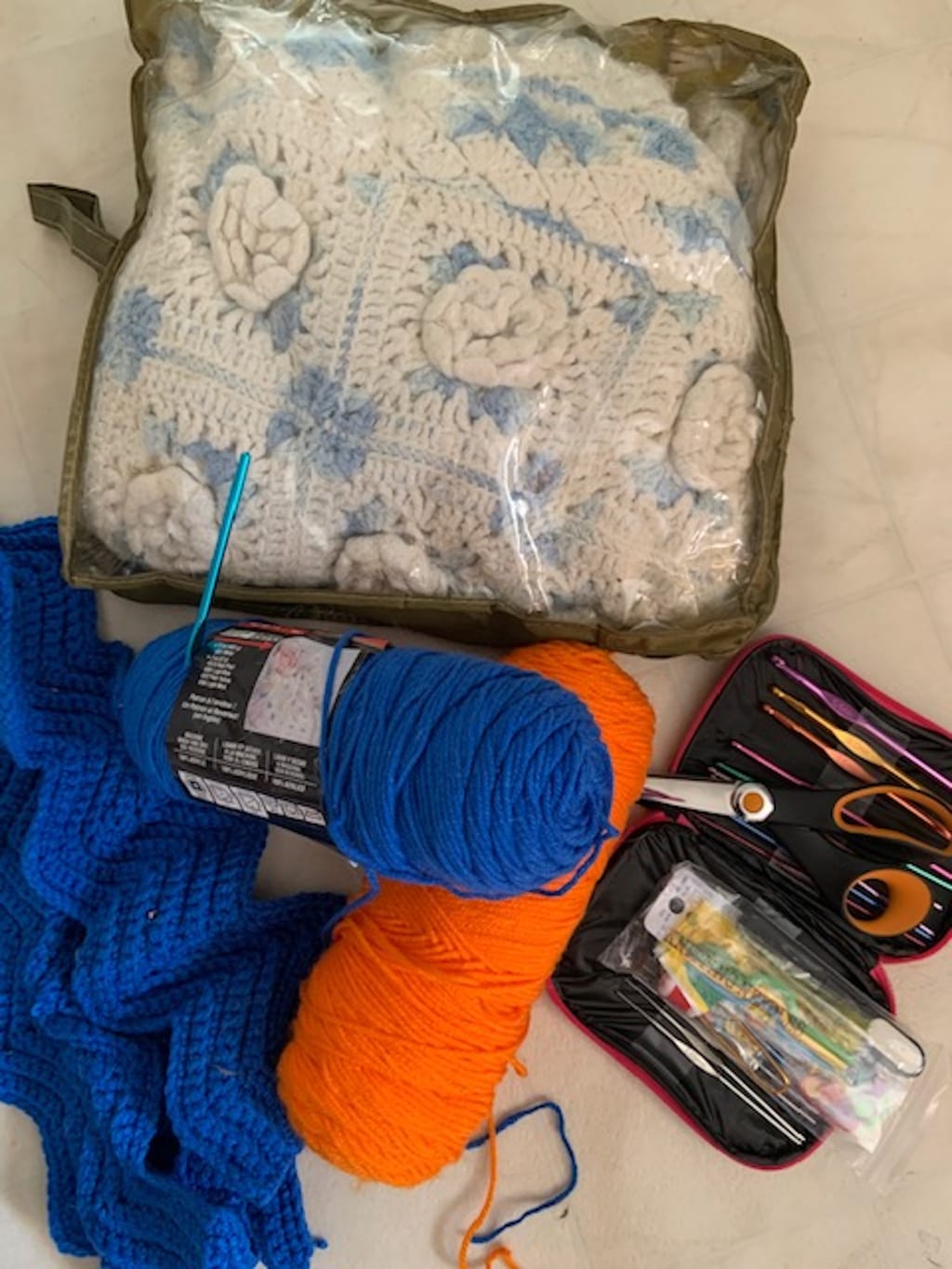
I made a lap blanket for my grandma, “Ma,” once. I crocheted it from soft, angora-like yarn in variegated white and powder blue, a block design with white roses in the center. I had good intentions when I bought that yarn: Ma’s favorite color was blue, and the petal-softness of it would be a comfort to her super-sensitive skin. This particular yarn was machine washable; the warmth such fluffiness promised was a bonus.
I’d learned to crochet a good twenty years prior and from the time I picked up my first crochet hook, I always had a project or two I was working on. My fingers were flying everywhere I went, from my son’s baseball games to family gatherings to sitting in front of the TV late into the night, if I had particular projects I wanted to get done. I made all kinds of things in varying degrees of difficulty, from Barbie dresses to baby clothes, to tablecloths, to delicate Christmas ornaments and stuffed toys. Once, I even “invented” a tutu for a Barbie doll when I made a mistake in my count for a Barbie dress I was making. Not wanting to pull it all out, I just kept going, purposely making the same mistake over and over and voila! Soon, I had a dress that was the exact replica of a tutu. I made tutus for years for my daughter and her cousins, who delighted in the fact that they were the only girls they knew who had tutus for their Barbies.
As a Gator fan living in Florida, I’d purposely created my own patterns that included Gator hats and mittens, as well as a two-foot-long, stuffed gator. Besides gifting them to friends and family — as well as the Gator line coach — I sold these items and delighted when I was watching a Gator game on TV once, where they were playing in very cold weather in another state, and the camera zoomed in on a fan who was wearing my Gator mittens. One year I crocheted so many of these mittens in an effort to make extra money for Christmas that I had calluses on my fingers where the crochet hook rubbed.
By the time I decided to crochet a blanket for Ma, I’d worked with almost every kind and weight of yarn available, from fingering to baby to worsted, and I could handle any size hook, so when I found this angora-like yarn and the rose pattern, I figured I could whip out the lap blanket in a few days. As it turned out, the rose pattern coupled with the yarn was one of the most difficult projects I’d ever tackled: I soon learned this type of yarn isn’t exactly the easiest to work with, and crocheting it into rose petals made the challenge even harder. I also figured out that when you’re crocheting rose petals, the only way to “fix” a mistake is to pull it all out and start over. I can’t remember how many times I ended up pulling out several petal rows, or how many times I had to fetch my cross stitch magnifying glass to better see what I was doing with this yarn but, the fact is, when I completed the blanket, it had been such a challenge that I threw the pattern away so I’d never be tempted to embark on such a labor-intensive project again.
Ma was seventy-five when I shipped the blanket from Florida to her rural Steuben County, Indiana, home. It was fall and Ma — always feeling chilly, even in summer — called right away to report how warm the blanket was, and how glad she was to have something to put over her legs as she rested on the divan in the living room. In my mind’s eye from one thousand miles away, I could see her: my “Ma” with her light pink skin, curly white, short-cropped hair and cataract-clouded blue eyes, wearing her signature navy blue house dress, leaning back in front of the TV, watching Lawrence Welk with the blanket draping her varicose-veined legs. It made me smile and gave me a warm, fuzzy feeling inside each time I thought of it.
After that, she and the blanket were practically inseparable. She used it no matter which seat she was sitting in; she even took it to bed with her. Whenever I visited, I smiled at how she used it even in stifling heat, fingering and caressing it like a child petting a cat. Through the years the blanket suffered plenty of wear; the rose petals which I’d labored and sweated over were first to age, as they started to curl inward with repeated washings. While the blanket maintained its soft feel, the fake angora “hairs” all but disappeared. But still, weathered as it was, it maintained its shape and never tore. It simply aged with her, graciously and quietly, but showing its age as the years wore on. My only regret is I never took a picture of that blanket back then, not before I sent it to Ma, and not once in the many times I drove up to visit her. I admit I’ve wished more than a hundred times that I had a picture of her with it as we sat and chatted during our visits.
Even though I have no photos of it, I do have my memories, and those images are delineated in my brain as clearly as any paper photograph. The sad thing is, except for my story, I have nothing of it to pass on to my children and grandchildren, so I try to be as vivid with descriptions as I can when I talk about Ma and the blanket. For example, through the years and as she aged her way into her eighties, she would phone me to tell me a story of her own. It was the same story she repeated often, her voice breaking as she fought tears over the miles between us.
“I dug out your old baby blanket again today, she would begin. “I’m holding it here on my lap, together with this nice, soft, warm one you made for me.” Doing this helped her feel like we were together again, she’d explain, as if she’d never told me this story before. Then she’d remind me of how my mother became ill shortly after I was born. “I had to take care of you,” she’d repeat. “And you became MY baby, My little girl. Do you remember?” And then she’d hit me with a request I could not honor, much as I wanted to: “Oh, please, Cindy, won’t you please move back to Indiana?”
It literally broke my heart to have that conversation because I wanted to come back as much as she wanted me there, but with myriad reasons why I couldn’t move yet, often I would try to sidetrack her by commenting that we had plenty of time for that to happen. One day, though, when I said that, she responded, “I’m not going to live forever. One day I’ll kick the bucket and then when you come to visit I’ll be dead, down the road, six feet under.” Her tone wasn’t mean or threatening; rather, she said it so matter of factly that it made me giggle.
“Now, Ma, you can’t do that because I won’t give my permission. You are not allowed to kick the bucket until I get there for good and then not for a long time after.” My comment would lead to some lively bantering about whether I could or could not control when she “kicked the bucket,” and we would say our phone goodbyes with a laugh.
One day, though, Ma wasn’t quite so eager to play along with me. When she asked for the umpteenth million time when I was planning to move, she added, “Please, please move back. I’m getting old. I’m eighty-six, and I don’t know how much longer I can hold off that bucket.” Her words were unsettling, not just because they pierced my heart but because I knew it was true. Ma had been diagnosed with cancer, and her prognosis wasn’t good.
She was four months past eighty-seven when I finally did move back. It was late summer and still warm but, as usual, she had the blanket on her lap when I visited. The blanket was well-worn, but still intact, and, as usual, she had it on her lap and she caressed it as we talked. I noticed her eyes had grown even more overcast; her face was thin because she’d lost a lot of weight since I’d seen her last. But still, she managed to perk up for a good chat. It was only a few weeks later when she was transported to a hospital, where she died only six weeks after I moved back. Before the funeral, I told my aunt and uncle that I’d like them to find that old baby blanket of mine she so often spoke of, and to give it to me. I instructed them to bury her with the one I’d crocheted, so it could keep her warm in the coldness of her death. I don’t know if they misunderstood my instructions as to the one I’d crocheted, or if somehow they knew I’d change my mind about not wanting it back, but instead of burying her with it, they saved it for me.
A few weeks later, my aunt called to let me know she’d saved it and that I could come pick it up anytime. It was over a year, though, before I could accept Ma’s death enough to fetch the blanket and bring it home where, in the safety of solitude, I sat and fingered it, holding it close to my chest. When I touched my cheek to it, I was surprised that even though it appeared the blanket had been cleaned, it still smelled of Ma’s house. Again and again I put my face into it and inhaled, each whiff blanketing me in memories so thick I almost suffocated. It was as if Ma were right there with me, as long as I kept my face buried in it. Desperate to hold on to the memories the scent evoked, I decided to preserve it by storing the blanket in a plastic zippered case. Now when I’m missing her, and when I feel like we’re a thousand miles apart —even though the cemetery’s just down the road — I unzip the case, bury my nose in the blanket and drink in its smell.
It gives me a sort of painful comfort: I can’t bear to hold the blanket and breathe in its memories for very long, yet it hurts to put it down.
Epilogue
I confess that after Ma’s death, I vowed never to crochet another blanket. It was like somehow all the zest I once had for my craft just dissipated. Every once in a while through the years, I would think about starting a blanket and then quickly move on to the next thought, and time would fly by as I entered my own senior years. Once, I even bought a bunch of yarn with the intention of making something — anything — but ended up giving all the yarn away. More years flew by until one day this past winter as I was finishing up another round of my own bout with cancer, when the thought came to me: I’m not getting any younger, and I’ve been fighting a long, ten-year battle with cancer. This past round, in which I’d had massive radiation, was the hardest one yet. The struggle hit me with an epiphany that I’d been denying since the start: I’m a survivor but no one lives forever. Even though I’m doing fine now, there is no promise of what the future might bring, or of how long I might have until — as Ma would put it — I, too, kick the bucket.
In my reverie I remembered how my great-grandma, a prolific quilter, had made sure to make a quilt for each of her grandchildren and great-grandchildren before she died. As I thought about that, and how it kept Grandma in my life for decades after her death, I decided this is something I could do. Even if I have years and years of life yet to go, I could make a blanket for each of my children and grandchildren, so they could have long-lasting, tangible memories of me one day, too. So, I’ve loaded up on yarn again and dug out my crochet hooks and scissors, and I’ve begun a new project — one that has given me new purpose and delight in life.
My children and grandchildren all live near the University of Florida, so I’m crocheting Gator orange and blue blankets for each of them. I have eight to make and I’ve got a good start. It’s an easy ripple pattern that I don’t even need instructions for, the yarn is easy to work with, and I’m hoping to have them all done in time to take them down to Florida for Christmas — when we can have a good chat about blankets, quilted and crocheted, and the circle of life, and of how kicking the bucket might be part of the process, but not necessarily the end.
About the Creator
Keep reading
More stories from Cindy Bevington Olmstead and writers in Families and other communities.
Charles, the Great Escape Artist
In the world of dogs, Charles was a chocolate lab extraordinaire. He had the friendliest of friendly personality, loved everybody he met, human or fellow canine. He especially loved cats and would seek out his favorite, Baby Kitty, to sleep with whenever he needed a good, long nap.
By Cindy Bevington Olmstead3 years ago in Petlife
Wise~Guys
— Look Behind what's in Front of You ~ Make Good Choices — Hey, So how you Doin'..! Made~Men — Mobster Movies romanticise a distinctive, elegant appearance, impeccable attire style, along with the 'Families' expressive lingo. Making their 'Bones' gave them Panache — with vintage fedoras, tailored pin-striped suits, mirror-polished wing-tip shoes adorned with tassels; with their 'Gun Moll' gorgeous dates on their arms.
By Jay Kantor17 days ago in Families




Comments
There are no comments for this story
Be the first to respond and start the conversation.