
The Bag of Chilies That No One Could Buy
One father's grief, one final promise — and a story that won't be forgotten

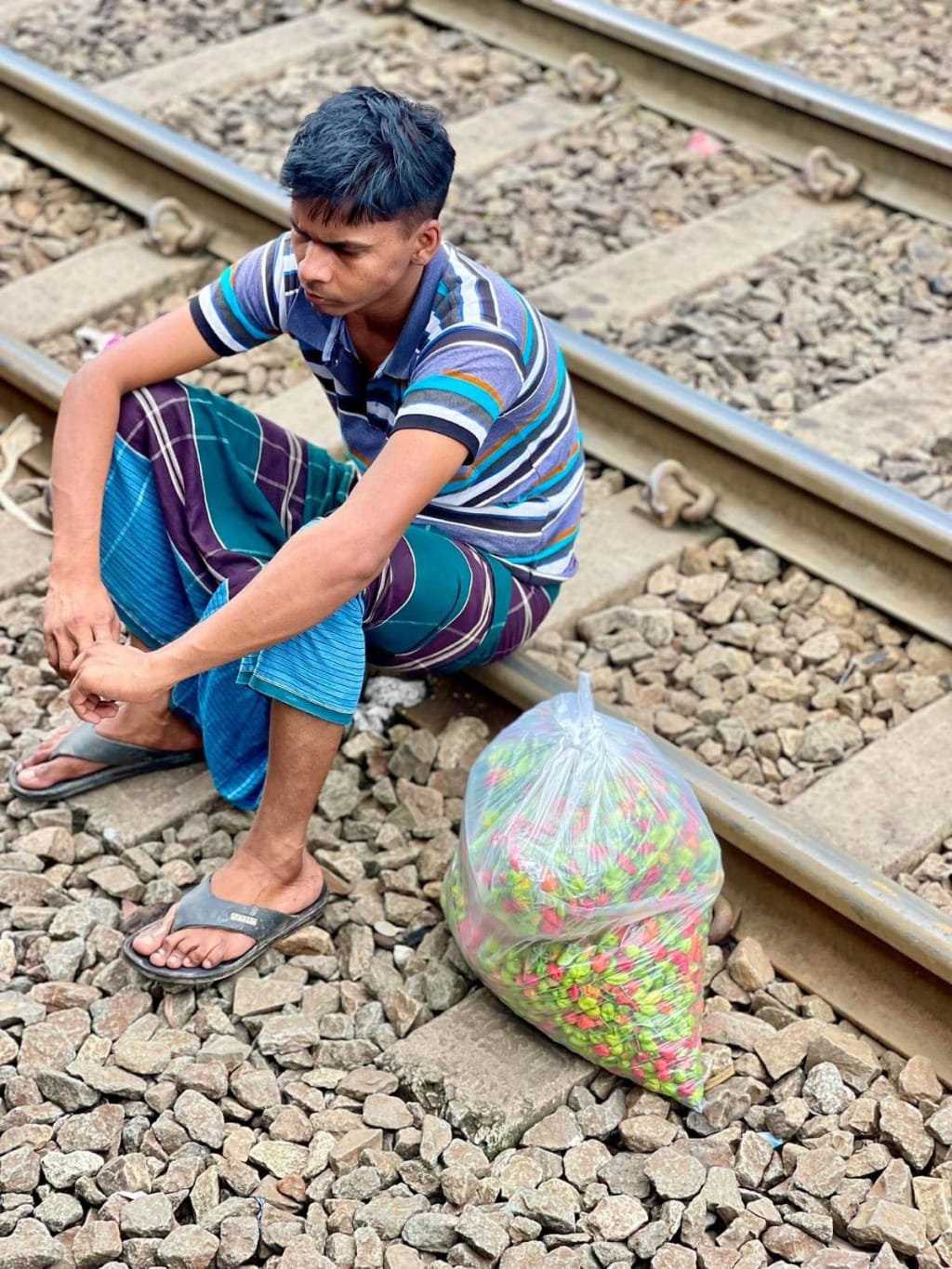
Brother, how much are the chilies?”
“Brother, these chilies… they’re not for sale.”
The platform was nearly empty, still wiping the sleep off its concrete bones. It was just shy of 8:00 AM. The train hadn’t arrived yet, but a gentle breeze was already making its way across the station, stirring dust, old leaves, and a certain kind of loneliness that only early mornings can carry. That’s when I saw him.
He was sitting quietly on the edge of the tracks—thin, almost skeletal, wrapped in a faded t-shirt and a worn-out lungi. His skin looked like it had weathered every season without complaint. His sandals, barely holding together, clung to his feet more out of duty than strength. Beside him sat a large black polythene bag, stuffed full of bright red and green bombai chilies, the kind you notice instantly because of their intense color and unmistakable scent.
I walked up to him, more out of curiosity than anything else. Something about his stillness, about the way he was guarding that bag of chilies like treasure, pulled me toward him.
“Brother, how much for the chilies?”
“These chilies… I won’t sell them.”
That stopped me in my tracks.
I let out a nervous laugh. “You’ve got a whole bag there and you’re not selling them? Why?”
He didn’t respond right away. But when he finally looked up, his eyes told me everything. They were red and swollen, cheeks wet with tears. He wasn’t just crying. He was unraveling.
His voice came out broken, like it had been stitched back together just long enough to speak.
“These chilies… I brought them for my daughter. But… she’s gone. I have no one now. I have nothing but this bag.”
I froze. The world around us seemed to blur. The sound of footsteps, loudspeakers, tea vendors yelling “cha!”, all faded into the background. Something heavier was speaking now.
I sat down beside him, right on the cold rail track.
“Why chilies?” I asked. “And… gone? What happened?”
He exhaled deeply, eyes still fixed on a distant point beyond the tracks, as though he could see through time.
He told me he lived in Arikhola, Kaliganj. A tiny village. Life was simple—some land, a cow, a little tin-roofed house. After his wife died giving birth to their daughter, Ruhi, she became his everything.
“She was just seven. My little Ruhi. Always smiling. Even when I pretended to be angry, she’d grab my hand and say, Abba, you love me too much to stay angry for long. And she was right.”
Three months ago, Ruhi caught a fever. The village doctors said it was nothing serious. “Seasonal,” they said. “Common in children.”
But days passed. Her fever didn’t break.
“She stopped smiling. That’s what scared me. Even when I held her, she’d just look at me like she wanted to say something… but couldn’t.”
He took her to Dhaka. That meant borrowing money, selling the cow, mortgaging the land. Hospitals. Tests. Waiting.
Then came the word that shattered him: Leukemia.
“I don’t even know how to spell it, bhai. But I knew it meant I might lose her. And I wasn’t ready for that.”
He fought. Hard. Sold everything. Went door to door in the village. Took loans from people who barely had anything themselves. But he wouldn’t let her go. Not without trying.
And then came the chilies.
“A week ago, she held my hand and said, Abba, next time you come back, bring me some red and green bombai chilies. I’ll make pickles with Ma’s old recipe.
I laughed. Why chilies, Ma?
She said, Because you love them. And I want to see you smile like before.
So I promised her. I said, I’ll bring a whole bag just for you.”
He kept his promise. That morning, before catching the train to Dhaka again, he visited the bazaar and bought the brightest, freshest bombai chilies he could find. He carried them like a gift wrapped in hope.
But halfway through the journey, his phone rang.
“It was the hospital. They said… she didn’t make it.
I was on the train, bhai. Surrounded by people chatting, laughing. Some were eating snacks. Some were reading the paper. And me…
My whole world had ended. Right there.
I didn’t even cry. Just sat still. Holding this bag.”
He looked at me then—fully looked at me—and said something I’ll carry for the rest of my life:
“There are millions of people in this world. But I have no one. No daughter. No home. No reason. Just this bag of chilies.
And I can’t sell them. I won’t.
They were meant for her.”
My train arrived. I could hear it pulling into the station behind me. But my legs wouldn’t move. The man’s pain anchored me to the ground.
I reached into my pocket and tried to offer him some money. It wasn’t much. Just something.
He pushed my hand away gently.
“I don’t need money anymore, bhai. What will I do with it?
You listened. That’s enough.”
I reached for his hand instead.
Held it tightly.
“I’ll plant a bombai chili tree in Ruhi’s name,” I told him.
“And I’ll tell people about her. Ask them to plant one too. Let her smile live in every garden.”
Tears streamed down his face. He didn’t speak. He just clutched my hand like it was the last thread tying him to this world.
The train blew its whistle again. Louder this time. Calling me back.
I let go.
He didn’t.
He had nowhere left to go.
Somewhere in Bangladesh, a father still sits with a bag of chilies he cannot bear to part with. Somewhere, a little girl named Ruhi lives on—not in hospitals or graves, but in the sharp color of every bombai chili, in the tang of every homemade pickle, in the stories we choose to carry.
If you can, plant a chili tree.
For Ruhi.
For every child who left too soon.
About the Creator
Kevin Hudson
Hi, I'm Kamrul Hasan, storyteller, poet & sci-fi lover from Bangladesh. I write emotional poetry, war fiction & thrillers with mystery, time & space. On Vocal, I blend emotion with imagination. Let’s explore stories that move hearts
Keep reading
More stories from Kevin Hudson and writers in Families and other communities.
WAR OF THE WORLDS (2025) – A Terrifying Mirror of Our Own Destructio
You’re not ready for this invasion. Aliens may be the enemy, but humanity is the real story. Director Jordan Vance’s 2025 take on War of the Worlds isn’t just a remake—it’s a reinvention. It rips the skin off the classic H.G. Wells novel and exposes something far more terrifying: us.
By Kevin Hudson7 months ago in Fiction
Wings of a Lioness: The Geology of Inherited Pride
People often ask me where I get the strength to pack my entire life into two suitcases and head into the unknown. Where do I get that step that never falters, neither in the cold Canadian North nor under the elegant skies of France? The answer doesn't lie in geographic maps, but in an old photo album, my mother's oversized ring, and that blue flight attendant's cap that is worth more to me than any crown. My courage is not my own doing – it is the dowry left to me by my mother, a woman who conquered heights with airplanes, and the earth beneath her feet with her unwavering character.
By Magma Star4 days ago in Families




Comments
There are no comments for this story
Be the first to respond and start the conversation.