
The Archipelago of Solitudes: Reflections on a December 24th
Meditations on Christmas Eve Solitude

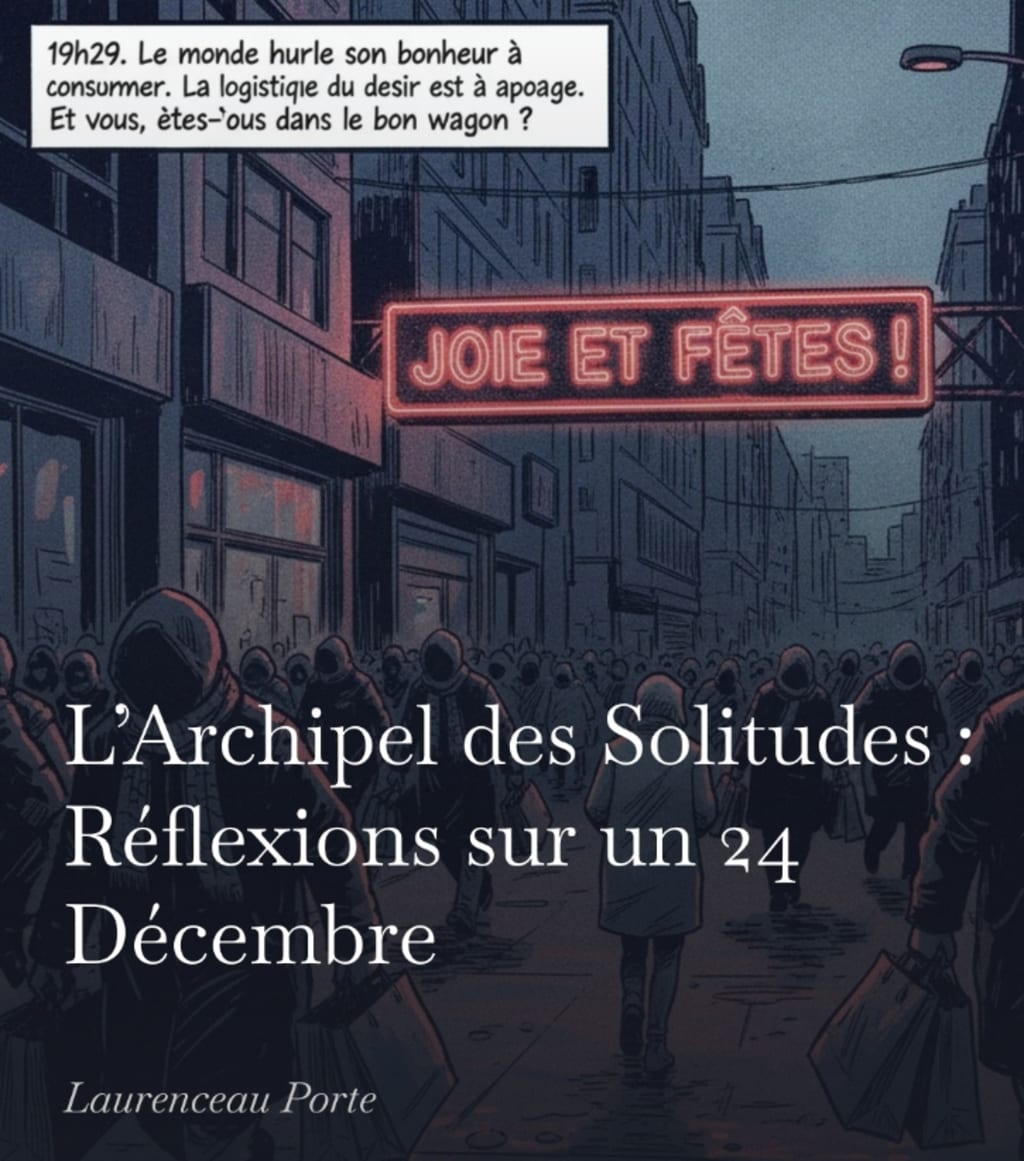
There’s this precise moment, almost magical, that you only truly catch on the evening of December 24th. Around 7:30 p.m., suddenly, the whole world seems to hold its breath. The last engine noises fade away, the overloaded shopping carts we pushed through supermarkets as if a thousand-year famine were looming, the frantic rush around gifts—all of it gives way to a deep, almost tangible silence. Not just the absence of sound, no: a presence that weighs heavily. For most people, it will soon be drowned out by laughter and clinking glasses. But for millions of others, that silence echoes like an inner scream.
It’s the abrupt end of what I call the “logistics of desire.” For weeks, we’ve kept the global economic machine running at full throttle, shipping tons of promises wrapped in plastic across the world, at the cost of oceans of fuel burned. And then, all at once, everything stops. Stores pull down their shutters. The city looks like an abandoned theater set, with its garlands twinkling for no one. In this sudden void, solitude takes on a different dimension. It’s no longer fleeting; it settles in, metaphysical, unrelenting. No more distracting yourself with shopping or perpetual motion. You’re left facing yourself, and for so many, that “self” is an abandoned place they no longer know how to inhabit.
In the collective imagination, Christmas is meant to be the great family gathering, the endless table, the warmth passed down through generations. Ads, shop windows, social media—everything sells us that idyllic picture. So being alone on this night isn’t just a circumstance. It feels almost like a fault, a failure in the grand narrative of modern happiness. The person eating alone ends up seeing themselves—and being seen—as a living failure. Yet the numbers are merciless: solitude hits the least well-off twice as hard (17%) as the wealthiest (7%). It has become the dark side of precarity, the force that ejects people from the warm circle.
We often picture solitude as an elderly person, alone behind lace curtains, with only the TV for company. Yes, hundreds of thousands live in full “social death” like that. But the problem runs deeper, and it’s younger than we think. Today, it’s the 18-24 age group that suffers most: 40% experience chronic loneliness, compared to just 7% among those over 65. For this generation raised on digital life, Christmas can turn into a nightmare, amplified by the endless parade of perfect lives on screens. The gap between those images and a tiny empty apartment hurts, in silence.
We’ve shifted from a society of relationships to one of connections. The difference is huge. A real relationship demands time, vulnerability, friction with the other. Connection is instant, reversible, filtered by algorithms that reflect only ourselves back to us. Tonight, no amount of clicking will replace a hand on a shoulder. The silence of the lonely is the price we pay for our obsession with absolute autonomy. By wanting to depend on no one, we’ve ended up mattering to no one.
Christmas is also the story of the hearth, that ancient fire that was never allowed to go out. In the past, people huddled together to ward off the fear of winter’s darkness. Today, we have central heating, but we’ve lost that instinctive solidarity. Home is no longer a solid refuge; it’s just a functional space. For the person who is alone, the lack of a hearth isn’t about lacking a roof: it’s the absence of an echo, the emptiness where no voice answers yours.
Our civilization excels at delivering everything… except human presence. We marvel at algorithms that predict our shopping desires, but we stay blind to the gulf between two neighboring doors. This Christmas loneliness is the direct result of our way of life: we chose total independence, and we reap the right to be invisible. We thought the screen could replace the fire. The result: millions of heated homes where people shiver from a cold that only a human gaze could warm.
We need the courage to say it: the injunction to forced family joy is a quiet form of violence. It humiliates those who don’t have the perfect setting. Christmas shouldn’t celebrate the nuclear family cocooned in its comfort; it should be the feast of unconditional hospitality, the one that simply says: “You’re here, and that makes me a little less alone.” That’s not pity—it’s survival.
Yet there’s also resistance in this silence. Some choose solitude as an act of freedom: refusing consumer hysteria, hypocritical dinners, debt for empty symbols. For them, December 24th becomes a space to breathe, a necessary asceticism. True fraternity can’t be ordered from a catalog; it’s woven in the small, everyday gestures.
Tonight, as the lights go out one by one, let’s look at those windows where a single bulb still glows. The transition we truly need isn’t just ecological; it’s human, relational. Let’s rebuild networks of human warmth so no one is forced into silence while the world celebrates. One person’s emptiness is everyone’s responsibility. It’s time to relight not only the stars, but the gazes that share them. And it starts with finally hearing the silence next door.
JLP
About the Creator
Laurenceau Porte
Chroniqueur indépendant. J’écris sur l’actualité, la société, l’environnement et les angles oubliés. Des textes littéraires, engagés, sans dogme, pour comprendre plutôt que consommer l’information.
Keep reading
More stories from Laurenceau Porte and writers in Families and other communities.
Oil and the Lingering Shadow
Some questions don't arise by chance. They emerge amid current events that revive old collective fears. The rumor of a potential U.S. attack on Venezuela over its oil is no longer mere abstract speculation as of late December 2025. With the massive deployment of U.S. naval forces in the Caribbean, the seizures of oil tankers, and direct statements from Donald Trump demanding the return of "stolen assets," this question has become a burning echo of geopolitical reality.
By Laurenceau Porte3 months ago in Journal
Wings of a Lioness: The Geology of Inherited Pride
People often ask me where I get the strength to pack my entire life into two suitcases and head into the unknown. Where do I get that step that never falters, neither in the cold Canadian North nor under the elegant skies of France? The answer doesn't lie in geographic maps, but in an old photo album, my mother's oversized ring, and that blue flight attendant's cap that is worth more to me than any crown. My courage is not my own doing – it is the dowry left to me by my mother, a woman who conquered heights with airplanes, and the earth beneath her feet with her unwavering character.
By Magma Star4 days ago in Families




Comments
There are no comments for this story
Be the first to respond and start the conversation.