

Annie searched the lists for several days until she found the entry.
When she had begun, she certainly hadn’t expected a reward. Still, she had wondered to find something so precious in a thrift store, and she had decided that someone might want it. So, Annie Jacobson skimmed through website classifieds, convinced she would find a desperate soul searching for the book.
Finally, she spotted it. “Seeking small, black, leather-bound journal. Handwritten note inside the cover, ‘For Emil.’ $20,000 reward.”
Before she started her quest for the owner, she had spent a month perusing the book’s contents. The pages had contained some of the most beautiful artwork her amateur eyes had ever seen. At first, she believed them simple sketches of flowers, a dozen or so variations of the same blossom followed by a dozen or so of a different flower, each sketch lovely in its own right. She noticed an odd texture to the lines, though, and she snapped a photo so she could zoom in and discern the cause.
Every bloom had not really been sketched, but had been crafted by writing words in the tiniest of letters, words that meant nothing to Annie. The artist must have travailed for weeks just to finish one drawing. Most likely, the artist had spent years to fill the entire book.
“For Emil.” Right there on the inside cover.
As she approached the imposing white brick midrise, Annie’s heart swelled. Her grandfather had whiled away his final years in a place like the one she now entered, and Annie had visited him several times per week. They had watched Broadway shows together on her phone, sung some of the songs until he grew too tired or the staff came to quiet them. Toward the end, he had sent her to the nearby thrift shop in search of treasure. Any unusual item would stir his memory to recount hours of stories – hours she had recorded on her phone so she could remember.
The notebook had fascinated him, just because it had spoken so much love and care and effort in its pages.
“He’s in hospice now,” Emil’s niece, Marian, was explaining. “We didn’t really understand why he made such a fuss about the notebook, but he has taken such good care of us that we humored him.”
“That’s a very kind uncle.”
“Especially since he is not even our real uncle. He was a friend of our Auntie Jeanine.” The woman paused. “It’s complicated.”
“It is none of my business,” insisted Annie. “I am just glad I found the notebook.”
As she said the words, both Annie and Marian glanced over at Uncle Emil, and Annie saw her companion startled.
“What is it, Uncle?” Marian demanded, and Annie realized that Uncle Emil had tears flowing from his eyes.
Instead of answering, he gestured both girls to sit on the chairs next to his bed.
Even in his crumpled, crinkled form, his silver hair waved with intermittent strands of sable. His voice, though, had lost almost all of its tone, and the girls had to lean in to catch his words.
“It is her notebook!” he exclaimed, and an unexpected twinkle shone through the tears.
“But you are sad?” Marian inquired.
“I am,” he nodded, “and yet, I am light with joy as well.”
“It is the notebook?” Annie wondered, glancing at Marian to see if the rightful questioner would take offense. Instead, Marian stared at her uncle with as much curiosity as Annie felt.
“Pull your chairs closer, my dears. I must tell you about this book.”
Obediently, the girls scooted closer.
“It has both broken my heart and mended it the same and beyond.”
Rather than continue, the man leaned back against his pillow and smiled into the air across the room. Both girls waited for a moment, but when he didn’t continue, Marian turned a questioning gaze to Annie.
“I have never seen him like this,” she whispered to Annie. “He has always been very sharp in the mind. What is in the notebook?”
Annie hated to admit how thoroughly she had examined the book. With a shrug, though, she explained what she knew.
“The, uh, book holds a series of sketches…” The images rose in her mind, and they brought a smile to her lips. The first set portrayed probably the most traditional of the images, a series of roses in varying shades of amber. Gilt and shining, the artist had somehow used words to create the definition of the images. “…but the colors seemed a rainbow of yellow, if that is such a thing. There were so many shades, from ochre to gold to lemon to palest primrose. Beautiful, but I could find no meaning in the words.” Annie admitted.
“What were the words?” Marian prompted.
“Gamboge roseus virorum…”
“Something about a rose, and maybe living?”
“The yellow rose,” came Emil’s quiet murmur. “Betrayal! And Virorum. It refers to the De Casibus Virorum Illustrium, a work by Boccaccio about Cleopatra.”
Again, both girls turned to the man awaiting his story, and he almost seemed to lapse into a repeat of his silence. After a breath, though, he continued in a stronger voice. “The pictures are a reference to my betrayal of your Aunt Jeanne, when I left her for a beautiful young seductress named Cleo. Or, at least, that is what Jeanne always believed.”
“But it wasn’t true?”
“Your aunt was my only love.”
For the only time during his story, his eyes locked on theirs, lucid and sincere.
“It was a miscommunication, and by the time I realized, Jeanne had left Shanghai.”
“He always calls her Jeanne,” Marian explained, “because they spent their final moments in Paris.”
“The next flower is an Asagao,” he interrupted. “It’s Japanese name. Once she left Shanghai, I lost her for a year until I ran into her at the festival in Iriya. We were surrounded by livid Morning Glories – “
“Angry flowers?” Marian interrupted.
“No, livid. The color. A special variety of ‘livid’ – stony-blue – flowers bred for that year’s festival. Staring at her among those blooms, I believed my heart would crack. She stood with her new beau, and she introduced me to him with a shy smile.” His eyes rose to the ceiling across the room, his mind seemingly lost to memory. “I had to stand there, a waxen smile on my lips as I realized the vanity of my love. The word, Anabasis, refers to a work by Cyrus – the name of the man who accompanied her in Japan. The Morning Glory spoke the vanity of our love.”
The melancholy look on the old man’s crinkled brow drew Marian to clasp his hand, and he turned a generous smile on her. “The third flower,” he continued, collecting himself, “is the Kopsia, a rare red gardenia that we encountered in Chiang Mai. I say we…” A sad chuckle creaked past his lips. “But in reality, I saw it with my girl, Kassi. She and I hadfound companionship after our loves were lost, but neither of us intended forever. Jeanne, though, did not understand when she saw us together, and so Jeanne remained hidden from my sight. The Gardenia, for hidden love. I only found out years later that she had been there.”
For a few moments, the promised silence materialized, and the young ladies peered compassionately at their elderly companion. Finally, Marian turned to Annie. “Is that all the flowers?”
“Um, no,” Annie admitted. There was a vine…”
“With pale blue flowers,” Emil finished, turning back to the girls. “Angelwing jasmine. I found Jeanne in Marrakech, in a garden of jasmine. Anactoria refers to a poem about Helen. In Marrakech, I confessed my love to Jeanne under a jasmine-covered trellis. I’m a horticulturist, you see,” he explained to Annie with a smile.
“Uncle Emil has traveled the world to study gardens,” Marian interjected. “It is where he first met my Aunt Jeannine, and she always described him in terms of flowers.”
With a sigh, Emil spoke to the ceiling. “I confessed my unconditional love. Which was good, because she had just signed a contract with a publication in Manhattan. They wanted her artwork, which, as you know, is quite remarkable. The publication funded her move to the States, put her up in an elegant apartment, and paid her quite nicely. She promised me that I could come to stay with her once I finished my studies in Marrakech, but when I returned, she had married.”
Both girls stared openmouthed at Uncle Emil, and Annie reached for Marian’s hand as if they were long friends.
“But Aunt Jeannine wasn’t married.”
“She was,” Emil countered. “You did not know him because he lived in this home. Her husband, Darius, was in a horrible accident only a few months after they married. He needed round the clock care, and sweet Jeanne came to see him every day, both because she cared about him and because she did not want him to feel forgotten.”
“I can’t believe I never knew she was married, though.” Marian wondered.
“She did not intend to keep him a secret, but Darius was an unusual man. It was a strange era, and a successful woman could not be burden with a crippled husband and still be the toast of the town. Jeanne resisted, but Darius insisted. It made for some awkward moments when she had to spurn a handsome suitor.” A wicked grin split Emil’s face, and Annie mirrored his expression.
“You admired him…” she posited, and Emil nodded.
“I did, and I admired her even more than I had before, even if it meant that she and I could never be together. I could be her friend, and I could be a friend to Darius, and I fully believed that her feelings for me had evolved. That she considered us nothing more than friends. I would never stop loving her, but I had to be fair.”
“But Paris,” Marian prompted.
With a heavy sigh, Emil turned his head to the side, laying his cheek upon the pillow and staring out the window by his bed. He had betrayed little emotion during his explanation of the flowers – even less than Annie or Marian – but a new tear leaked from his eye.
“I was in Milan when she called me. Darius had died, and Jeanne had collapsed upon hearing the news. When she awoke, the doctor sent her for an examination. It wasn’t unexpected from a woman at the time, but it concerned the doctor nonetheless, and he was right. Jeanne was ill.”
“Aune Jeannine flew to Paris before her death, but I never knew why.”
“To meet me.” Emil crinkled his eyes in a smile. “We were in Paris for the last two days of her life. She told me she had written our story...”
“Is that why you cried?” Marian wondered, and Emil shook his head.
“The final flower – a pale green coronaria anemone outlined in the word ‘Enmerkar’ – refers to undying love, and Susan was my name for her.”
“Susan?”
He smiled. “Susa was the home of Queen Esther, and she was the most beautiful woman in the kingdom. Just like my Jeanne. She created a successful career as an artist, and she charged me to care for her family with her estate. Which I did. She made me this journal, which has excited me for the first time in years.”
“Excited?”
“The anemone – undying love. When I leave you, I am going to Jeanne. And we will love forever.”
With one last sigh, Emil settled into sleep, and Marian rose to her feet. She led Annie to the corridor.
“You’ve brought him so much joy.” Marian raised her phone, sliding her fingers across the screen. “From Uncle Emil.”
Annie’s phone buzzed, and when she read the screen, she balked. “I don’t need it.”
“Uncle Emil gave us everything,” Marian smiled, “and you gave him Aunt Jeanine. He’s happy now – buy yourself a journal.”
About the Creator
Keep reading
More stories from Carmi Cason and writers in Families and other communities.
Wise~Guys
— Look Behind what's in Front of You ~ Make Good Choices — Hey, So how you Doin'..! Made~Men — Mobster Movies romanticise a distinctive, elegant appearance, impeccable attire style, along with the 'Families' expressive lingo. Making their 'Bones' gave them Panache — with vintage fedoras, tailored pin-striped suits, mirror-polished wing-tip shoes adorned with tassels; with their 'Gun Moll' gorgeous dates on their arms.
By Jay Kantor21 days ago in Families
Men who eat nuts tend to have better quality sperm
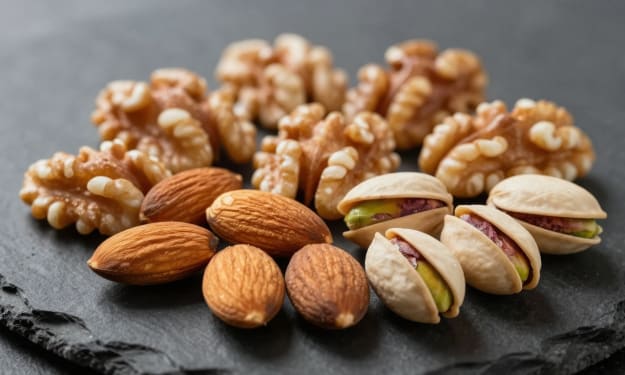
Peak Potency: How a Daily Nut Habit Elevates Male Sperm Quality Male fertility rates have dropped in recent years. Many couples struggle to conceive, and men often overlook their role in this challenge. Your diet can make a big difference here. Nuts stand out as a simple fix. They pack antioxidants and healthy fats that support better sperm quality. Think of them as fuel for your reproductive system. Studies show men who eat nuts regularly see real gains in sperm health. If you're planning a family or just want peak vitality, adding nuts could be your smart move.
By Story silver book 4 days ago in Families



Comments
There are no comments for this story
Be the first to respond and start the conversation.