
Siblings, Spiderwebs, and Serendipity
An adoptee's journey of self-discovery

What is your wish when you blow out the candles on your birthday cake, or throw a penny in a fountain, or when the clock says 11:11? For me, every wish I made growing up was always the same; that I would someday be reunited with my biological family.
I was born Virginia Teresita Alvarez Cardozo, in Asuncion, Paraguay and was adopted at eight months old to a family in the United States. I was raised an only child, and often fantasized about what it would be like to grow up with a sibling. My fascination was amplified by the fact that I was the only person in my adoptive family who didn’t grow up with a sibling at home.
While I had an older brother, Paul, from my dad’s first marriage, we were eighteen years apart and never lived in the same household. Our life experiences were vastly different, and after so many years of being an only child, my brother wasn’t always keen to have an annoying little sister hanging on his arm when he would come to visit. Due to this dynamic, my brother and I never developed a close relationship. For me, it was not about having a sibling necessarily, but more so the idea of having a true shared experience, be it biological, lived, or by age, gender, ethnicity, or adoption, none of which Paul and I had in common.
In 2007, when I was eleven, my parents took me back to Paraguay to see where I came from and commissioned a social worker to locate my biological family. Disappointingly, the investigation did not result in a reunion, but it did reveal that I had a sister and three brothers still living in Paraguay. Although I still didn’t know their names or what they looked like, this newfound information only fueled my determination to find them.
For many years after my initial trip, I scoured the internet in vain, hoping to come across them. With the rise of social media during this period, I was convinced it was only a matter of time. I searched hundreds of profiles with the surnames Alvarez and Cardozo trying to identify similarities and fantasizing about what my birth siblings were like. They felt so close!
In 2017, I resumed my search efforts, and once again, my parents supported me and restarted the investigation. This time, after a long process that included rough translations, third parties, and numerous emails back and forth, I was informed that the investigation was a success! Not only had they located my family, but the siblings I had dreamed of wanted to meet me! I had an older sister, Daxi, who was 30, and three younger brothers, Francisco, 23, Paolo, 22, and Jerson, 16. It was surreal to finally learn their names and faces.
It would be a full year before I was able to make the trip due to finances and logistics, but for that entire year, I spoke to my extended family and siblings daily. It was not without challenges and things often got lost in translation as I did not speak fluent Spanish, and they primarily spoke Guaraní, the indigenous language of Paraguay mixed with Spanish. But I wanted so badly to form a bond with my siblings, especially my sister, so we persevered with Google Translate.
After all of the anticipation, the moment finally arrived. Meeting my siblings for the first time was indescribable. As soon as I stepped off the plane, the entire family was waiting for me. The first person to come up and embrace me was my sister, and it was everything I had always dreamed of. I reveled in their presence and this feeling of being complete.
The entire trip was unforgettable, and we traveled all over Paraguay; from my birth family’s hometown of Puerto Casado in the North, to the Capital, Asunción, were I was born, to my sister’s town of Capiatá, to the countryside in Belén, where my cousins lived, and even near the border in Ciudad del Este to see the fabulous Iguaçu Falls. I got to experience the way that Paraguayans live from a local perspective rather than as a tourist. It felt like I got a glimpse into an alternate reality of the life I could have lived. I tried new foods native to Paraguay including Sopa paraguaya, Mbeju, and Chipa, rode on a motorcycle through the countryside, drank the Paraguayan staple of Tereré, and even saw the world renowned Paraguayan classical guitarist, Berta Rojas in concert, thanks to my brother Francisco who is a professional cellist in the Orquesta Sinfónica Nacional del Paraguay. I saw so many different sides of the country; it was the trip of a lifetime. Not only did I have an authentic experience, but for the first time I had the sister experience. Little things that other people might take for granted, like doing each other’s hair or nails, or getting makeovers together, or sharing one another’s clothes and makeup, were so significant to me because for the first time, I had my biological sister to do them with.
When I returned from my trip, I was inspired to create like never before. I wanted to commemorate this life changing experience, the pride I felt for my birth country, and the gratitude I felt toward my birth family, especially my siblings, for accepting me.
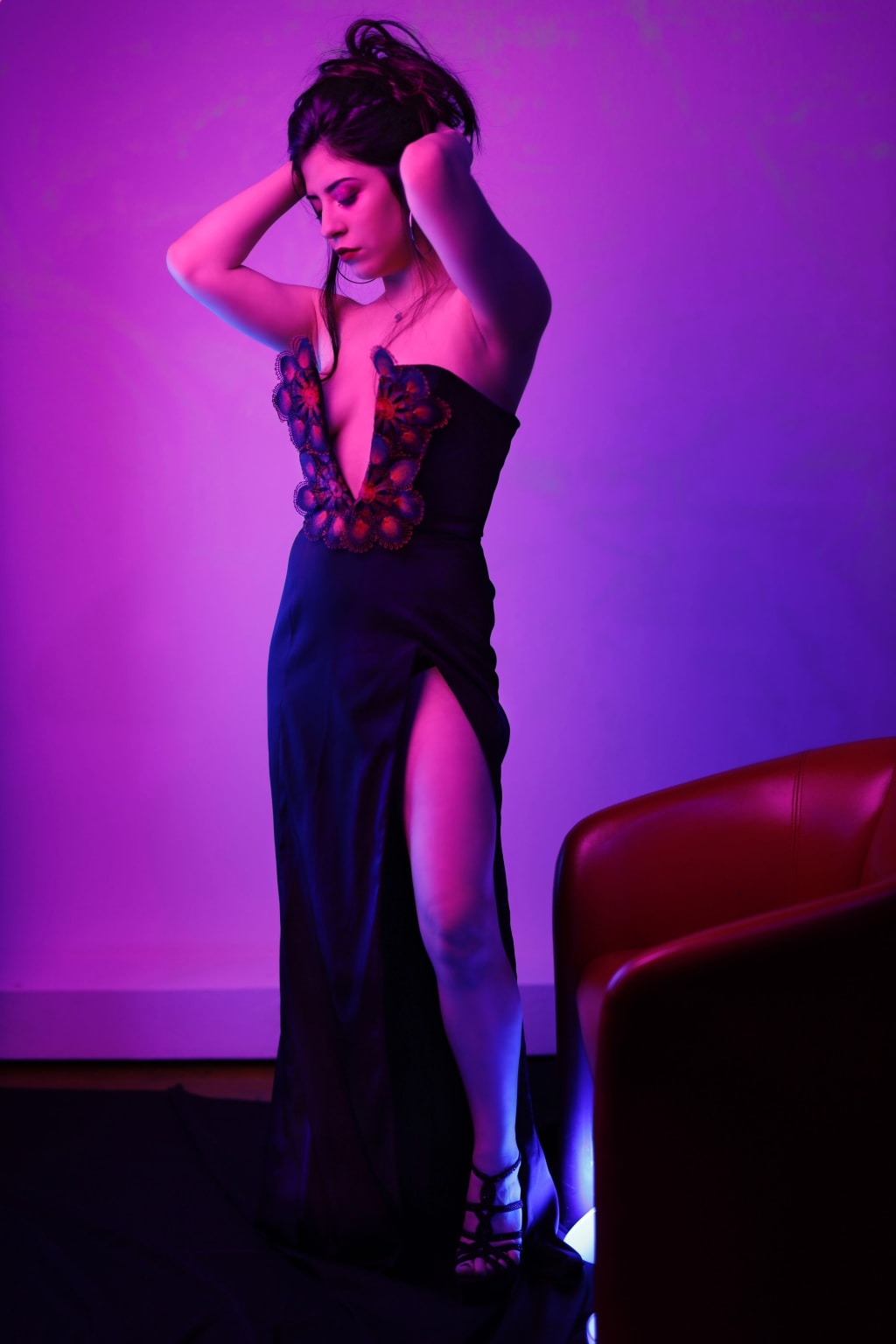
My background is in textiles and sewing, so I was compelled to collaborate with my sister and combine my passion for apparel design with the traditional art of Paraguay to tell our story.
I embarked on a mission to source Ñandutí lace, the epitome of traditional Paraguayan design. This was made possible by Daxi, who traveled to the heart of Ñandutí production in Itaugua, Paraguay to select the lace I would use for my design. She picked out a motif common to the area, identified by its small, round, ‘spiderwebs’ going around the center of the lace. It was perfectly fitting because the lace resembles flower petals opening, which gives it its name- hope; something I never lost on my journey.
Meanwhile, I researched trends in Paraguayan fashion, specifically from Paraguayan designers, and consulted with my sister and other family members about styles, silhouettes, and fabrics that would be common to Paraguayan consumers so that the final product would be akin to what can be seen in the Paraguayan marketplace.
It was a long process constructing the dress, beginning with draping the prototype. I decided on a strapless, deep V-cut bodice, with a floor length gown. The dress featured princess seams all the way down, so it would be fitted and could conceal boning that would help to support the weight of the lace as well as the lining and interfacing. The use of princess seams was a technical decision which meant there were many pattern pieces which had to be cut multiple times, beginning with the original draped muslin prototype which consisted of fifteen pattern pieces. After the prototype, I cut paper patterns, and from the patterns I cut the garment fabric, interfacing, and lining. Altogether I cut seventy five pattern pieces.
Despite the arduous process, the final product was the most satisfying project I have ever created because not only did I conceive and construct it from scratch, but it also served as a testament to the love I have for my birth family and country. It tells my story and proved that even with an ocean between us, we shared a sibling bond that enabled us to take on this task together, and that made it more valuable to me than anything I have ever designed.
It has been a long and, at times, bittersweet journey that culminated in both closing one chapter of my story, and the beginning of a new one. Today, my siblings and I remain in contact, although communication is difficult and was made even more challenging with Covid. However, I already know that we’ve beaten the odds by being reunited, and have no doubt that we will beat the odds once again by remaining connected through our sibling bond.
About the Creator
Keep reading
More stories from writers in Families and other communities.
Writing To Succeed
If you want to find something that will help readers find your writing, possibly expand your audience, and maybe even get you noticed for other things, then you’re not alone. But how can you get it done in a world full of want-to-be writers? Look less at what you’re writing now, and more at what other writers have used to boost their views and reads.
By Jason Ray Morton 6 days ago in Writers




Comments
There are no comments for this story
Be the first to respond and start the conversation.