
Recipes from Formosa
A story of a restaurant on the brink of failure, and a family who is always there, even when they're gone.
The hours before the sun rises are always the quietest. The silence that settles in the streets before the city wakes used to bring her a sense of comfort – a peaceful cocoon of time she could call her own.
But not anymore.
The silence stretches and bleeds into her waking hours, into the empty corners of her breakfast restaurant, as the pandemic ground her livelihood to a suffocating halt.
Still, every morning, she arrives in the dark and turns on the kitchen light, setting her hands to a familiar routine. Kneading sticky dough and toasting sesame seeds. Measuring soy milk and slicing green scallions. She doesn’t know what else to do. Sometimes she thinks the scent alone keeps her sanity hanging by a thread, in this upside-down world that nobody saw coming.
She tries to stop expecting the bell of the front door to ring.
The sizzle of the fried crullers seems unnaturally loud, now that she’s down to just one part-time delivery assistant. At least people who now work from home still eat and order breakfast. And Taiwanese breakfast is delicious and inexpensive.
She doesn’t want to change that. Even as the price of flour skyrockets.
She places the finished shaobing sandwiches in the warmer, little sesame seeds flaking off the crispy exterior onto the parchment paper beneath. She doesn’t have to taste it to know that the satisfying crunch is up to her clientele’s exacting standards.
Brushing her hands on her apron, she avoids looking at the lines of red numbers glaring from her laptop and distracts herself by rearranging the tables that are all pushed to the side. Their worn, uneven legs scrape against the aging tiles. One side of the caution tape looped around them falls off.
She tapes it back up and suppresses the urge to cry.
Endurance has always been a family trait, ever since the old days of foreign occupation in Taiwan, all the way through the opening of this small breakfast joint thirty years ago, after her parents managed to scrape the funds together.
She endured when they passed. And she endured through the recession twelve years ago. She’s so tired of enduring, though, and wonders what it would be like to let it all go. The disappearance of her family’s restaurant would just be one of thousands of small business closures – swallowed up in the vast, destructive wake of an invisible disease.
Is the struggle worth it, in the face of such an inevitable end?
She stares at the far corner by the window, where she used to do her homework after school, her tiny legs dangling back and forth. She can still hear her parents’ voices echoing around her, as they worked in tandem to prepare for the next day.
Her memories of this place are as ingrained as the floor beneath her feet.
But memories can’t pull the restaurant out of the quicksand of debt. They can’t pay the bills or assuage her fears of waking up to broken windows from yet another riot.
They especially can’t do anything about the letter she received last week: We’re sorry but your loan application has been denied.
There’s a sour feeling of failure, deep in her gut.
It persists through the rest of the day, its weight growing heavier as she returns home. Social media notifications ping from various apps on her phone, and she stares numbly at the messages (Do you guys have a congee bar? Why can’t you deliver to my zip code? $4 is ridiculous for a pork bun – lower the price!) before throwing it across the room.
She leans against the kitchen counter and screams into her arms until her throat hurts.
“I can’t do this,” she whispers hoarsely. “I just can’t.”
Turning her head tiredly, she spots her little recipe notebook half-buried beneath a pile of unopened mail. It’s less a recipe book and more of a haphazard collection of notes, jotted down in both traditional Mandarin and English. There are no measurements written inside. Just “a dash” of this, “a handful” of that.
She sighs and pulls it out, her gaze settling on its faded black cover and bent corners. The pages within aren’t in much better condition, stained brown with sauce, ink smeared from dried water spots.
It’s been many years, but she still recognizes her mother’s neat, blocky handwriting, interspersed with her father’s nearly illegible scrawls and her own additions squeezed into the margins. She flips through each page, reading old recipes she already knows by heart.
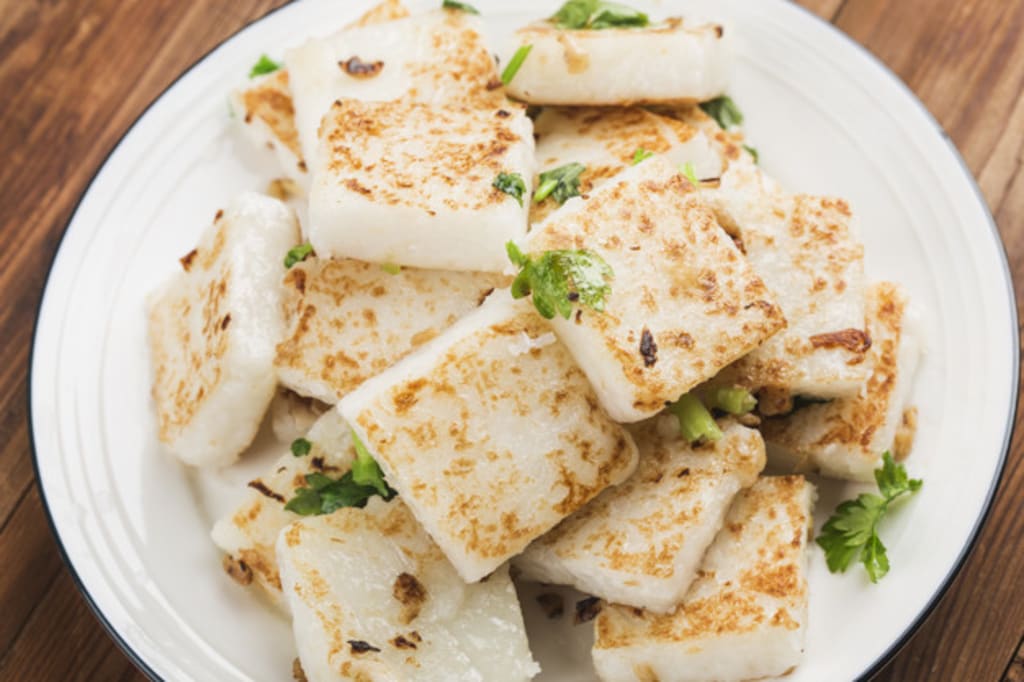
The last recipe is that of luo bo gao. Turnip cakes are small and plain – the least photogenic item on her menu, and often doused in chili oil by customers who have a spicier palate. But, inexplicably, it’s her favorite. She likes how unassuming it is. Nobody ever thinks about how much work it takes to make sure it’s not too dense, not too chewy. But her grandmother did – she was the one who taught her to snap the turnip leaves to see how fresh it is. If it’s green, buy it. If it’s white, leave it.
She exhales a deep sigh, and a bitter sadness overtakes her. All this knowledge – these bits and pieces accumulating over time, overlapping in her mind like the scales of a fish – what’s the point? The younger generation isn’t interested in the daily drudgery of running a small local restaurant. She supposes they aren’t to be blamed; no-one gets excited about backaches and orthopedic shoes.
She would be the only one left to mourn, if the restaurant closed for good. There might be a blurb in the local newspaper, a few well-meaning platitudes from long-time patrons. But in the end, it’s home to nobody except her. It’s probably better that her family isn’t alive to see it.
“I’m sorry,” she murmurs, her fingers clenched over the notebook. “I tried. I really did.”
Her throat aches as she tries to blink back the hot tears welling up. But she doesn’t quite succeed, and a droplet escapes, running freely down her chin until it lands on top of the last page.
The blank page warps under the splash of moisture, and suddenly the droplet disappears, the paper snapping and rippling all on its own.
“What—?” she says, voice shaking then clenches her eyes shut. She must be hallucinating.
But when she opens them again, she’s utterly stunned to see her name being written, as if with an invisible brush dipped in water. Slowly, she realizes it’s a nickname that she hasn’t seen or heard in a very long time; one that only her grandmother used.
“Ah-mah?” she breathes out.
It can’t be. It’s impossible.
She stares, transfixed, as her name gradually fades. Then the watery writing reappears.
I’m right here.
“You’re— alive?”
Of course not. Silly girl.
She blinks, gaping. “I don’t understand.”
Hm, well. We don’t have cell phones here.
A sharp huff of laughter escapes her. “This is a dream, isn’t it?” she mutters to herself.
Does it matter?
Her grandmother always had a way with mincing words down to the essential.
“No,” she says quietly, a resigned smile crossing her features.
Now, tell me what’s wrong.
“I—” she starts, feeling the heavy weight of guilt again. “I’m going to close the restaurant.”
Her grandmother's words disappear, and the page remains blank and still. She doesn’t know what to make of that, but imagines that her grandmother is still there, listening.
“It’s losing money. A lot of money. I applied for a loan, but it didn’t go through. With everything that’s going on— it’s just—” Her voice trails off, then becomes threadbare and weary. “It’s hard.”
I know.
“I’m sorry,” she says again, averting her gaze. “I know mom and dad put everything they had into it. I tried to keep it going. But— I guess it wasn’t meant to be.” Her voice wavers. “It’ll all be gone soon.”
I see.
“I feel—” she says, the words like glass shards in her throat. Her family had never been one to talk about their emotions. But if she couldn’t tell her own grandmother, then who else could she go to? “I feel like the restaurant is a part of me, a part of our family. And I let it die.”
If it is not living, how can it die?
“What?” she blurts out.
It’s a building with lights and a kitchen. If you think it’s living, it’s only because you are there. You are the one who is alive.
She stares for a long while. “But— without it, I don’t know what to do. What will happen to everything that mom and dad passed on to me? Everything you taught us?”
That is something for you to decide.
“I don’t want to forget, though,” she says, tears springing to her eyes again. “I have so many memories there. I feel like it’s all I have.”
You forget. You have us.
“You’re not here,” she says tiredly. “Not really.”
You carry us with you. Your soul has inherited our struggles and burdens, but it has also inherited our courage. The courage to move forward. With or without the restaurant.
It scares her, the thought of such a huge part of her life coming to an end. She tries to look ahead, to see what possibilities lie beyond, but she sees nothing. Only an emptiness that aches with loss.
“I’m not courageous,” she ends up saying, shaking her head.
You will be.
Something about the simplicity of it sparks a faint sensation behind her chest. It’s not quite hope, but perhaps one day— it could be.
“Thank you, Ah-mah,” she says softly.
Don’t forget to take care of yourself.
She can almost hear her grandmother’s brisk tone, and she realizes that maybe memories are not so easily forgotten.
“You, too,” she says, a long-buried grief surfacing as she watches the watery words fade away. Almost desperately, she bursts out, “Please tell them I miss them. Every day.”
They know. They miss you too. We all do.
“Will you come back? To the book, I mean.”
Who can say?
She raises an eyebrow. Of course, her grandmother would choose this very moment to be oblique.
Also, that loan you didn’t get? Apply again.
She blinks in confusion. “They already turned me down. I’m not going to magically qualify the second time around.”
Trust your Ah-mah.
She does. And so she applies once more, occasionally glancing at the notebook, which remains open on the kitchen counter. Although no more words appear on the page, she imagines that her family is still there, somewhere on the other side of it.
Several weeks later, a letter arrives in the mail.
She stares at the approval, which includes a list of repayment terms and a check for twenty-thousand dollars.
Her hands shake as she counts the zeroes again. She still has no idea if her restaurant will survive past the year. But it’s a chance. And that’s all she needs to start finding the courage to move onwards, into the unknown.
About the Creator
Keep reading
More stories from writers in Families and other communities.
Wise~Guys
— Look Behind what's in Front of You ~ Make Good Choices — Hey, So how you Doin'..! Made~Men — Mobster Movies romanticise a distinctive, elegant appearance, impeccable attire style, along with the 'Families' expressive lingo. Making their 'Bones' gave them Panache — with vintage fedoras, tailored pin-striped suits, mirror-polished wing-tip shoes adorned with tassels; with their 'Gun Moll' gorgeous dates on their arms.
By Jay Kantor20 days ago in Families
Bettijo Hirschi
Introduction Bettijo Hirschi is a multi‑talented creative professional from the United States. She works as a designer, art director, photographer, writer, and event planner. Bettijo has built a long career in creative work and media. People know her for her artistic skills, her work in magazines and television, and her lifestyle blog. She is also known in recent news because of changes in her personal life.
By Farhan Sayed5 days ago in Families
How to Succeed at the Benson Directory®
Congratulations and welcome to the Benson Directory® employee #22391! As our newest call handler, you will have the privilege of speaking with dozens of unique and interesting people on a daily basis as well as the opportunity to earn bonuses for high performance. Contained within this handbook you will find a set of ease to follow instructions designed to help you settle in to your new role and begin paving the way to success.
By S. A. Crawford4 days ago in Fiction
The Devil's Cut
“Comrade, finally you’re awake.” The voice was smooth, sensual. A flickering incandescent bar was all that lit the white, sterile room. All Vladimir remembered was everything going black. He tried to move his arms and found them strapped to the gurney.
By Matthew J. Fromm6 days ago in Fiction



Comments
There are no comments for this story
Be the first to respond and start the conversation.