
re.making textiles
working with already cut fabric scraps to make something new.

Fabric and fibers have always been my best method of communication.
My grandmother and I had a fraught relationship. I felt that she was harsh and brash, and I was sensitive and easily hurt. We struggled to communicate with each other, but eventually we figured out how to speak through crafts and textiles. She perpetually had a project in her hands, be it a sweater she was knitting as a gift, or a cross-stitch she had been working on for months, or a latch hook pillow she was finishing off for a grandchild. Her hands were always busy making something. Her sewing box was the stuff of wonders, with a variety of scissors each devoted to their own craft and threads perfectly organized by color. And I found curiosity and joy in watching her make. So, despite our differences, working on a project together was one place in which our relationship was easy and exciting. She taught me to knit, crochet, hand sew, embroider, latch hook, and needlepoint, but really what she taught me, was a love for fiber arts and a way to communicate with her and others. She would set me off with new project and I would sit on the floor working away in my little “factory” for hours, my parents amazed by my sudden devotion to a new craft. Years passed, the craft might change, but fibers and fabrics remained.
In university, still maintaining an obsession with textiles and crafting, I found myself studying and researching the ways in which across cultures, all over the world, women have often learned language and learned to share their stories through fiber craft. From Philomela of Greek mythology weaving the story of her abuse, to Native American rug weavers, to the Suffragettes of the early 20th Century, to the African American quilters of Gee’s Bend using cloth from everyday life, to Hmong refugee women creating story cloths, to female political prisoners in Chile sewing Arpilleras, we see women speaking out and sharing stories through textiles. Fabrics have become a common language through which women and femme people all over the world can communicate. In some ways, textiles are so synonymous with language now that we tend to forget the actual connections between fiber and language. Phrases like “having a yarn,” “spinning a tale,” and “weaving a narrative,” are just parts of our vocabulary. But no matter what, I wouldn’t let myself forget the connection between storytelling and textiles.
And so, with the skills I had learned from my prolific creative grandmother and all the knowledge from research and study about textiles, I left university with one certainty, I would become a textile artist. Someway, somehow, I would find a way to express myself and tell my story through fibers. Slowly over a few years I learned to flat pattern draft for clothing, I learned dye methodology, I took a machine knitting course here, and weaving course there all to see what I was best suited to. Finally, combining a few of my new skills, I started making myself the clothes that best expressed who I wanted to be out to the world. I wanted to be comfortable and wear clothes that I could layer because I don’t like the notion of seasonal clothing. I wanted to only wear natural fibers that were ethically manufactured because sustainability is essential to the future. I wanted to wear simple garments that still spoke volumes. I wanted prints and colors to show off my personality without being over the top and sticking out like a sore thumb. But most of all, I wanted clothing that I could wear and love and create memories in for a very long time. So, in textile design and clothes making I found my answer to how I could use textiles to best express myself and communicate with others.
After a while, I started doing craft fairs and pop-up events, which involved cutting, printing, sewing, and ironing unique garments on repeat for weeks and sometimes months in isolation at a studio I rented in San Francisco. The practice of getting ready for a craft fair was solitary and strenuous, but ultimately led to a broadening of my world. Hanging my creations from racks in big warehouses or halls could suddenly lead to conversations with strangers about their relationships to clothing or fabric. Someone could buy a piece I had made, which would then lead to other conversations between the customer and their friends. Something I created with my own hands, scissors, fabric, and ink could create conversations and it could be meaningful to people outside of my personal orbit. With fast fashion taking over, and with access to cheap disposable fashion just about everywhere, we often look at clothing without considering it that much. What went into the creation of our clothing? Who made it? What is their story? Where did the fabric come from? What is the history of this fabric? I never want my customer to feel so disconnected from a garment I make and sell. Through craft fairs, and now through social media, I’ve been able to keep sharing narratives about my history with textiles but also about textile history in general.
My brand Maker & Mineral has now existed for 6 years. While I have had to mostly homogenize my available products instead of creating exclusively one-off unique pieces, and while I can’t do as many craft fairs as I need to keep up with orders, I still make every piece with my own hands. I cut, I sew, I print, and I iron every Maker & Mineral piece to order, which means I still get to be a part of each garment and I still get to be a part of that garment’s narrative. I also get to hear the stories of repeat customers telling me about how something I created made them feel great, or how they had this wonderful adventure in a piece I cut and sewed for them. And of course, after 6 years of garment making, despite all attempts to create minimal waste, I have acquired a lot of off cuts. Sometimes I donate them to schools, sometimes I sell them to other makers, but now those scraps are getting a new life and a new chance to tell a story of their own.
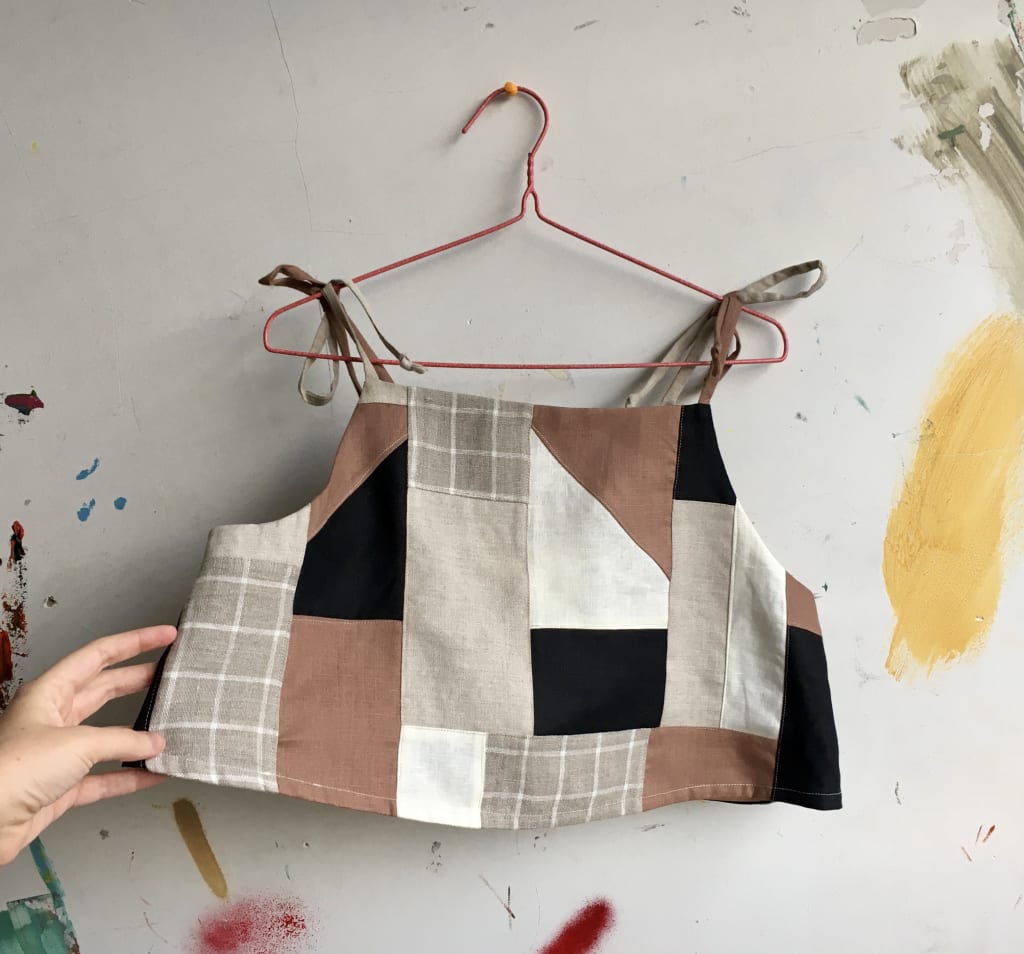
First, I organize the linen scraps by color. I iron them flat and use my Fiskars Spring Action scissors to cut them into a squared off shape. Slowly, I start to place the scraps and let them tell me where they will best be suited by color and size. I move pieces. I cut some more. And once the pattern feels right, I piece them together and top stitch them into place by section. Back and forth between the iron and the sewing machine, I slowly see the patchwork come to life. Eventually, once the fabric is all combined, I pull out my Fiskars scissors again to cut out the flat pattern and sew up the garment. Letting the fabric guide the process, each piece is a unique creation of its own, pulling from waste to make something unique and new. This unique patchwork piece then goes out into the world with its own amalgamated history of the garments it originally came from and gets to be a part of the future stories its owner will create.
Just like in my youth, when I would be so completely consumed by a project my grandmother gave me, now I find myself consumed by the ways scraps will fit together, by the way fabrics will feel together, by the way colors will play off each other, by the ways small scraps start to form a larger picture, and by the way a scrap garment will get a new life. And still, after years of running Maker & Mineral and learning every fiber craft available to me, I still communicate best through fabric, and my hands, just like those of my grandmother, are always busy making.
About the Creator
Samantha Ives
Been crafting since the womb (ok not really, but pretty close)... I'm a californian living in australia perpetually falling in love with textiles.
Keep reading
More stories from writers in Families and other communities.
Hottest in the Office
Dear Rafi, You’re very distracting to work around. For the first second I saw you the other day, I thought you were some type of executive. It took a moment to realize no, you were just the new guy, dressed up for the job he wants. Be still, my heart.
By Gabriel Shames4 days ago in Pride
Top tipple tricks
Been thinking a lot about drinking, lately. Not least because of a recent episode of over-indulgence and the inevitable after effects. Some readers may recall the earlier articles I wrote about beating the booze. Here I set out an experiment in techniques for cutting down on my alcohol intake. The experiment was successful, the techniques worked, and I have armed myself with an arsenal of weapons in the war against the demon drink. I have yet to fire the first round however. It's all a question of timing (perhaps procrastination).
By Raymond G. Taylor5 days ago in Psyche



Comments
There are no comments for this story
Be the first to respond and start the conversation.