
Protecting the Baby Turtles: A Family’s Lesson by the Sea
On the shores of Hawks Bay, two curious children learn why sea turtles struggle to survive—and how small actions can save them.

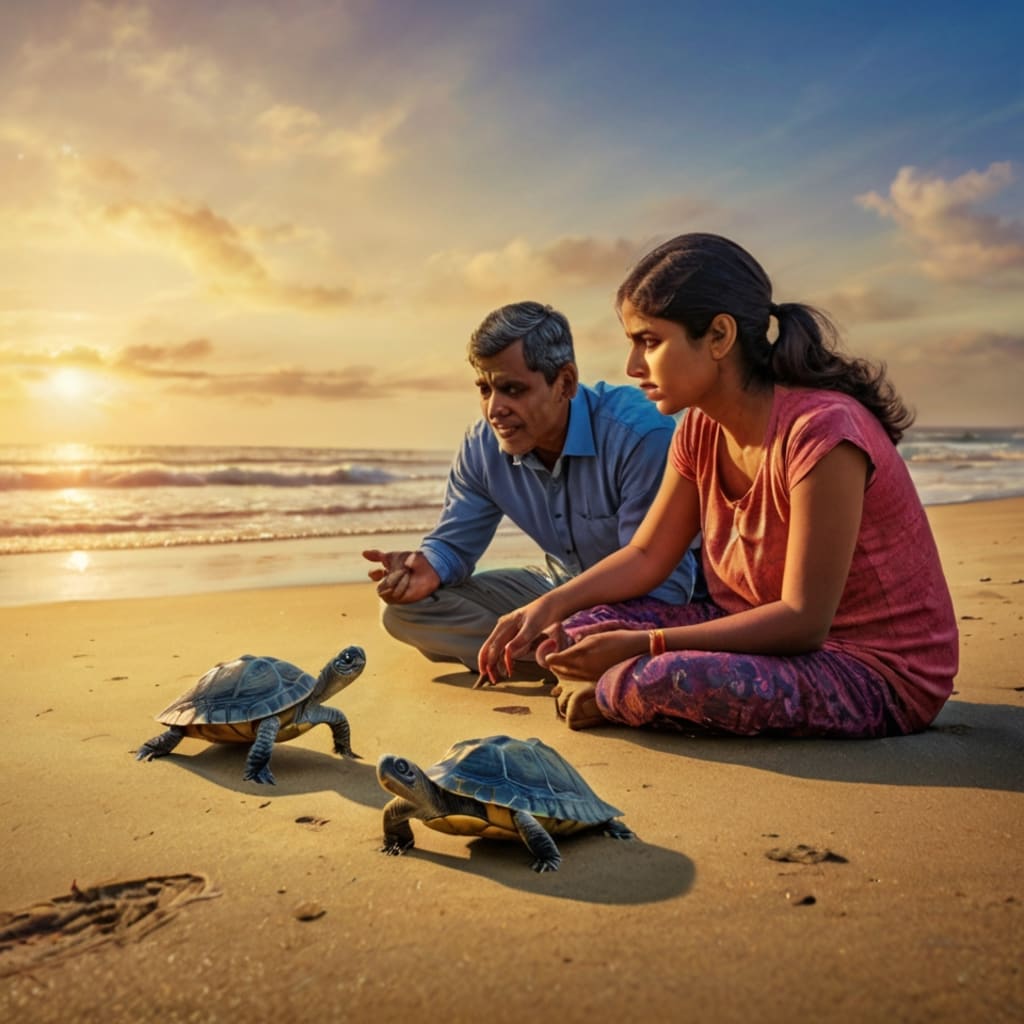
Protecting the Little Turtles: A Family’s Lesson at the Beach
BY:Ubaid
The family was overjoyed that day. Syeda Nazaan, her husband, and their two children, Umar (11) and Furman (13), had finally come to the sandy shores of Hawks Bay near Karachi. The sound of crashing waves, the endless stretch of blue water, and the salty breeze created a magical atmosphere.
As the children played along the shore, Umar suddenly pointed at something moving on the sand.
“Mama! Look—what is that?” he asked curiously.
Furman and their mother quickly turned to where he pointed. A tiny creature was crawling slowly toward the sea. Their father was walking ahead and didn’t notice.
“That’s a baby turtle,” their mother explained with a gentle smile. “It has just hatched from its egg and is making its way to the ocean.”
“There are turtles in the sea too, Mama?” Umar asked, surprised.
“Yes, my son. Turtles are an important part of the marine ecosystem. Without them, the balance of sea life would be disturbed.”
Furman frowned in concern. “But Mama, these babies are so small. How will they ever reach the sea safely?”
His mother sighed. “That, my dears, is a sad story. Let’s sit down on the sand, and I’ll tell you all about the green turtles and the olive ridley turtles that visit our shores.”
A Mother’s Story
Once they sat down, Mama began:
“You must have read the story of the tortoise and the hare, right? Where the tortoise wins the race?”
“Yes, yes, we’ve read it!” both boys chimed together.
Mama smiled. “Well, the tortoise won that race, but sadly, sea turtles are losing the race for survival. Their lives are full of danger, and their very species is at risk of extinction.”
“Why, Mama? What’s happening to them?” Furman asked, clearly worried.
“There are seven species of sea turtles in the world. Two of them—the Green Turtle and the Olive Ridley Turtle—come to Pakistan’s coasts to lay their eggs,” Mama explained.
“What nice names! Who gave them those names?” Umar asked curiously.
Mama chuckled. “The Green Turtle is the only vegetarian sea turtle. It eats seagrass and algae, which turn its skin a greenish color—hence the name. The Olive Ridley Turtle has an olive-colored shell. Unlike green turtles, it eats both small sea creatures and plants, so it is omnivorous.”
The boys listened with fascination as their mother continued:
“These turtles travel thousands of kilometers to return to the beaches where they were born, just to lay their eggs. Every year, between August and December, they arrive at Pakistan’s shores. The Green Turtle mothers usually return to the very beach where they hatched. The Olive Ridleys, on the other hand, come in massive groups—sometimes nearly a hundred thousand females gather to lay eggs together. This is called ‘Arribada’, a Spanish word meaning arrival.”
“And what happens after they lay their eggs?” Umar asked.
“The mothers leave,” Mama said sadly. “They never come back. The hatchlings break out of the eggs on their own and begin their dangerous journey toward the sea. Sadly, most of them don’t survive.”
Both children gasped. “Why not, Mama?”
“When the tiny turtles crawl to the water, they are easy prey for crows, kites, and stray dogs. Many are eaten before they can even touch the sea.”
The boys’ faces turned somber.
Threats from Humans
Just then, some plastic bags blew across the sand, carried by the wind. Their father, who had rejoined them, shook his head in frustration.
“Our people still don’t stop throwing trash everywhere,” he said.
“Papa,” Furman asked at the perfect moment, “our science teacher told us about plastic pollution. Do these bags really harm turtles?”
“Yes,” their father replied gravely. “Many baby turtles get tangled in fishing nets and plastic waste. Worse still, adult turtles often mistake floating plastic bags for jellyfish—their favorite food. Once they swallow the plastic, it blocks their stomachs, and they die.”
The children looked horrified.
“That’s terrible! What can we do to save them?” Umar asked urgently.
A Family’s Promise
Mama put her arms around her children. “The first step is simple—we must never throw trash on the beach. If we all take care, fewer turtles will die from pollution.”
Papa added, “And when we see hatchlings on the sand, we should help guide them safely to the sea. Every small effort matters. By protecting the turtles, we protect the balance of life in our oceans.”
Then, with a voice filled with emotion, he gave the children a final reminder:
“Always remember—these baby turtles have no mother to protect them. We humans must take that responsibility.”
The boys nodded with determination. That day, on the golden sands of Hawks Bay, a family learned not just about turtles, but about their own duty to the world around them.
About the Creator
How to Fix Loose or Crooked Glasses Frames?
Eyeglasses are designed to improve your vision and make daily activities more comfortable. However, over time, glasses frames can become loose, bent, or misaligned. If your glasses constantly slide down your nose or feel uneven on your face, it may be a sign that your frames need adjustment or minor repair.
By Parham Optical6 days ago in Families
Top tipple tricks
Been thinking a lot about drinking, lately. Not least because of a recent episode of over-indulgence and the inevitable after effects. Some readers may recall the earlier articles I wrote about beating the booze. Here I set out an experiment in techniques for cutting down on my alcohol intake. The experiment was successful, the techniques worked, and I have armed myself with an arsenal of weapons in the war against the demon drink. I have yet to fire the first round however. It's all a question of timing (perhaps procrastination).
By Raymond G. Taylor7 days ago in Psyche


Comments
There are no comments for this story
Be the first to respond and start the conversation.