
On the Neretva
The author recalls his hometowns before the Bosnian War
Capljina and Sarajevo, my hometowns, have to me become inseparable from the memories I have of my parents before the war; thus any recollection of the streets, monuments, and rhythms of those cities — to which I have not returned — will inescapably take the form of an elegy to them. The thought of returning, except in remembrance, has always troubled me.
In my childhood, Capljina was a city of interiors. Its position on Bosnia’s border with Croatia, along a narrow river flowing down from the mountains to the North, gives its inhabitants a feeling of being at a remote crossroads, on a restless frontier. This is especially true of those who settle on the city’s fringes — among them my mother, who moved to her parents’ home overlooking the marshlands when she and my father separated around the time I was born.
My mother came from a formerly significant Croat family, and their house was no less grand and degraded: bird shit stained the marmoreal plinths adorning the garden, cypresses leaned defeatedly over the narrow path circling the rose garden, and the pinewood pergola beside the house was rotting where the rainwater gathered in little pools. Still, it was rare to have such a garden in Yugoslavia, and in time I learned to associate its grandeur and isolation with certain of my mother’s peculiarities.
My mother was a singularly obsessive person, one who rarely enjoyed the company of others. Her study of birds was more paranoid than scholarly. We went frequently to Hutovo Blato, the marshland preserve, to watch them. Often I straggled behind her in what seemed an impenetrable grove of bending reeds, yet my mother was determined to share with me her hermetic passions. In Capljina is the church of St. Francis, in whose likeness I found the image of my mother wading into a marsh of waterlilies, her trousers darkly soiled, immersed in the swarming of swifts, sparrows, and insects.
Although my mother only rarely left the estate, and always for some practical reason, she never stopped me from undertaking my own explorations. Approaching the town, the Neretva Valley opens like a flower. At a bend in the river stands the old minaret, a solemn and imperious relic of the Ottoman era, and the mosque with its otherworldly dome—the subject of many rumors, particularly among the Croats. To me it shared an uncanny affinity with the planetarium in Sarajevo; I was never able to dismiss the image of a white-bearded astrologer peering through a telescope into a lactic nebula, or across the Bosphorus toward the distant hills of Cappadocia. Those were my childish fantasies, before I could have known the sinister fate of those for whom the dome had more than an intimation of spiritual importance.
I spent winters with my father in Sarajevo. His apartment was in Bistrik, near the Miljacka River. In stark contrast to my mother, my father kept himself in broad and varied company—and the streets of Sarajevo gave themselves freely to his temperament. He was a musician, popular in his circle. His was a Dionysian realm, without pretension, but likewise blurred by tremendous quantities of rakija, as seen in the eyes of those who took it as daily sustenance. My father was no exception. Hence in the daytime I wandered the streets alone, haunting the historic Ottoman neighborhoods.
My father was a reserved man. Perhaps it’s what made him a surprising musician. He claimed to have descended from the dervishes and gypsies of Rajhastan. Much about him remains a mystery, but it’s certain he didn’t have any inheritance to support his artistic life. His apartment was a dispensation from my mother.
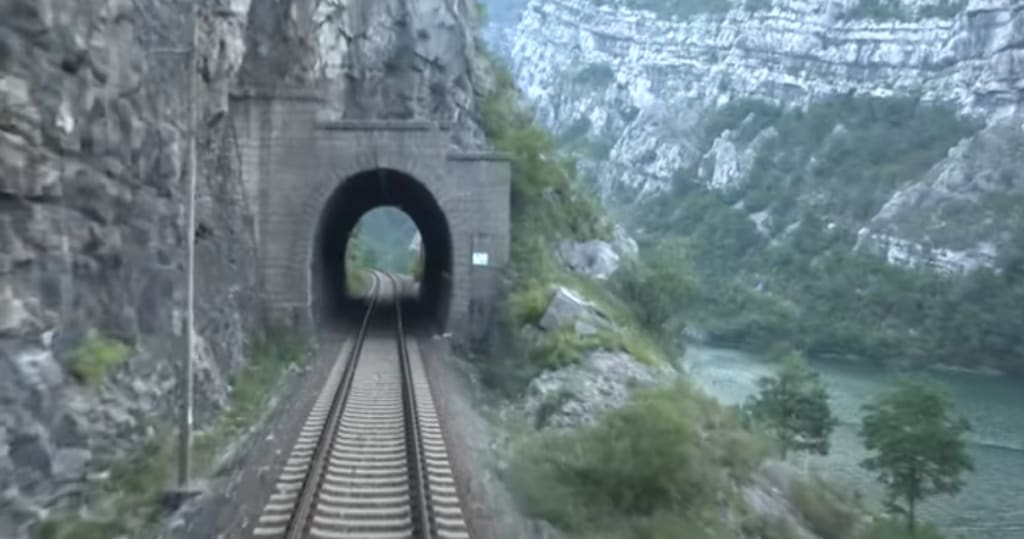
In the decades that have passed since my parents sent me to England, there is no memory more comforting and familiar than that of the train that once brought me from Sarajevo to Capljina and back again, by way of the Neretva Valley. Many hours I spent quietly nestled in a train compartment, my unwrinkled brow pressed to the cold glass of the exterior window, watching the rapid succession of roads, houses, bridges and factories. In fact, that simple journey is my earliest memory, and hardly do I remember a time when I didn’t endure it alone—yet knowing my mother or father awaited me on the other end.
Hometowns are unfinished monuments; we may trace their beginnings to some definite moment, but their endings are never clear.
About the Creator
Willa Chernov
Willa Chernov is a writer and translator living in New York.
Keep reading
More stories from Willa Chernov and writers in Families and other communities.
The Last Divination
I. My grandfather, before he was hit by a truck, used to tell me stories about our ancestors in the mountains. For millennia, he claimed, they raised sheep in the same valleys, drank water from the same wells, and practiced the same traditions. It was, according to him, an unforgiving life: sometimes it rained until their huts were swept away, or their sheep were devoured by wolves. But as there was hardly anything to take from these poor shepherds and farmers—and because the mountains were considered to be impassable—they were rarely visited by armies.
By Willa Chernov5 years ago in Families
Wise~Guys
— Look Behind what's in Front of You ~ Make Good Choices — Hey, So how you Doin'..! Made~Men — Mobster Movies romanticise a distinctive, elegant appearance, impeccable attire style, along with the 'Families' expressive lingo. Making their 'Bones' gave them Panache — with vintage fedoras, tailored pin-striped suits, mirror-polished wing-tip shoes adorned with tassels; with their 'Gun Moll' gorgeous dates on their arms.
By Jay Kantor20 days ago in Families




Comments
There are no comments for this story
Be the first to respond and start the conversation.