

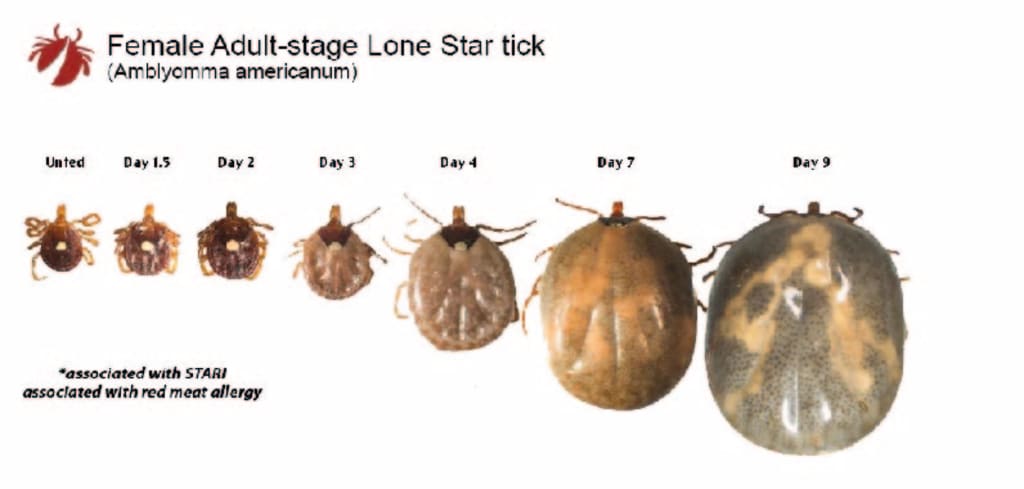
A new health alert is getting a lot of attention in the United states. The Centre for Disease Control is sounding an alarm over a tick-borne disease which is spreading across the country which leads people to develop an allergy to red meat.
It is believed to have affected nearly a half a million Americans so far and new studies show that nearly half of doctors don't know about it, they don't know how to diagnose it or to treat it. It is bizarre when you think about it because you just get a tick bite and then you have an allergy to milk, and an allergy to meat
According to Dr Tara Narula who is a cardiologist at Lenox Hill Hospital, Northwell Health, "It is a really interesting allergy and we've only learnt more about it in the last 15 years or so since it was first published in 2008 and in fact it is a meat board, meat allergy but it's also called an alpha gal allergy.
Alpha gal (3-galactose), is an oligosaccharide found in most non primate mammalian tissue and their products including milk and cheese. It is the sugar that is found in many meats, including cows and pigs but not in humans so what happens is the tick carries this Alpha Galaxy saliva either because it produces it or it bites wild animals, then it bites you and injects the saliva into you. Your body think it's something foreign because you don't carry that and it makes you antibodies. One, two, three months down the line, you sit down to have your, mince sauce, burger or your piece of red meat and your body cries out because it's seeing the sugar again and it swings into a full blown response which you feel in the symptoms.
What would the symptoms be like if you become allergic to red meat from the Tick bite?
Some of the symptoms can be gastrointestinal (GI) upset, nausea, vomiting, diarrhea, stomach pain, headache but it can also be full-blown anaphylaxis, itching and hives. What's also interesting is that with most food allergies the allergy happens about 15 to 20 minutes after you eat something so it's very easy to make that connection. With this allergy it can happen 2 to 10 11 hours later so imagine how would you connect the dots if you wake up in the middle of the night, you're not going to think it's because of something you ate at dinner so it can definitely fly under the radar both for doctors and for people and that's why this is so important because there is a blood test that can pick it up you can detect the antibodies and while there's no cure or treatment if you recognize it and you stop eating red meat the allergy can potentially Wane over time as long as you avoid tick bites again.
What is the best way to protect yourself from tick bites in general?
- Avoid tall grasses
- Wearing long shirts and pants tucking them in
- Use insect repellent that's EPA recommended
- Wear Permethrin treated clothing
- Have a shower when you come in
- Do tick checks
- Check your children and look in their hairline, belly buttons and behind their ears
- Wash and tumble your clothes or iron in hot temperature
What do you do if you find a Tick?
If you find a tick, you want to pull it out with tweezers and there's a website called the Tick Spotter - named by the University of Rhode Island where you can take a photo of the tick you found and upload it within 24 to 36 hours after which you will be told what type of tick you found.
What do you do if you get bitten by a Lone Star Tick
If you get bitten and you treat it in good time, then your symptoms won't last as long so, lucky if you find out straight away. You must try to reduce your exposure to ticks because if you are exposed to ticks, it means your symptoms will last longer.
Some people are already allergic to dairy, and some take medications that are coated with gelatin which is made with Alpha galactose. A study in 2015 showed that for about 80 percent of individuals it took seven years to get diagnosed so imagine how long your suffering would last before you get diagnosed.
Are there parts of the country that we're seeing this more than others? Does it matter where you live?
The lone star tick is really predominantly in the South, the southeast, the Mid-Atlantic States but because climate is getting warmer, we're seeing it as far north as Maine and the west.
What does it look like?
You recognize it with a little star a white star on the back of the female tick that's why it's called Lone Star
About the Creator
Keep reading
More stories from writers in Families and other communities.
Wise~Guys
— Look Behind what's in Front of You ~ Make Good Choices — Hey, So how you Doin'..! Made~Men — Mobster Movies romanticise a distinctive, elegant appearance, impeccable attire style, along with the 'Families' expressive lingo. Making their 'Bones' gave them Panache — with vintage fedoras, tailored pin-striped suits, mirror-polished wing-tip shoes adorned with tassels; with their 'Gun Moll' gorgeous dates on their arms.
By Jay Kantor29 days ago in Families
🅼🅸🅳🅽🅸🅶🅷🆃 🆂🅽🅰🅲🅺🆂
"It's 10 in Tuscon! We all know what that means... It's Time for Midnight Snacks with your man, Gerald Gee! Ready to spend the night together? Me too! I'm full of snacks and can't wait to regurgitate them all back into your hungry ears. Crack a brew! Pop some corn! Anything to get ready for one hell of a show where the talk maybe cheap but the words cut deep...
By Lamar Wiggins7 days ago in Fiction



Comments
There are no comments for this story
Be the first to respond and start the conversation.