
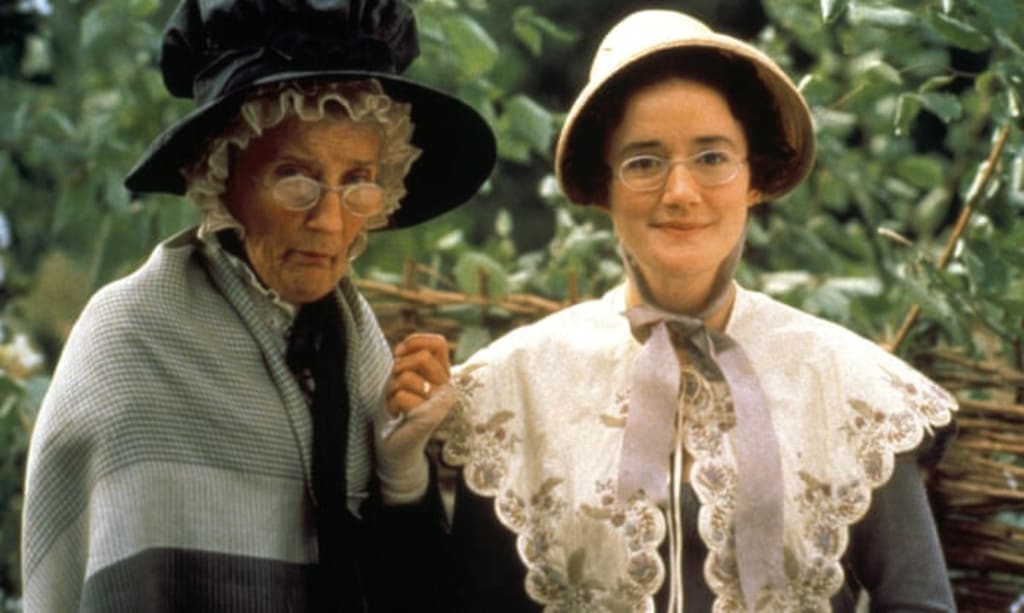
Vivacious Miss Bates was enjoying a great deal of excitement. The time in Bath had been marked by every conceivable delight, and Miss Bates had expectations of her present happiness continuing. Though not a famous local beauty, she was estimated to be quite a credit to the neighborhood, and her wit, though sometimes the merest shade of spiteful, was generally pleasing, and much admired. Tall enough to cast down her eyes at the impertinent and insipid, yet small enough to look through her eyelashes at the assured. Warm enough to kindle the interest of the equally charming, yet cold enough to dim the hopes of the mere admirer, Miss Bates was confident of her own charms wherever she went.
Bath was an old sea-side town, a bastion of quiet respectability. Equally famous for the healing powers of the water from its springs as for its charming houses, Bath was well-known as the home of the eccentric, the aged, the impoverished, and the infirm. In the ordinary form of matters Miss Bates, Maria to her intimates, would have in the most superior and lady-like fashion, have resisted coming to such a place, however, since she herself was suffering a slight cold, and her mother had particularly wished to come, Maria had exerted herself to appear complacent with this shift in society.
In fact, though Maria was slow to admit it even to herself, there was another attraction to the region. Although the superior Miss Bates was not supposed to be cognizant of the fact, Bath was also home to another set of society: that of the repentant rake and the impoverished fop. While such men were certainly not eligible, they did provide a welcome wit at all balls and assemblies, and, unlike the majority of the elder set, they could dance. Further, they provided a pleasing scope for an agreeable flirtation. One of that number in particular, Harold Burke, had been particularly pleasing in his attentions to Miss Bates since she had entered Bath.
It is true, considered Miss Bates to her, that the Coles say that he is a gambler and an inveterate spendthrift. Also, that Mr. Warwick insists that he displays an unpleasing lack of gravity. But really, such things don’t really matter in a situation where there are no serious intentions on behalf of either party. In the meantime there is no reason whatever that his ineligibility should interrupt a pleasing flirtation.
No sooner had Miss Bates come to this comfortable conclusion, then it appeared all of society had risen to strive against it. Her own mother, Agatha Bates was the first to raise the clarion call of the resistance. One night, after observing her daughter and Mr. Burke exchange telling glances over whist, Agatha confronted her daughter in her dressing room. These evening chats were a matter of long tradition between mother and daughter. In these interludes, they had discussed all matters—art, mathematics, flirtation by means of a fan, and the construction of the perfect romance—were all fields that had been thoroughly trod in the sacred precincts of Maria’s boudoir. Therefore, when Mrs. Bates inquisitively poked her head through the door, Maria met her with every symptom of pleasure.
That is, until the reason for her mother’s presence became clear.
“This Mr. Burke seems very pleasant,” commented Mrs. Bates.
“He is considered so,” replied Miss Bates.
“Such a good dancer, and such pleasing wit.”
“Such is his reputation.”
“So elegant in his dress.”
“Mother!” exclaimed Miss Bates, tossing aside her hairbrush, “surely you have not spoken so of a man since father asked the banns to be read for you, yet I know full well that you dislike Mr. Burke. Tell me plainly, what are you prying after?”
“I am curious to know, my dear, if I should be expecting to prepare for a wedding, or if I should commission some workmen to expand your window so that you need not tear your dress as you escape to Gretna Green.”
“Truly Mother,” laughed Miss Bates, “how can you ask such things? Surely you know that I would never lower myself to wed Mr. Burke, the man is a known gambler, with a reputation I am certain it is not proper for me to know of.”
“May I ask, Child, then if you know all that of him why do you permit such ardent attentions on his part?
“Because, Mother, if I limited my acquaintance to only those that were entirely proper for me to know then I would only speak to gouty old men, widows, and spinsters!”
“Such as I, perhaps?”
“Oh, you know I didn’t mean you, you are perfectly delightful! But I must have some entertainment, and you cannot dance with me.”
“That I cannot, though I do think it may be wiser for you to be more sparing in the distribution of your charms, and perhaps, spend a little more time keeping spinsters and gouty men company, and a little less time presenting your hand for Mr. Burke to kiss.”
At this last volley, Maria had the good grace to blush. The conversation followed less alarming channels from that moment on, but when her mother finally left, Maria was struck with the conviction that her mother would not be sorry to see the back of Mr. Burke, and could be nothing but grieved at her daughter’s partiality to his company.
Miss Bates assumed the matter was ended, but over the course of the next few days it appeared to Maria as if her mother had summoned all her company to her aid. In the milliner’s shop, Miss Bates was accosted by Mrs. Howard, her aunt, and warned, in the most delicate of terms, that Mr. Burke was nothing more than a flirt. As she strolled in the lane, she met Col. Davidson, a friendly retired army officer, who made vague, yet pointed comments about the useless nature of the modern youth. This persecution pursued her even to church. On Sunday, when the vicar gave a sermon on conceit and worldly wisdom, Miss Bates noticed Miss Lewis casting reproachful glances at her, and even caught the dressmaker’s little assistant smirking at her.
Miss Bates left the church fuming, certain that all of society was speaking of her “loose” behavior with Mr. Burke. When her mother broached the subject she was certain that no one could possibly believe that there was anything serious in her relations to Mr. Burke. It was all errant twaddle.
“But,” she thought, with a dangerous twinkle in her eye, “if all of Bath has determined that Mr. Burke is the evil serpent who has taken in the gullible Miss Bates and compelled her to fall madly in love with him, who am I, little Miss Bates, to prove them all wrong? Why should it be that everyone is convinced that I shall be his conquest? I think they should rather warn him against being mine!”
From that point on, Miss Bates, in the most discreet manner possible, set loose all her charms upon the one goal of stealing the heart of Mr. Burke. Her smiles grew a trifle more inviting, her eyes shone a little brighter, and there was no event he attended where Miss Bates was not found. She even consented to waltz with him. Where once she had held herself aloof and did not condescended to join him in witty mockery of those surrounding them, now, she joined him with flair, and many the pitiful dowager was made low for her pleasure.
“My, what a fetching hat Mrs. Darby! I especially admire the way that you have recalled the exact shade of your hair in the trimming.”
“Why Mrs. Lanston, I was admiring that dress just the other day at Hillston’s shop, I never imagined it could be so flattering on a lady of your figure.”
“Mrs. Larimore, so glad to see you again, I had forgotten I had missed you!”
Mr. Burke was not unaware of this new rise of his star in Miss Bates’s eyes, and took cautious advantage of it. The handsome pair was often seen strolling through the village arm-in-arm, dancing, and in ever way enjoying the other’s company.
Mrs. Bates observed these attentions with new concern, ever since Maria’s pursuit of Mr. Burke had begun, Mrs. Bates had been politely, but firmly, banned from her daughter’s bedroom. It was not so much that Maria was unfriendly; it was merely that once Agatha had crossed the threshold, she was so smothered by girlish babble and feminine gossip that all hope of serious conversation was inexorably banned before it had even begun.
One fine morning in April, Mrs. Bates was woken up by a nervous maid.
“Excuse me, marm, I hate to disturb you, but Miss Bates looks poorly. She didn’t want me to fetch you, but she is all flushed and she doesn’t talk sensible.”
Concerned, Mrs. Bates got out of bed directly and proceeded to her daughter’s room. Her daughter, aside from the occasional ague, enjoyed excellent health, so Mrs. Bates was not unduly worried. Until she opened the door to her daughter’s bedroom. The normally healthy and vibrant Miss Bates was flushed, tossing and turning with fever, and covered with a strangely familiar rash from head to foot.
“Smallpox!” exclaimed a now terrified Agatha.
The next week was a nightmare for the entire household. Dr. James came and went, initially with reassuring smiles, and later with a frown he made great pains to hide when interacting with Mrs. Bates. By the eighth day, however, he wisely made no secret of his concerns to Mrs. Bates.
“The pustules are neither of large number or great size, and this speaks well to her chances.”
“Dr. James,” interrupted Mrs. Bates, “I am not a stupid woman, and I am well aware of the look men acquire when they are certain that the truth will prove too much for a lady’s delicate sensibilities. It is no kindness for you to conceal the truth from me. Speak plainly!”
“Certainly madam, my apologies. What concerns me is your daughter’s fever. It is prodigiously high, and nothing we have tried has lessened it. I have bled her as much as I dare, and I can do no more.”
“She is…”
“If the fever does not go down in another few days it will surely kill her.”
With these grim words, Dr. James gripped his hat more firmly and escaped out the door before he could be made the victim of any feminine scenes. Though in this, he misjudged Mrs. Bates. For eight days she had been certain of the worst, now, finally, she felt she had some means to fight the inevitable.
She cut her daughter’s hair, quite close to the scalp to allow the heat to more easily escape her body. She wrapped her body in damp sheets to keep her cool, and even paid a visit to every single dining room in Bath for the hope of securing ice to cool her daughter. Through all this, Maria remained insensible, until late on the eleventh day, when, finally, the fever broke. Her recovery was slow, with Miss Agatha Bates often despairing that her daughter were ever return to her usual good health and spirits. Many days, Maria would be sensible for only a few hours, or even a few minutes, at a time, and then lapse into restless sleep and nonsensical mutterings. It would be a full fortnight before she became entirely herself again.
Though still covered in unsightly pustules, Maria was once more conscious, though very weak and somewhat confused. She even ate a little and Dr. James, left the house smiling on the thirteenth day.
“How do you feel?” Inquired Mrs. Bates of her daughter on the beginning of the third week.
“I do believe I am well Mother, truly, I almost feel well enough to get up today and even these unsightly scars seem to be going away without too many marks. With a little care and some caution in the matter of dress, no one will even know I had this frightful disease in a few days!
“Certainly, my dear!” At these, too hearty words of optimism, Miss Bates noticed something amiss.
“What is bothering you mother? Is it not fine that I will be well again?”
“Certainly, I am all happiness!”
“What are you concealing?”
At these words, Agatha spared one false glance at her daughter’s face, and something in her eyes betrayed her to her daughter.
“Since I recovered my mind, you have not let any mirror, or even undisturbed water into my room. Mother, what has happened to me? What is wrong with my face? Do not be silent! Tell me or I vow I will get up and fetch a mirror myself!”
Mrs. Bates fetched her daughter a mirror and handed it to her with a resigned air. Maria took the mirror and stared long and hard at her ravaged face. Her hair, once thick and long and full of neat, golden, ringlets, the epitome of beauty was now hewn short, darkened to a vague and mousy brown, and lying flat to her head. That loss alone made her catch her breath. As Maria stared into the mirror she despaired. With no fortune she had faced a precarious future. With no beauty, what could ever become of her and her mother. Surely her Mr. Burke would not mind, but then, he was so very handsome himself surely he would not wish to appear next to such a frightful hag as this woman she now stared at.
“Your hair will grow back,” commented her mother, appearing to read her mind. “And blond, curly hair has been in fashion so long that straight, brunette hair is more than likely to come back into fashion before too long, maybe by the time you are well enough to once more appear in society.”
“You are very kind and thoughtful mother,” commented Maria, lost in contemplation of the greater and more permanent loss. Her face, once smooth, and clear was now speckled, drawn, and hollowed. There were large, hideous, pits distorting her complexion.
“I look a hag.” She said calmly. Maria remembered when little Sarah Huston has contracted the pox. Sarah had re-emerged in society only to discover doors closed to her at every turn. Not only were people afraid of catching some hint of the pox from her, but what hostess would expend effort to further the matrimonial chances of a girl, no matter how sweet and good, who would never again have the beauty to catch a husband. Maria remembered with shame how she had “consoled” Miss Huston, while really triumphing over her, as pretty Miss Huston was the only other girl her Mr. Burke had praised to her.
“How I rejoiced that she would never again interfere with me…”
“I beg your pardon?”
“Nothing mother, surely, it is not so bad, perhaps if I wear face cream, and possible, a little, a very little, rouge, these scars won’t be so very noticeable.”
Mrs. Bates merely nodded, and silently carried away the mirror. Whatever hopes her daughter found pleased her. She merely wished that it could be a true hope, and not vain.
The rest of the spring passed uneventfully. In the summer, Miss Bates once again dared to go out of doors. Arrayed in her most fetching bonnet and most becoming dress, she made her appearance in the Pump Room. Upon entering at her mother’s side, Maria eagerly surveyed the other patrons. Across the room, she saw Mr. Burke talking animatedly to Miss Anne, Sarah Huston’s younger sister.
He observed her shortly after she found him. He looked at her, and in his critical eyes she could almost imagine him cataloguing every flaw in her appearance—her still shorn hair, her wasted figure, every pock and pit in her face, the large eyeglasses she was compelled to wear because the disease had ruined her eyesight. His hard gaze, inexorably turned cold, and with no sign of recognition he turned his back to her.
Agatha gripped her daughter’s arm as she made to go towards him.
“No, my dear, let us return home. You are tired, and you won’t get him back by drawing comment.” Silently, Maria followed her mother home. Later that day a stiff missive was delivered to the door. It was from Mr. Burke and declared his regrets at being unable to meet Miss Bates, but family business called him to France, and he did not expect to return for at least a six month.
After spending the whole day attempting to not notice her daughter’s prolonged silence, Agatha found Maria in her bedroom that night.
“Tell me, Maria,” began Agatha, “why would an indifferent acquaintance first compel such sorrow by his absence and further, feel the need to explain his sudden absence?”
Maria was silently plaiting her hair: she met her mother’s eyes steadily in the mirror.
“How long were you engaged?” inquired Agatha.
“The last four months. I wished to get married immediately; I even agreed to go to Gretna Green. We were supposed to leave the night I took ill. I wrote you a letter; it is in my bedside table if you wish to see it.”
Agatha went over to the dressing table and took out the letter silently as her daughter continued her confession.
“I thought I loved him, and I was certain he loved me, that neither my small fortune, nor my poor complexion would cause him distress. Yet, he proved differently in the pump room today.”
“Did you write him today?
“Yes, I wished to know if he had recognized me. He returned my letter unopened and merely said he was leaving for France and had no immediate intention of returning.”
Agatha looked at her daughter steadily and, without reading the letter, tossed it into the fire.
“Please, mother, I know I was wrong, please don’t scold me, you could hardly make me feel any worse than I do already.”
“I won’t talk at you, Maria, you have more than enough on your mind now, and you have already paid for any follies you have committed.”
Miss Bates re-entered society one week later. In the absence of her Mr. Burke, she made several very important discoveries. First, was that due to the injudicious use of her tongue earlier, most of the fellow guests at every function slighted her, or gave her only desultory conversation. Second, those that she previously thought so small and amusing, were not really so worthy of mere condescension as she thought before. Rather, she discovered a wisdom and good humor in them that far exceeded her former acerbic wit and satirical view of society. Third, she soon learned that deprived of the protection and escort of handsome Mr. Harold Burke, and weakened, both in strength and wit by her high fever, she was now more and most often the butt of all humor rather than the protagonist.
“Mother!” Maria wailed, face-down in her bed one evening. “Have I truly hurt those around me so much that they would all turn on me now? Mrs. Larimore gave me the cut direct today in front of half of Society, and all laughed! I had no defenders at all!”
“Did you return a reply to her?”
“No, how could I? I was so overcome that I couldn’t think of anything at all, I just stood there. What should I have said?”
“I rather think my dear, that the next time that happens, you should reply graciously and do your best to reflect well on the one that mocks you.”
“What? Why?”
“Well my dear, if they are a real friend, they will be grateful to you for not shaming them in public, as they, perhaps inadvertently, did you, and beg your pardon later. If they are not a real friend, then your soft reply will shame them to silence at least, and possibly later to good behavior.”
“Mother?”
“Yes, my child?”
“Is that how you have managed to hold you head up and be so gracious despite all the gossip about poor father’s dying for shame of his debts?”
“Yes, partially. But also, I have learned that by spending kindness freely to those around me, I have laid by such a store of good regard, that no matter what a gossiper said, to those that count, I will never have to be ashamed.”
“I think, Mother, I shall have to sow my own garden of goodwill. Do you think I can ever start one here?”
“It may be too late for here my Dear, as you have laid for yourself such a reputation as a critic of all. But, on that count, I have good news.”
“Yes?”
“Dr. James insists that you must have fresh, country air to complete your recovery, and my uncle has graciously given us the use of a cottage that he possesses in Hartfield to our use for however long we have need of it. I have merely to write and accept his offer and we can be on our way.”
With a nod and a smile, Maria indicated her approval of this idea.
It is for this cause and manner, that Mrs., and Miss Bates found themselves relocating to Hartfield. It was hard to break into Society at first as it was a small village and the neighbours were too inclined to look upon new comers as strangers rather than potential acquaintances. But, under the good offices of Old Mr. Knightly, as well as the winning smiles and graces of a repentant and humbled Miss Bates, the old women soon found them not only accepted, but welcomed at every door.
Upon his death, Mrs. Bates’ good uncle left them the house he had once lent them, and the ladies Bates grew old in that house. Sadly, the fever had permanently affected Miss Bates’ brain and she grew sillier and sillier over time. Yet, it was here, that she sowed her field of good wishes, made many good friends, among them Miss Emma Woodhouse and Mr. George Knightly, the son of her first friend in Hartfield, and eventually, lived happily until her story was resurrected by Miss Jane Austen to illustrate her own heroine, Miss Emma Woodhouse.
About the Creator
Keep reading
More stories from Margaret Wilder and writers in Families and other communities.
In the End, Family Is Everything
"Family is not always about blood. It is about the people who choose to stand beside you when life becomes difficult." In a world that moves too fast, where everyone is chasing something — success, money, recognition — there is one place where we can still return without needing to prove anything.
By Zakir Ullah6 days ago in Families
Hottest in the Office
Dear Rafi, You’re very distracting to work around. For the first second I saw you the other day, I thought you were some type of executive. It took a moment to realize no, you were just the new guy, dressed up for the job he wants. Be still, my heart.
By Gabriel Shames6 days ago in Pride



Comments
There are no comments for this story
Be the first to respond and start the conversation.