
Maryam and the Magic Dupatta
A Daughter s Lesson in Love Care and Appreciation

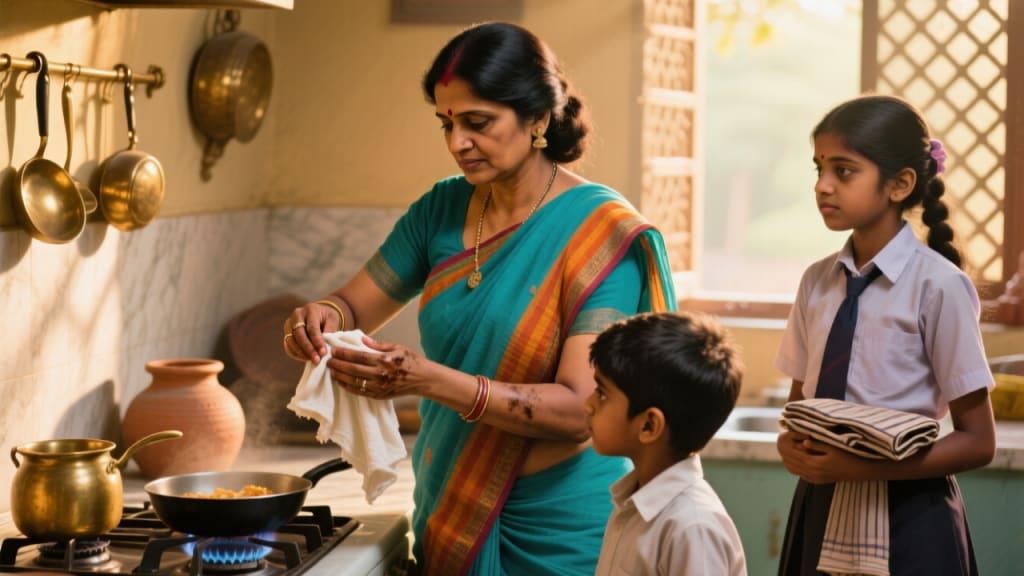
Maryam Shehzad was in an exceptionally cheerful mood today. Tomorrow, there was a school function at which she had to play the role of a mother. After the final rehearsal at school, she still needed to practice at home thoroughly. Her teacher had instructed the students to observe their mothers carefully—to watch how they move, how they sit, how they stand, how they perform household chores, and even how they drape their dupattas (long scarves). Maryam knew she had to be precise in her portrayal, and she was determined to get it right.
Today happened to be a holiday from school, yet she woke up very early in the morning, excited and a little anxious. She spent the entire day watching her mother—studying every little movement and gesture. She observed how her mother prepared breakfast, handled kitchen utensils, washed the dishes, cooked, and even carried out small household chores. Maryam noticed how her mother neatly tucked her hair under her dupatta while working, how she adjusted it when it got loose, and how the fabric always seemed to accompany her seamlessly through every task.
Hours passed, and Maryam absorbed every detail, trying to imprint them in her memory. She carefully noted how her mother’s expressions changed while performing different tasks—how focused her eyes became while cooking, how her smile appeared when speaking to family members, and how gently she scolded her younger siblings while still being tender and caring.
As the evening approached, Maryam suddenly remembered something that made her heart skip a beat. She hadn’t arranged a dupatta to wear for tomorrow! Panic set in immediately. She ran to her mother and expressed her worry.
“There’s no need to worry,” her mother said calmly, sensing her distress. “You can wear the dupatta I am wearing; it will match perfectly with your outfit.”
Maryam looked at the dupatta and froze. “This dupatta!” she exclaimed, a sudden wave of concern washing over her.
“Why? What’s wrong?” her mother asked gently.
“No, nothing… it’s fine. I’m just going to sleep now,” Maryam replied, trying to hide her embarrassment and disappointment. She went to bed, but sleep seemed miles away. Her mind was still filled with images of her mother’s busy day and the way she used that very dupatta while performing countless household tasks.
She recalled the morning vividly: her mother had worn the dupatta, freshly washed, and entered the kitchen to make breakfast. Every time her mother washed her hands, she used the same dupatta to dry them. Even after washing dishes, she used the dupatta again to wipe her hands. While cooking, whenever sweat appeared on her face from the heat of the stove, the dupatta wiped it away.
Her younger brother had come in from playing outside, his hands covered in dirt and mud, and her mother had cleaned them using that same dupatta. A pot was lifted from the stove, and she used the dupatta to hold it safely in her hands. Even the smallest chores, like wiping her little daughter’s running nose, were done with that same piece of cloth. Maryam shivered at the thought, realizing how much that dupatta had been through.
“Oh no! How can I even think of wearing that dupatta tomorrow?” she whispered to herself. The thought of wearing something that had already been used for so many practical purposes and cleaned in every possible way seemed overwhelming. Despite her anxiety, she finally drifted into sleep, her mind still replaying the day’s observations.
The next morning, Maryam woke up and got ready for school. She stepped into the living room and was greeted by a small, wonderful surprise. Her mother’s dupatta, now clean, neatly ironed, and perfectly arranged, was waiting for her. Maryam couldn’t help but wonder when her mother had managed to wash and iron it all in the middle of the night, but the effort filled her with happiness. She carefully picked up the dupatta, feeling a wave of gratitude and admiration for her mother.
With the dupatta in hand, she felt ready. Today she would wear it not just as a costume piece, but as a symbol of everything she had learned from observing her mother. Every wrinkle in the fabric, every fold, every gentle adjustment, now carried a memory of her mother’s care, patience, and hard work. She realized that the role she was about to play required more than just acting—it required understanding the love and effort that goes into being a mother.
Maryam wore her outfit carefully, draping the dupatta exactly the way she had seen her mother do a hundred times. When she looked at herself in the mirror, she didn’t just see a child pretending to be a mother. She saw a reflection of all the love, strength, and dedication her mother embodied every day.
At school, when she performed in front of the audience, she remembered everything she had observed: the way her mother moved her hands while cooking, the gentle adjustments of the dupatta, the subtle gestures of care towards family members. Her teacher and classmates were impressed by how realistic and heartfelt her performance was. Maryam’s heart swelled with pride, knowing that her preparation and attention to detail had paid off.
Later, when she returned home, she hugged her mother tightly. “I couldn’t have done it without you,” she said softly. Her mother smiled, a little proud and a little amused at her daughter’s seriousness.
That day, Maryam learned more than how to act like a mother for a school function. She learned about patience, care, multitasking, and above all, love. The simple dupatta, once just a piece of cloth, had now become a symbol of her mother’s tireless efforts and devotion. And Maryam understood, in her heart, that the role she played on stage was a reflection of the real-life heroism she witnessed every single day at home.
With a heart full of gratitude, Maryam carefully folded the dupatta and placed it back where it belonged, realizing that it had taught her lessons far beyond acting—lessons of life, responsibility, and deep respect for her mother.
About the Creator
Thief In The Night
To the thief in the night that took and replicated what once was mine: Honestly, I feel kind of bad for you. It’s funny, because we hardly know each other. I only know of you through the magazines you’ve written and the broadcasts you have televised in the past — as well as through the public mentions of you from your show business connections there.
By Snarky Lisa6 days ago in Humans



Comments
There are no comments for this story
Be the first to respond and start the conversation.