
Lola's Cookbook*
Nothing is certain in life, except for grandma's cooking
I hadn’t been inside a church in eight years.
Filipino-American funerals are typically two day affairs, with an evening wake at the funeral home followed by a mass the next day. So after an almost decade-long absence, I found myself at St. Stephen’s Catholic Church where family friends and relatives gathered to say goodbye to my mother’s mother, my Lola.
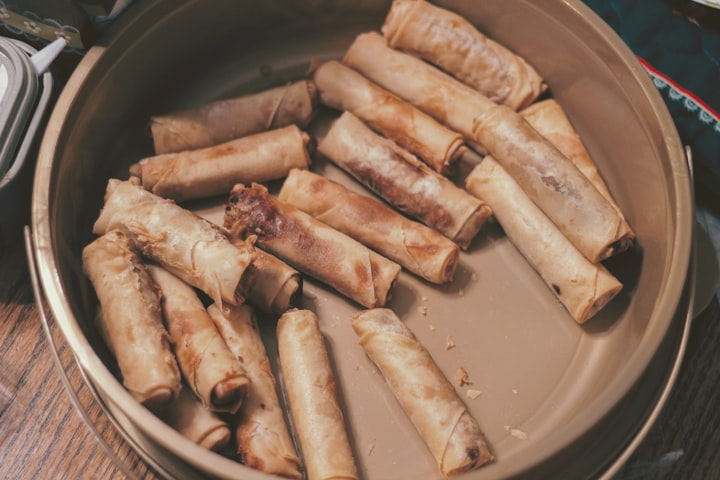
Starving after the long service, I ate my egg salad sandwich in solitude. I’d made a whole loaf’s worth and brought them to add to the buffet, but nobody else touched them. Perhaps because the crusts were roughly chopped (I cursed myself for not sharpening my knife) or because some salad had fallen out and smeared across the faux-crystal platter. I remembered Lola’s lumpia, Filipino spring rolls, and longed to be eating those instead of this soggy abomination.
I recalled the last time I made some with her, years before I’d started college. I’d only made about a dozen—and they mostly turned out asymetrical and varied in size. A few of them looked pregnant, about to give birth to minced carrots, celery, ground pork and water chestnuts. She’d made about 100, all perfectly uniform, looking like good little soldiers lined up for battle.
“You know,” she said. “When I was a kid I always dreamed I had a restaurant.”
Tita Baby’s perfume reached me before she did. As I took her hand to my forehead for a blessing, I could smell her fresh red polish.
“Your Lola was my favourite auntie,” she theatrically sobbed, her darkly tattooed eyebrows contrasting against her powdered face. Tita Baby was not a blood relative, but I would never address an elder without the title of Tita (aunt) or Tito (uncle). “She made the best pancit palabok.”
I anticipated that this would somehow segue into how her brilliant daughter, my Ate Lisa (she made me call her ate, or “big sister” because she was 9 months older than me) was going to become a doctor (or was it that she was going to marry a doctor? I couldn’t remember). Thankfully I saw my mom from across the room, gesturing me over with a wave of her hand.
“Psst! Anak, come here,” she called in a loud whisper, using the term “child”, even though I was 26 and a college graduate, complete with college tuition debt.
“Your Lola left you this,” she said in heavily-accented English, with a slight waver in her voice. Even though my mother had not been “back home” for almost 30 years, her ancestral tongue revealed itself when she was upset. She handed me a black Moleskine notebook. Then she smiled. “There is something in the pocket.”
Later as I sat in my room with the door closed, covertly sipping a glass of wine (out of respect for my mom I don’t drink freely in front of her), I examined the book. The cover was still pristine and it had a sheen as if the plastic wrapping had just been taken off. But the curvy pages told me it was well-used.
It was her cookbook.
Page after page, Lola’s recipes were meticulously written in perfect cursive. There was her famous shrimp-y pancit palabok; the tangy chicken adobo; the fiesta favorite kare kare, or as I liked to call it, “peanut butter stew”. And lumpia.
A tear fell from my eye and onto the paper, wetting the blue ink as it dripped down to the bottom of the page.
I remembered the pocket at the back of the book. I took a peek, anticipating not much at all. But there sat a cheque. And made out to me was the amount of $20000.
I blinked and looked again. My grandmother had left me twenty thousand dollars.
What did she want me to do with it? Pay off my student debt? Put a down payment on a place of my own (where I can liberally drink wine outside of my bedroom)?
But all I knew at the time was that I missed her. And I needed her food.
I dedicated myself to re-creating her recipes. I drove across town to the Asian grocery store for ingredients like malingguy leaves for the comforting chicken soup, tinola. I made sure I had enough ginger for dishes like arrozcaldo, a chicken and rice porridge.
I followed the recipes to a T, not even using a food processor to mascerate shrimp for a paste. This was not Lola’s way. “Ah,” she would say with a wave of her hand. “Why waste the corriente (electricity)?”
I saved the lumpia for last. When I sat down to roll them my hands were already tired from finely chopping each ingredient (I reminded myself yet again to sharpen my knife). I assembled a pile of egg roll wrappers and prepared a dish with beaten eggs and water. I took a square of wrapper, scooped up a spoonful of filling into it and began. I visualized Lola’s wrinkled yet agile fingers rolling them up like a cigar, smoothing it out as she closed it, then quickly dipping her fingers in the egg wash to seal it shut. I moved slowly at first, focusing on this memory. One by one I got faster and more precise, until finally I had my own neat army of spring rolls ready to be deep fried.
I was satisfied with my work. Salamat, Lola. Thank you.
I knew now what I should do.
Out in the living room Mom was watching Wheel of Fortune, her nightly ritual. I marched in, Lola’s cookbook in hand. I’d never been more sure of myself.
“I’m going to open a restaurant.” I announced confidently. “And it will be called Lola’s.”
*this would have been a submission for the $20000 Moleskine Challenge, but I missed it by mere hours
About the Creator
Keep reading
More stories from Alexis Lee and writers in Families and other communities.
Wise~Guys
— Look Behind what's in Front of You ~ Make Good Choices — Hey, So how you Doin'..! Made~Men — Mobster Movies romanticise a distinctive, elegant appearance, impeccable attire style, along with the 'Families' expressive lingo. Making their 'Bones' gave them Panache — with vintage fedoras, tailored pin-striped suits, mirror-polished wing-tip shoes adorned with tassels; with their 'Gun Moll' gorgeous dates on their arms.
By Jay Kantor20 days ago in Families



Comments
There are no comments for this story
Be the first to respond and start the conversation.