
Language Learning For Children
How children's brain works to learn language?

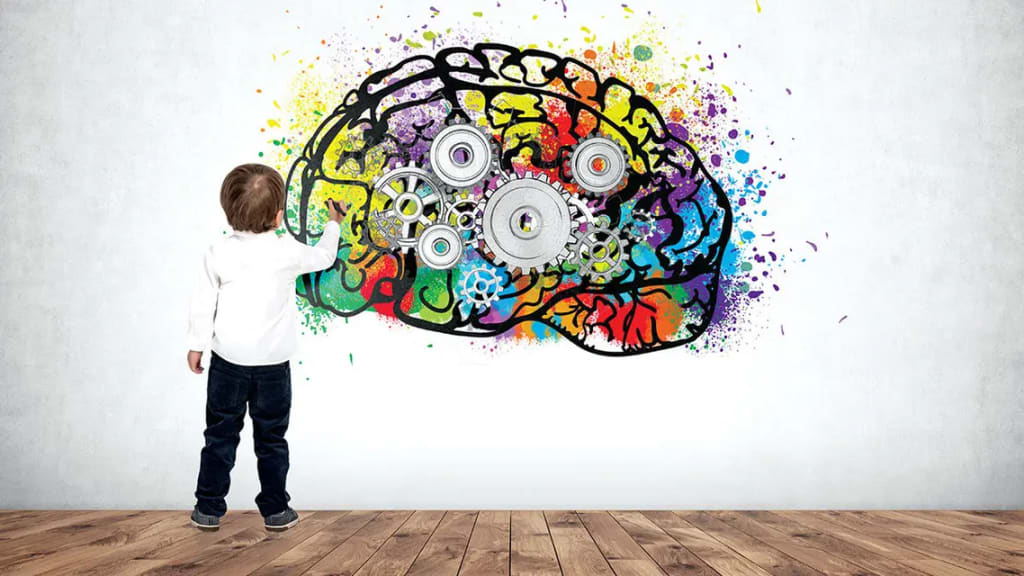
How children's brain works to learn language?
Children's ability to learn and use language, compared to learning other things, has baffled scientists for decades!
Learning a language is something very important for a child. It is the way that they will communicate with others. Language learning process is done with many stages in the child's age. This process can take up to 6 years. For decades, scientists have been perplexed by children's ability to learn and use language in comparison to other skills.
Children's ability to learn and use language, as opposed to learning other things, has baffled scientists for decades. For example, most children at the age of three or four cannot tie their shoelaces or coat buttons, On the other hand, they can do things that are incomparably more complex: convert an idea into a series of sounds The same meaning, which someone else can pick up and understand. A child's journey from a single syllable in the first year to complete sentences at the age of four is fast Unusually. Knowing very well, those adults who are trying to master a second language, how exhausting, and achievable, If they are lucky, at a very slow pace.
The reason for this is likely, say neuroscientists at Georgetown University Medical Center, USA, in A joint study with others from Children's National Hospital, published in PNAS on September 7, 2020, is Babies and young children have super powerful brains of some sort. Whereas adults process most neurological tasks assigned to specific regions in one or the other of the two hemispheres Cerebral hemisphere Young children use the left and right hemispheres of the brain to do the same with language. Perhaps this is why children recover from a neurological injury more easily than adults. The study also showed that before they recovered, the language learning process was not affected by the injury.
Commenting on these important findings, Professor of Neurology at Georgetown University Elisa L. Newport: "Their study solves a mystery that has puzzled clinicians and neuroscientists for a long time." This is because traditional surveys have not been able to reveal the details of these phenomena. Now, using functional magnetic resonance imaging (fMRI) that is analyzed in a sophisticated and more complex way, Researchers come to this.
The analyzes presented in the study examined fMRI activation patterns of language activation maps in each hemisphere brainstem for 53 individuals divided into four age groups: 4-6, 7-9, 10-13 , and 18-29.
The researchers found that all four groups showed left-sided language activation. But most of the young children also showed significant activity in the corresponding right hemisphere regions. It was shown that in adults, the corresponding area in the right hemisphere was activated in different tasks completely. For example, during processing of voice-expressed emotions in young children, areas in both The cerebral hemispheres are involved in understanding the meaning of sentences as well as recognizing emotional impact.
According to Newport, brain networks that specify specific tasks begin in one hemisphere or the other during Childhood, but it is not completed until the child reaches about 10 or 11 years of age. The importance of this work, in addition to its therapeutic importance, is that it provides evidence of how to unify systems The cognitive and the neural networks that underlie it and their consolidation over time during development. It provides insight into the principles of cognitive systems development.
At the End of this story, we are still asking the question:
How children's brain works to learn language?
Leave a like to the story.
Thank you for reading my story.
About the Creator
Love That Acts, Not Love That Speaks
When Love Became a Language Instead of a Practice In modern parenting culture, love is increasingly defined by what is said rather than what is done. Emotional affirmation, verbal reassurance, and constant validation are treated as the primary evidence of care, while less expressive forms of love are often overlooked or misunderstood. A parent who says “I love you” frequently and validates feelings consistently is assumed to be providing something essential, while a parent who demonstrates care through sacrifice, consistency, and enforcement may be perceived as distant or emotionally limited.
By Peter Thwing - Host of the FST Podcast3 days ago in Families
Guard Your Battery
Why are some people so attractive just by standing there? It’s not because they are "likable," but because they don’t need everyone to like them. I realized later that truly charismatic people allow themselves to be criticized, but they never criticize themselves. They never try to please the world; instead, the world stops to watch them.
By Emily Chan - Life and love sharing6 days ago in Poets




Comments
There are no comments for this story
Be the first to respond and start the conversation.