
Land
Being her keepers and stewards of the Lenape land was their focus.
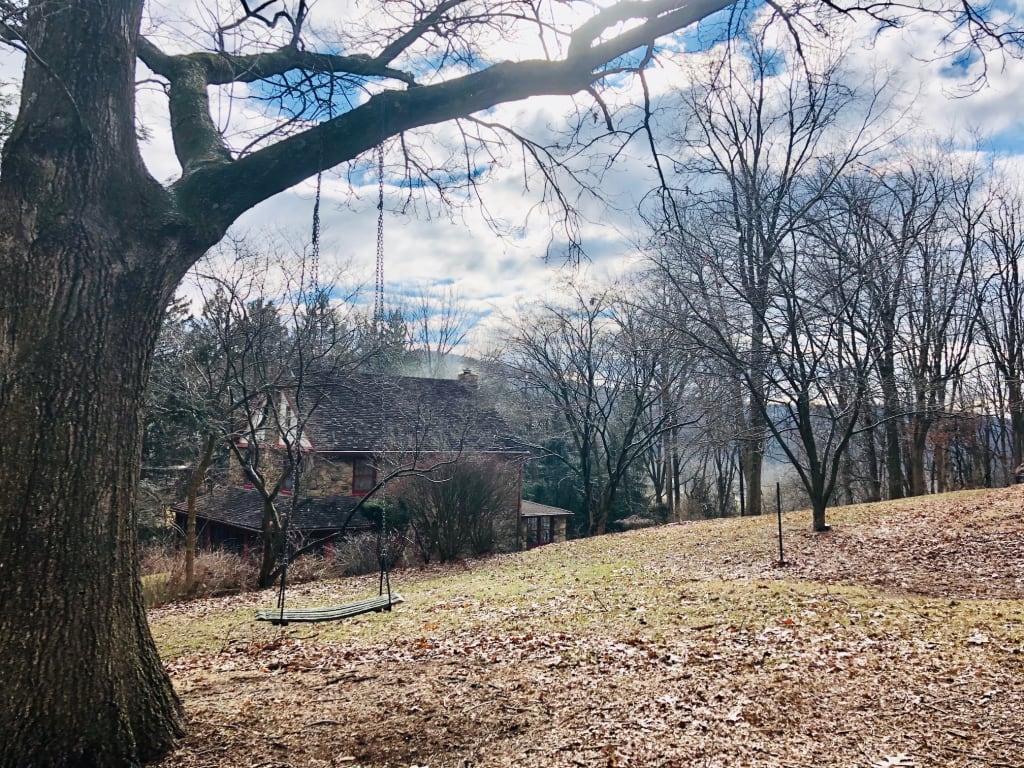
The young couple moved to the house on the hill in early April before, unbeknownst to them, the small plot of land would light up with spring flowers-dogwoods, azaleas, daffodils. This land was Lenape land (i.e., stolen land), though you wouldn’t know it from the Zillow listing or any of the local histories written about the small mountain town. These narratives, written by (surely) well meaning white folks, painted the forced and at times brutal removal of the Native Americans from their ancient homeland as progress or, in one convoluted tale, as of their own free will. It read, “The Indians that had occupied our area were of the Lenni-Lenape tribe. They must have certainly regretted leaving the lush valleys, forests, and rolling hills...” Reading such tales made their bodies contort.
This was their first house and she was four months pregnant with their firstborn when they drove the moving truck up the steep driveway. The neighbors, mostly older folks whose families had lived in the area for a couple of generations, were pleased that the new neighbors would lower the average age of the road quite significantly, if for no other reason than to call their neighbors and gossip. “She’s nine months pregnant and out stacking wood! Her husband allows this?”
These neighbors, bumped into on walks and following storms wherein fleeting moments of community arose through the mundane tasks of shoveling snow and clearing a fallen tree, would tell tales of the house on the hill. “My cousin lived there when it was number 19. The basement was so decrepit that his wife refused to move in.” “My great-grandfather lived there. The property was an orchard then. He’d raise chickens and not one would live to adulthood.” The air about these retellings was mysterious. Not saturated with enough detail to worry the mind, the young couple took the stories in stride. The house was beautiful and they felt a great honor staying within her walls. Being her keepers and stewards of the Lenape land was their focus.
Standing on the ridgeline, staring through the spruces towards the low lying mountains, it was not difficult to understand why the Lenape had chosen this as their sacred grounds. The mountains were bold yet humble and you could travel them afoot. The land could be intimately known. They knew many children and their parents had sat in this place before them, bearing witness to the flight of the birds and the changing of seasons, hunting deer and skinning rabbits, worshipping the land for all that she was. It was both deeply painful and unequivocally necessary to meditate daily on the first people who loved and lost this land.
The contractions began 48 hours after the midwife conducted a painful membrane sweep. “My sweeps always work,” she stated, her thick Scandanavian accent providing a layer of assuredness.
They walked into the forest in this beginning stage of labor, the contractions bringing the young woman to her knees, hands on the earth. She had one contraction in the backyard, two on the kitchen floor, three in the sunroom. By nine o’clock she retired to bed, not knowing what was to come but already having a reverence for the power of the contraction. The waves of energy continued and picked up in frequency and intensity as the night grew deeper. Rather than causing her to bow down on knees, these contractions lifted her to her feet, hands above the head. The night wore on and she did not sleep. She recorded the timing of contractions, jotting them down in her little black notebook in which she drew sketches of plants and birds native to the region.
Rise, step, breathe, jot. Rise, step, breathe, jot.
The sensations were bold, the experience primal, the mind devoid of thought save for one- the only way out was through.
At three in the morning it was time to drive to the birth center. The young man could tell his wife was no longer in a cognitive space and had passed into a place of surrender; hence his surprise, when sidestepping down the stairs she blurted out, “Towels!” He saw her to the bottom of the steps and leapt back up them, tearing into the small linen closet and grabbing the pile of beach towels at the very top. A small stack of money fell to the ground as he yanked the towels out. “What the fuck?” he said out loud to the towels as if expecting an answer from the overpriced, far too neon towel they had purchased at a pharmacy in Ft Lauderdale years ago. Upon further inspection it was all one hundred dollar bills and he estimated it to be over $10,000. (Later, crouched down in the bathroom, the baby’s screams reaching him through three sets of doors and a floor below, he counted the money and concluded it to be $20,000.)
Adrenaline pumping, he shoved the stack into the inside pocket of his winter coat and bounded back down the stairs. His wife was just climbing into the car, her legs in between two pillows, plus an additional pillow on the seat and another (for good measure?) on the dirty floor beneath her feet. He was genuinely impressed she had carried so many pillows in her state. “E, you won’t believe this, but I found a stack of money in the linen closet!” Words escaped the young woman at this time stage and he thought perhaps he saw a nod from her but he couldn’t be sure. Did she know about this money? There was no way, he thought.
Mother Nature paved the way for fifteen hours of labor. The young woman sat on a large ball at the side of the bed. The vastness of the pain caused her to fall into a rhythmic trance, a pain dance, a sacred stance. Contrary to other worldly pain, this pain signaled not that something was wrong, but rather that a process was in motion. This helped keep the fear at bay. As each contraction arose she gripped the bed frame with her left hand and swayed back and forth on the ball, her right arm outstretched, petting the quilt. She did not cry or scream or even talk. She breathed, a silent warrior called to peaceful arms.
The young man sat beside his wife. Strong. Brave. He could see her energy depleting, but having grown up on a small, cold, mountain farm he had weathered enough storms to know that Mother Nature was supreme. All was well. He helped his wife climb into a warm tub, her water intermittently breaking as she made her way to the bathroom. The curtains were drawn just so that a geometrical ray of light pointed across the room from the bed to the bathroom, marking their path. This made him think of the beloved trails by their home where labor had begun, which turned his thoughts to the bald eagle soaring above the fire tower, which made him think about his grandmother, and then - the money.
He was surprised yet again and felt at odds with his discovery for he shared everything with his wife and for once, he could not impart information to her. He wished to focus energy on the birth of his son and contemplating money felt wrong. His wife mustered a smile, grasping his hand. What the hell would they do with the money? Was it a crime to find unclaimed money and not report it? Could they be in danger if someone was looking for this money? With his wife no longer working, their small growing family made just enough money to pay the bills. They were not struggling but had nothing extra to spare. They could use the money as a cushion or put it towards their son’s college fund. Deep down within his subconscious the young man knew, however, where this money should go.
The pushing began around 4 p.m.. His wife was entirely focused, consumed, overtaken by the power of labor. She was in the throes. Labor. How aptly named, for she was working harder than she ever had before. She moaned in a deep, guttural manner and it was clear then that humans are in fact animals. By 7 p.m. the baby’s heart rate was slightly below the midwife’s comfort zone. “This baby has got to come out now, and if he doesn’t within the next 10 minutes, we will go to the hospital for some assistance.” He saw a glint of mischievousness in his wife’s eye - the same look she gets when she’s found a particularly rare shell on the beach. She took a deep breath and for the first time, howled as loud as she could, the sound waves reaching the moon and she bore down, hard. Their son’s head crowned and with two more seismic pushes he was born. They called him King.
So it became that the young couple learned to follow King’s lead. They were sleep deprived and happy, lonely and fulfilled. When finally they felt they had some sort of footing on this new earth, they sat down in the sunroom while King slept to talk about the money. The young mother remembered a well-worn piece of scrap paper that the previous owner had left on the counter. Along with her matter-of-fact nature and dry humor, she brought the paper to the table. It was clear that many residents had passed this same paper along. There was a simple, architectural style sketch of the house with notations to support the functioning of the old stone home. Crawl space dimensions. Elite Fuel service cheapest rates. Radon remediation checklist. Marked with a small asterix on the linen closet read Call Jeremiah with a local number.
“Well shit,” she said, “Better give him a call.”
A young woman answered. “Mt. Penn Pizza.”
“Hello, we are trying to reach Jeremiah.”
“Jerry? Is this a joke?” She responded, sounding put off.
“Um, no sorry.”
“You didn’t see the obituary? Jerry died two weeks ago. 120 years old. The third oldest living person in the world they say. Do you want pizza or not?”
“No, no, we are sorry about his passing. Thank you. Goodbye.”
“Man. I really wanted pizza.” She sighed.
Indeed, the local tribune featured an article about Jeremiah “Jerry” Chillaway, a descendant of the Lenni-Lenape tribe and a man who had dedicated his heart and hands to the land. He was a founding member of a local conversancy that worked to create the beloved network of walking trails in the town. Jerry was a creator who had started a community art project that used natural materials-twigs, leaves, stones, etc. to create ephemeral art installations in public spaces with the goal of drawing attention to how we relate to nature. He spent his weekends canoeing the river, kayaking the marsh, and hiking the hills. He whittled his own walking sticks and was fond of making them for others, leaving them, unannounced, at neighbors doorsteps - a gentle call to head to the woods. He was a proud father, grandfather, and great-grandfather. Jerry had lived in the building now occupied by Mt. Penn Pizza his whole life and had seen many iterations of the commercial space below, most notably the town general store and art gallery that he had run for decades. He hated the pizza and loved the young people that worked there.
The young parents would never know the connection between Jerry and the money so they opted to follow what they did know. This money, just like the land they resided on, was not their own. It belonged to the first people, the Native Americans. They knew then where the money belonged. It was donated to the Lenape Nation.
About the Creator
Keep reading
More stories from writers in Families and other communities.
Wise~Guys
— Look Behind what's in Front of You ~ Make Good Choices — Hey, So how you Doin'..! Made~Men — Mobster Movies romanticise a distinctive, elegant appearance, impeccable attire style, along with the 'Families' expressive lingo. Making their 'Bones' gave them Panache — with vintage fedoras, tailored pin-striped suits, mirror-polished wing-tip shoes adorned with tassels; with their 'Gun Moll' gorgeous dates on their arms.
By Jay Kantor25 days ago in Families
A Story of Leavie Scott
Leavie Scott’s story begins with a simple but powerful belief: that growth is possible at any stage of life. From an early age, Leavie understood the value of resilience, shaped by family influence and real-life experience rather than shortcuts or easy answers. Growing up, the lessons that mattered most were not always spoken aloud—they were shown through perseverance, responsibility, and the expectation that hard work would eventually open doors.
By Organic Products a day ago in Families




Comments
There are no comments for this story
Be the first to respond and start the conversation.