
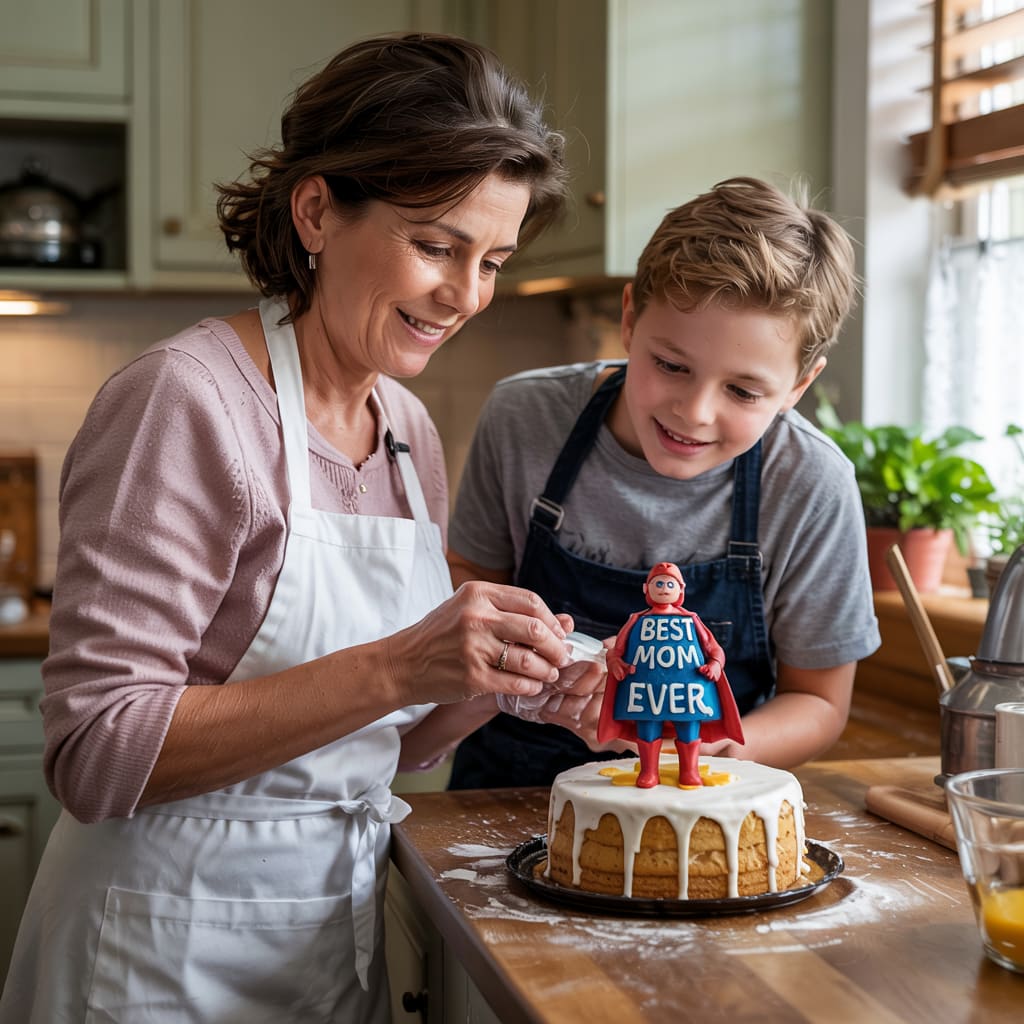
My mom always said that the kitchen was the heart of the home.
She didn’t mean it in the cheesy Pinterest-decor way, either. She meant it like a battlefield medic means “Don’t move him, he’s bleeding out.” Our kitchen held memories, arguments, burnt casseroles, and more than one glass of spilled red wine mopped up with a dish towel. It was where she fed us, held us, and—more often than not—held herself together.
Growing up, I was “Mom’s guy.” Not because she made me that, but because I stayed when others didn’t.
Dad left when I was eight. I still remember the quiet slap of the screen door shutting behind him. My older brother acted like it didn’t matter, and my little sister was too young to understand. But me? I saw everything. The way Mom stared at the empty chair at the table. How she’d cook enough food for four, even when it was just the three of us. I became the one who helped, stirred sauces, tasted soups, and later, wiped her eyes when she thought no one was looking.
It started with breakfast.
“Watch the eggs, Danny,” she said one Saturday morning. “I’ve gotta get your sister dressed.”
I was nine. I burned the first batch, naturally. But by the third Saturday, I had eggs down to a science: sunny-side up, a little crisp around the edges, with a sprinkle of salt and pepper like she liked.
From there, I became her shadow. I learned how to make her famous lasagna, the one with three cheeses and spinach she snuck in so we’d “get our greens.” I figured out the secret to her flaky pie crust—cold butter and colder hands. And I learned that when she was really upset, she’d make bread. Kneading the dough like it was all her pain and frustration wrapped into one elastic lump.
High school came, and I kept cooking. At first, it was just our thing—me and Mom, shoulder to shoulder. Then friends started showing up for dinner. Word got out that the Garrisons had the good garlic bread, the warm kitchen, the mom who smiled even when she looked tired.
“You’re like... her little husband,” my friend Jordan teased once. “You two are like a team.”
I shrugged. “I guess. She needs a teammate.”
It didn’t feel weird. It just felt like love.
When I left for college, I worried more about her than myself. Who would remind her not to burn the chicken? Who would catch her staring out the window too long? Who’d make the garlic bread?
I came back as often as I could. And when I graduated—culinary school, of course—I moved back home.
Not because I had to, but because I wanted to.
“Just for a few months,” I said. “Save up, maybe open that café I’ve always talked about.”
But those few months stretched into a year.
We fell back into our rhythm. Sunday dinners, Tuesday baking nights, Friday “let’s just order takeout” jokes. I watched her get older, slower, but still smiling.
Then one day, she said, “You have to go.”
We were rolling out pasta dough. She wasn’t even looking at me.
“What?”
“You can’t be just my guy forever. You’ve got a life to live, Dan.”
I felt ten years old again. “I’m not staying because I have to. I’m staying because I want to.”
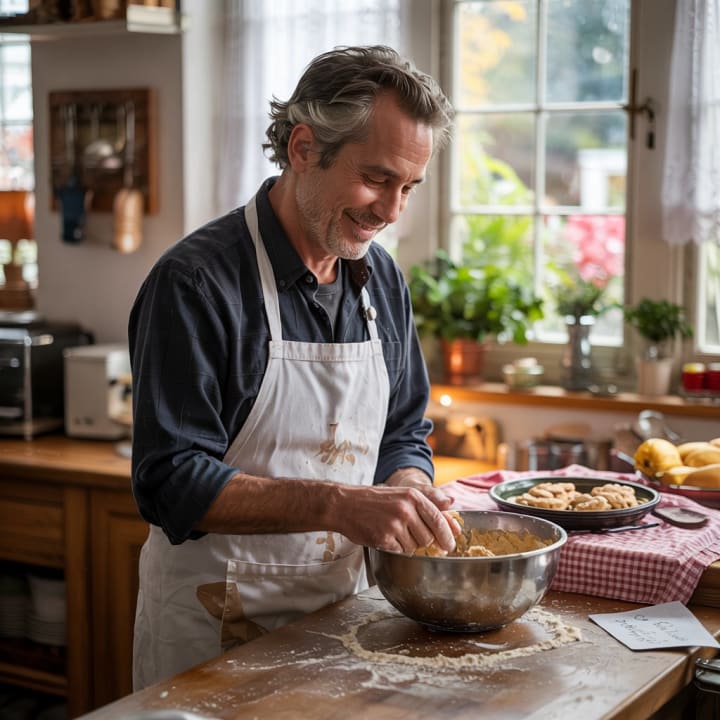
She wiped flour off her hands. “I know. And that’s why it’s time. You’ve given me so much. Now give yourself something, too.”
So I did.
I opened the café six months later. Garrison’s Kitchen. Nothing fancy—brick walls, handwritten menus, my mom’s lasagna on Thursdays. She came every week, always sitting at the same table by the window. She never said much. Just smiled and ate like she was tasting memories.
When she passed, a year later, I closed the café for a week. I couldn’t even look at a rolling pin without falling apart.
But on the seventh day, I came back.
I made her bread—kneading slow and steady—and baked it just the way she liked.
A woman came in, maybe in her fifties. “I heard your mom used to make a mean peach pie,” she said softly. “Any chance you’ve got some?”
I did. I served it with extra whipped cream, just like Mom used to.
Now, every Sunday, I make a dish from her old recipe box. The regulars call it “Mom’s Menu.” People bring stories, photos, sometimes tears. The kitchen’s still the heart of my world—and I’m still Mom’s guy.
Only now, I share her with everyone else.
Moral: The heart of a home isn’t built with walls—it’s built with care, presence, and the quiet ways we hold each other up.
About the Creator
Keep reading
More stories from Muhammad Numan Khan and writers in Families and other communities.
A Story of Love
I used to believe love and hate were opposite ends of a spectrum. But that was before I met her.Rhea. She entered my life like a storm in the dead of summer—unexpected, loud, and with the power to rearrange everything. I hated her the moment I met her, and maybe that was why I couldn't stop looking. We first crossed paths in our literature class during our final year at university. She was loud, opinionated, and constantly challenged everything I said. I was precise, methodical, and believed that words were tools—not weapons. She, on the other hand, wielded them like knives dipped in honey. “Love is a battlefield,” she said one day in class. “It’s not sweet, it’s not safe. It’s war.” I scoffed. “Sounds like you’ve never been in love.” She didn’t flinch. Just smiled. “Sounds like you’ve never been in war.” Everyone laughed. I didn’t. That was the beginning. We were assigned as partners for a final project—an in-depth analysis of tragic love stories across literature. Irony, the professor said. I cursed him internally. We met after class, surrounded by the scent of old books and bitter coffee in the university café. I suggested Wuthering Heights, thinking the classic tale would impress her. She rolled her eyes. “Too predictable. Let's do The Unbearable Lightness of Being. Love, sex, politics—messy and real.” Of course, she would pick something like that. We argued for days. Over the theme. Over the characters. Over the damn font on the presentation slides. But somewhere between heated debates and silent, stormy glances, something shifted. I started looking forward to our meetings. The day she showed up soaked from the rain, cursing the weather and still holding a crumpled printout of her notes, I offered her my hoodie without thinking. She looked surprised. “Wow. You have a heart.” “You sound disappointed,” I replied, smirking. We laughed. For the first time, without tension. It was strange, how quickly the lines blurred.
By Muhammad Numan Khan10 months ago in Fiction
Mariah Carey’s Kids: A Glimpse into the Lives of the Superstar’s Twins
Mariah Carey, often hailed as the “Songbird Supreme,” is not only a global music icon but also a devoted mother. Over the years, fans have been fascinated by her family life, particularly her twins, Moroccan Scott Cannon and Monroe Cannon. Born on April 30, 2011, via cesarean section, Mariah’s children quickly became a central part of her life, capturing public attention alongside her illustrious career in music.
By Story Prismabout 8 hours ago in Families
When Desire Replaces Compassion
When the river first arrived in Devpur, it was not called a miracle. It was simply water, flowing where water always had. It curved around the village like a patient guardian, feeding fields, filling wells, and cooling tired feet at dusk. Children learned to swim in it before they learned to write their names. Elders sat by its banks every evening, arguing about harvests and memories with equal seriousness. No one thought to own it. No one thought to sell it.
By Ibrahim Shah about 18 hours ago in Families
📢 Raise Your Voice Thread: 02/05/2026
Our “Raise Your Voice Threads” are hosted most alternating Thursdays at 12PM ET to offer creators more avenues to uncover exceptional stories on Vocal. As we are continuously searching for fresh creators and inspiring stories, this thread provides an opportunity to exchange and discuss the stories that have moved and motivated us on Vocal.
By Raise Your Voice by Vocal2 days ago in Resources



Comments
There are no comments for this story
Be the first to respond and start the conversation.