
India-Pakistan Tensions Escalate Over Kashmir Attack
"Nuclear Neighbors on the Brink
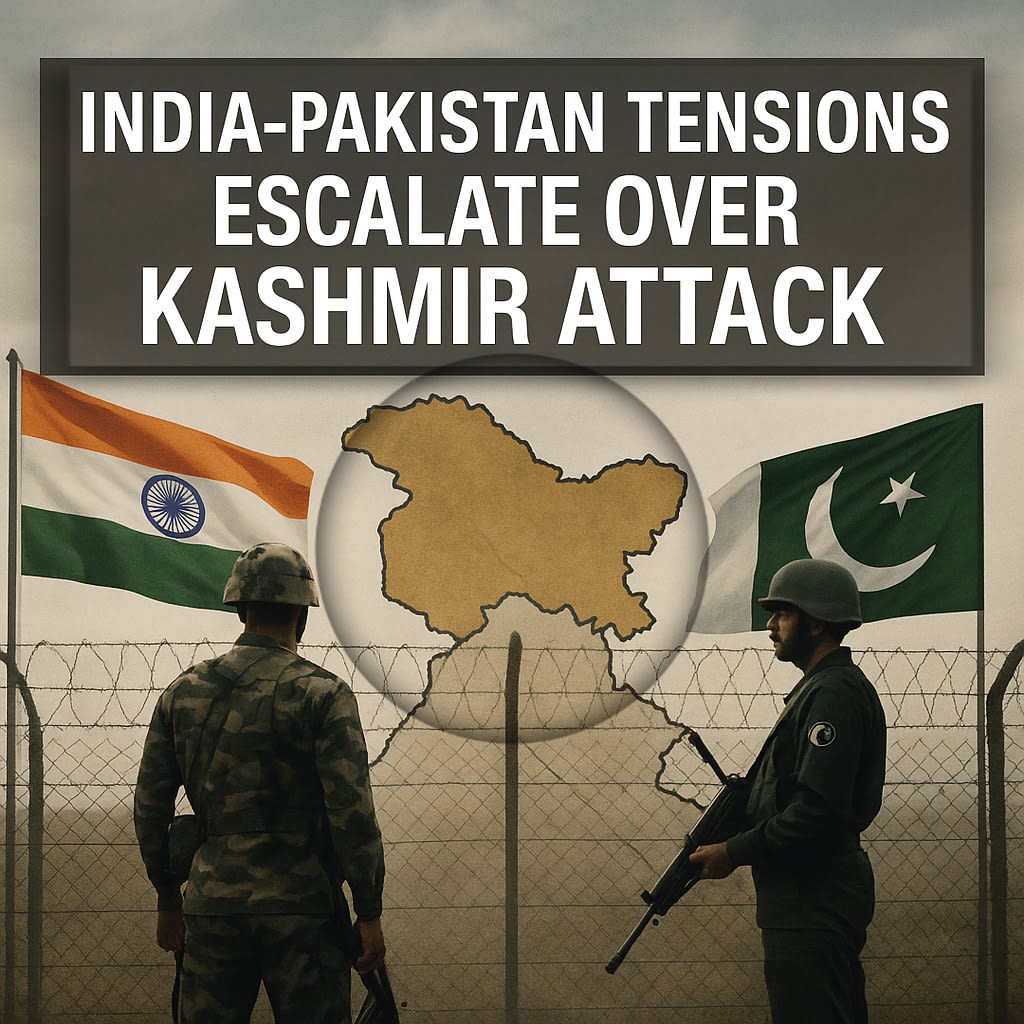
The long-standing rivalry between India and Pakistan has once again flared up dramatically following a deadly terrorist attack in Indian-administered Kashmir. The attack, which claimed the lives of 26 Indian tourists and injured dozens more, has triggered a sharp diplomatic and military standoff between the two nuclear-armed neighbors. Both countries have exchanged strong accusations, further destabilizing the already volatile South Asian region.
The Attack and Immediate Aftermath
On April 22, 2025, heavily armed militants launched a brutal assault on a bus carrying Indian tourists near Srinagar, the summer capital of Jammu and Kashmir. According to Indian authorities, the attackers opened fire indiscriminately, resulting in one of the deadliest civilian massacres in recent years in the disputed territory. The bus driver managed to steer the vehicle to safety before succumbing to injuries, potentially preventing an even higher death toll.
Indian security forces swiftly responded, killing two militants at the scene and capturing one alive. Initial investigations, based on recovered weapons, communication intercepts, and the confession of the arrested militant, pointed towards Pakistan-based terror groups allegedly supported by Pakistan’s intelligence agencies.
Prime Minister Narendra Modi condemned the attack in the harshest terms, promising a "strong and decisive" response. “The blood of innocent Indians will not go unavenged,” Modi said during a national address, as protests erupted across several Indian cities demanding retribution.
India's Response: Diplomatic and Strategic Moves
In a swift and significant move, India announced the suspension of the Indus Waters Treaty, a crucial agreement brokered by the World Bank in 1960 that governs the sharing of rivers between the two countries. Under the treaty, India controls the eastern rivers (Ravi, Beas, Sutlej), while Pakistan controls the western rivers (Indus, Jhelum, Chenab).
By suspending the treaty, India has signaled its intent to leverage its upstream position to pressure Pakistan economically. New Delhi plans to halt the sharing of hydrological data during flood seasons and has hinted at expediting dam projects on the western rivers to utilize more of the water for Indian needs, a move that could severely impact Pakistan’s already water-stressed agriculture sector.
Indian media and political commentators have hailed the decision as a "water strike," suggesting that controlling Pakistan’s water lifeline would be more effective than military retaliation.
Additionally, India has launched a diplomatic blitz, engaging with Western allies and Gulf nations to isolate Pakistan internationally, labeling it a "state sponsor of terrorism."
Pakistan’s Reaction
Islamabad, for its part, has categorically denied any involvement in the attack. Pakistan’s Foreign Ministry called India's allegations "baseless and irresponsible," accusing New Delhi of using the attack as a pretext to escalate tensions and distract from its own domestic troubles.
Prime Minister Shehbaz Sharif appealed for an independent international investigation, inviting the United Nations and other neutral bodies to verify facts on the ground. He warned that any unilateral Indian action, particularly regarding water resources, would be considered an "act of aggression" and would be met with a "robust response."
Pakistan also called an emergency meeting of the Organisation of Islamic Cooperation (OIC) to discuss what it termed as “Indian state terrorism” in Kashmir and human rights violations.
International Community’s Concern
The international community has expressed grave concern over the spiraling tensions between India and Pakistan, urging both sides to exercise restraint. The United States, United Nations, China, and European Union have called for a transparent investigation into the attack and emphasized dialogue as the only viable solution.
The UN Secretary-General António Guterres issued a statement stressing that both countries must avoid actions that would escalate the situation further. “Given the history and the nuclear capabilities of both India and Pakistan, the world cannot afford another conflict in South Asia,” he warned.
China, an ally of Pakistan but also a major trade partner of India, has offered to mediate between the two sides, although India has traditionally rejected third-party mediation on Kashmir, insisting it is a bilateral issue.
The Indus Waters Treaty: A Looming Flashpoint
Perhaps the most worrying development is India’s suspension of the Indus Waters Treaty. For decades, the treaty has survived multiple wars and skirmishes between the two nations, acting as a rare success story in an otherwise hostile relationship.
Pakistan relies heavily on the Indus River system for its agriculture, which employs about 40% of its workforce and accounts for roughly a fifth of its GDP. Any significant alteration of river flows could trigger a humanitarian crisis, intensify internal instability, and push Pakistan toward even more drastic actions.
Experts warn that weaponizing water could have unintended consequences. "Water is life," says South Asia policy analyst Dr. Alyssa Ayres. "Turning it into a tool of coercion may invite unprecedented retaliation, destabilizing not just India-Pakistan relations but the broader regional security architecture."
Historical Context
The Kashmir conflict dates back to 1947, when India and Pakistan gained independence from British colonial rule. Both countries claimed Kashmir, leading to three full-scale wars and countless skirmishes. In 2019, India revoked the semi-autonomous status of Jammu and Kashmir, a move that Pakistan and much of the international Muslim community strongly opposed.
Since then, the region has been under heavy Indian security presence, and militancy has seen sporadic surges. India accuses Pakistan of training and arming militants to foment unrest, a charge Pakistan denies, insisting it only provides "moral and diplomatic support" to Kashmiris seeking self-determination.
Future Prospects
The current crisis could unfold along several dangerous paths:
Military Escalation: Border skirmishes along the Line of Control (LoC) could intensify, possibly leading to a limited conflict or even a full-scale war.
Water Wars: If India aggressively withholds water resources, Pakistan may respond by taking the issue to international courts or, in a worst-case scenario, launching covert operations against Indian infrastructure.
Diplomatic Freeze: Even if war is averted, diplomatic ties will likely deteriorate further, reducing any chances for future peace talks.
Regional Impact: Increased instability in South Asia could disrupt global trade routes, worsen refugee crises, and draw in other powers like China, the United States, and Russia.
Conclusion
The deadly Kashmir attack has once again exposed the fragility of India-Pakistan relations. As nationalism rises in both countries and hardliners push for aggressive postures, the risks of escalation have rarely been higher. The suspension of the Indus Waters Treaty introduces a new, potentially catastrophic dimension to the conflict — one that could have dire humanitarian consequences far beyond the two countries' borders.
Now more than ever, responsible leadership, international mediation, and public pressure are needed to prevent another tragic chapter in the long and painful history of South Asia.
About the Creator
Wise~Guys
— Look Behind what's in Front of You ~ Make Good Choices — Hey, So how you Doin'..! Made~Men — Mobster Movies romanticise a distinctive, elegant appearance, impeccable attire style, along with the 'Families' expressive lingo. Making their 'Bones' gave them Panache — with vintage fedoras, tailored pin-striped suits, mirror-polished wing-tip shoes adorned with tassels; with their 'Gun Moll' gorgeous dates on their arms.
By Jay Kantor19 days ago in Families
Becoming a sleeve snake
The Treacherous Minister A long time ago, in the land of Greece, there was a wise and just king who ruled his kingdom with fairness. The king trusted all of his ministers and often consulted them on matters of governance. Among all his ministers, there was one whom the king favored above the others—a man named Faisal. The king valued Faisal’s advice and often sought his counsel for important decisions.
By Sudais Zakwan6 days ago in Families




Comments
There are no comments for this story
Be the first to respond and start the conversation.