
I Will Stand on the Moon and Watch You Circle the Globe
The Story of a Foster Family, a Stray Dog, and a Neighbor with Unusual Sweater Pockets

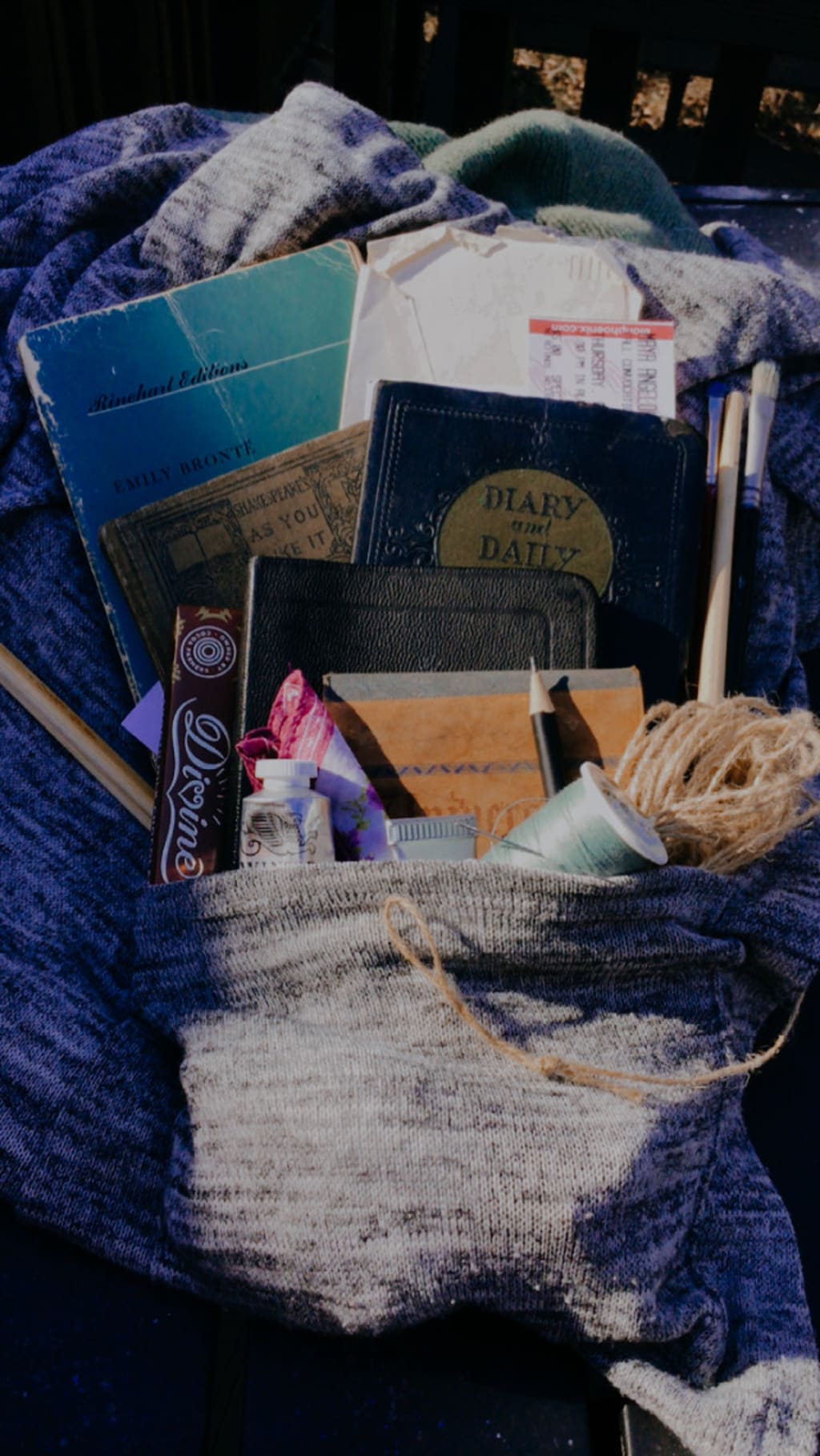
Ms. Eleanor lived down the hall. The first time I saw her it was Halloween. I’d just had two cavities filled, and I was not in the mood for candy collecting, but Mr. and Mrs. Smith asked me to take David and Lily. They were okay kids. They never hassled me about being black in a white family. They had parents. I had someone to remind me about homework, to care about when I went to bed, and to take me to the dentist. I was a foster kid. I knew I wasn’t one of them. I wasn’t a Smith, but that was okay.
Lily held her plastic pumpkin handle in her teeth and shook her head. David cleared his throat and pointed at the door. It was the apartment of Ms. Eleanor, beloved befuddler of humankind. “This apartment is okay,” I reassured them. “It has one of those smiling pumpkin stickers on the door. The ones used to mark which doors will open on candy hoards.” Before David could reply, or I could I knock, the door opened. There stood Ms. Eleanor. I took her in: red boots, black velvet pants, silver sequin top, and, growing over her like moss—a gray sweater—alternately hugging her and swinging away. Her hair was in a high bun and she wore a little crown. She reached into one of the pockets of that sweater. She dripped rustling sweetness into Lily’s plastic pumpkin and David’s skull.
Then she looked at me. “No candy for you, I think? But you must have something.” Out of her other pocket she brought a small black notebook. “The pages are empty, but you can fill them. It’s like life.” We all said thank you, and she nodded and smiled. As we walked away, David looked at me.
“She’s sort of—”
“Sort of what?”
“Different.” Lily answered with a smile. “Not bad different. Just different-different. Different like you.”
“Do you mean because we’re both black?”
They looked at me. “No,” said Lily. “That would be weird. It’s because you’re both not afraid to be different.”
“And because you’re both pretty,” added David with the beautiful matter-of-factness of childhood. Was I? A white boy had never called me pretty, at least not and meant it. I held out my hands, and we walked down the hall.
The next day, in English class, our teacher told us we would need to start keeping a journal.
A few days later, I met Ms. Eleanor outside. She asked, “How’s the writing going?” I shrugged. “Don’t be afraid of the blank page. It is space. Stand on the moon and circle the globe. See everything. Write anything.” Then she reached into a pocket and gave me a bandage, a paper clip, a mesh bag, and a silver pen. I thanked her and thought she really wasn’t afraid to be different. When I got to the apartment, David had a freshly skinned knee, Lily was trying to read my science report and had popped the staple, and Mr. and Mrs. Smith were bringing in the shopping.
The next day I knocked on Ms. Eleanor’s door. “How did you know?”
“Know what?”
“Know what I’d need?”
“I rarely know, but the pockets often know. Would you like to join me for tea?”
It became, at least, a weekly meeting. Ms. Eleanor told me stories. She had traveled the world and she had painted her travels. She had old books, strange and colorful prints, and back and white framed photos. I liked to look at them and ask questions. I wanted to hear her travel stories, but, somehow, it always came back to me.
“The Smiths call me Jackie, but I like Jacks. Some of the kids at school ask me if I’m a boy or a girl. And I’m always running late.”
“This,” she told me, “belonged to my grandfather, then my mother, then me, and now you,” and she pulled a watch on a chain out of a ponderous pocket and placed it in my hands. “The watch keeps time for anyone who holds it. It isn’t a boy watch or a girl watch. You are you. If you want to be Jacks, be Jacks, and, if you don’t yet know who Jacks is, find out.”
I thanked her and admitted, “I’ve been writing in that little black notebook you gave me and not only for school. I wrote a story about a person who travels the world, like you did. I want to travel the world—and write about it. It’s like an ache in me. Nothing makes it better. Mary and John want me to think about college, and I do think about college, but I think more about travel and words. Those are my dreams—but, I’ll go to city college and find a regular job. Maybe I can save enough money, one day. Mary and John told me they’d help me pay for college, and I’m grateful. They aren’t exactly rich, either. No one around here ever is.”
“There are different ways to be rich, Jacks. Make your mind and your memories rich. One day, you will travel.” She picked at the threads of one pocket. Before I left, she pulled a dog treat out of the other pocket and handed it to me.
For a week I carried that dog treat around. Then it happened. I took out the trash, as usual, but sitting beside the dumpster was a skinny black and tan dog. I held out the treat. The dog licked my hand, ate the treat, and followed me home. David and Lily were immediate fans. John was won over quickly, but Mary held out. She insisted we see if the dog were lost. After that, she was still unsure. I told her about Ms. Eleanor and the dog treat, and she gave in. Apparently, the pockets held sway even over Mary and John.
We couldn’t decide on a name. David wanted Ella, and John thought that might be a nice tribute to Ms. Eleanor, but Lily wanted Honey. I suggested Keeper. Mary repeated, “Keeper. Keeper. Our Keeper.” Mary was looking at me as she spoke. Everyone loved my name. For a moment, I felt like I belonged, and Keeper stayed.
Not that dogs are easy in an apartment. There were chewed socks and accidents; there were walks in the rain, but I never balked. Keeper sometimes fell asleep with David or Lily, but by morning she was always beside me. We whimper-whispered stories in the gray dusk. She pulled love out of me like David and Lily now pulled candy out of Ms. Eleanor’s pockets. I scratched Keeper’s belly and she licked my face. I told her things I had never told anyone. I had a friend who asked nothing of me except to be my friend.
It was after this that Ms. Eleanor become Aunt Eleanor. There was another beautiful blank black book, always a few pages before I finished the last one. There was a handkerchief the day before I started reading Mister Charlie’s Blues. There were poems by Audre Lorde, Alice Walker, and Maya Angelou. There were old sets of books by the Brontës and Shakespeare, given one at a time. There was a cravat to go with a nice outfit, before I even knew I had won a school award and would have to be on stage. There were handwritten poems, notes, and little drawings.
When we went for walks in the park, those pockets held bread crumbs, dog treats, and Fair Trade chocolates for David and Lily. When we went to art museums, they held sketch pads and pencils. When we went to the flower market, they held ribbons to tie up gifts for our friends. When we walked along the street, they held wrapped sandwiches and cookies for neighbors, for the unhoused, and for strangers who would often become friends. Before I had a hole in my sock, they held thread and a needle. Aunt Eleanor’s hands taught me to sew. There was always an answer, often before the question came, in the pockets of Aunt Eleanor. I thought, I hoped, it would always be so.
One day, I stopped at Aunt Eleanor’s. I had been taking classes at city college. I was about to finish an associate’s degree. I wanted to talk with her about what came next. I had tried to save money, but it wasn’t easy. Mary said it was because I always gave my earnings away. But when so many people needed so much, and I had Mary and John, what could I do? Aunt Eleanor didn’t answer.
When I opened my own door, I saw she was having tea with Mary. Today it was quiet, though. Slowly, Aunt Eleanor stood up and reached into both pockets. Then she pulled out empty hands and stretched her arms into a hug around me. “Jacks, I have cancer,” she whispered in my ear. “Let’s enjoy today. I want to go shopping. I want to buy the biggest, brightest yellow hat we can find.”
Later, we talked about things. She had already given me a lot of books, paintings, and prints, but she gave me more. I helped her make notes about what she wanted to send to friends in other places, to give to neighbors, and to give to my family. There must be special gifts for Lily and David. I had taken the summer off, and I devoted it entirely to Aunt Eleanor. We talked so much. We said nearly everything, I think. We cried, we laughed, we told secrets, and Keeper kept them all.
And then one day, Aunt Eleanor left me. I held her hand as she was going. She whispered, “Jacks, you and your family are the best thing that could have happened to me. I want you to have my mother’s ring and my sweater, remember. I want you to wear them, if you want to. I want you to reach your hands into the pockets. Don’t forget.”
Then it was over. I went to the kitchen table. Mary was there. She brought the sweater and placed it around my shoulders, like a royal robe, but I shuffled my arms in and then gripped it tightly, painfully, to my chest. I yelled. Then I cried. Finally, I sat up. “I don’t know what to do. I don’t know. It doesn’t seem right, just to go on—like she’d never been—”
Mary and I sat in the presence of the absence of Aunt Eleanor. Finally, she spoke. “Jacks, she loved you so much. Try the pockets.”
I took a deep breath, closed my eyes, and sent my hands down, like diving from a cliff. I came up with one, last, blank black book. There was a note written inside: “I know we belong to each other. We always will. Don’t worry, My Love. You have a good family, a good dog, a good gray sweater, with good deep pockets—your very own—to draw from.” The book also held an envelope. Inside was information about an insurance policy. I had twenty thousand dollars—with which to make my dream of travel and writing come true—a parting gift from Aunt Eleanor’s ponderous, prolific, and prophetic pockets. I suddenly understood her last words to me: “Don’t worry, Jacks, about what comes next. I will stand on the moon and watch you circle the globe.”
About the Creator
Olivia Lee Stogner
Poet, playwright, novelist, teacher, traveler, activist, friend, feminist, fair trade product buyer, sister, dog lover, book lover, and wood nymph. Connect: @ladyolivialee.
Keep reading
More stories from writers in Families and other communities.
Wise~Guys
— Look Behind what's in Front of You ~ Make Good Choices — Hey, So how you Doin'..! Made~Men — Mobster Movies romanticise a distinctive, elegant appearance, impeccable attire style, along with the 'Families' expressive lingo. Making their 'Bones' gave them Panache — with vintage fedoras, tailored pin-striped suits, mirror-polished wing-tip shoes adorned with tassels; with their 'Gun Moll' gorgeous dates on their arms.
By Jay Kantor18 days ago in Families
My Mother And George Michael
On Christmas Day 2016, news broke that George Michael had died. It was late in the evening, and my mother and I were sat in front of the TV. Our friends and family had gone home, we had eaten way too much food and we were tired. My mother was asleep, in fact. I wasn’t. I was scrolling, looking for anything to watch. It was Christmas Day, surely something good would be on. But what I got were reruns, repeats, Christmas specials from the year before that I had already seen… I sort of gave up and logged onto Facebook just to pass the time. That’s when I saw it. George Michael had died. I immediately jumped out of the sofa. That couldn’t be. Or maybe it could. It was 2016, after all. I put on Sky News because who can believe anything they see on Facebook these days? And there it was. The man I had grown up with had died. My mother didn’t know. Not for another minute, when I had to gather the courage to wake her up. I was crying and I knew she would immediately know something was wrong. I gently woke her up and pointed at the TV…
By Carol Saint Martin7 days ago in Families
Ludacris and Nelly draw backlash over bookings at MAGA-coded music festival
Ludacris and Nelly headlining a mostly right-wing event is good for them. It’s also great for the genre of hip hop. The two rap veterans have showcased their talents on other stages. Why can’t they perform for mostly MAGA folks and grab that bag?
By Skyler Saunders4 days ago in Beat



Comments
There are no comments for this story
Be the first to respond and start the conversation.