
How Owen Davis' "Infinity Train" Showcases Death Onscreen; And Why It's Important
How children's television today is broaching more sensitive topics with it's young viewers

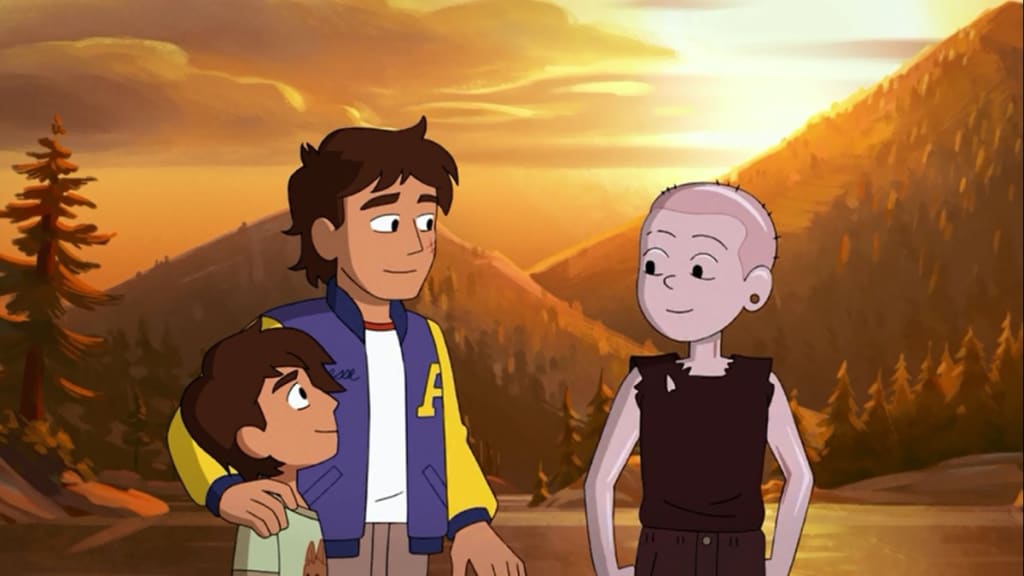
On January 9th, 2020, the main character of a television show broadcasted on Cartoon Network was shown murdering another character onscreen. M.T. (a.k.a. Lake) is the standoffish protagonist in Owen Davis’ show “Infinity Train”, where the passengers are regular people, plucked from their real life and boarded onto the mysterious train. The series portrays the character dealing with uncomfortable situations, such as divorce, bullying and death. The latter, takes shape in many forms throughout the series, the most gruesome example being the demise of one of the main antagonists. Although at first glance this scene may seem inappropriate to have on a children’s tv show, there are many more programs today that try to broach more mature topics with their younger audiences. And in a society where people are more openly discussing their own issues and fears, the importance of responsibly educating young viewers about the real world becomes crucial to their development, as well as our own.
While M.T. is not actually a passenger on the train (rather a “reflection” of another passenger that gained agency) and her “purpose” is that of an aid and companion to Jesse (A human passenger struggling with self-assurance) her compelling story arc becomes the core of the show. In one of M.T.’s more desperate moments, she becomes trapped in the wasteland outside the train, handcuffed to a wounded Agent Sieve. Sieve is officer from her realm, ruthlessly hunting her down. As she struggles to get back on the train to safety, Sieve attempts to stop her, shouting triumphantly, “…[T]here’s no better way to go!” then to complete his mission by ending her life, even at the expense of his own. She angrily retaliates, grinding him into the gigantic wheels of the train, killing him. So what does his death and her act of violence represent to the viewer?
In recent children’s media, there are many more shows that choose to broach touchier subjects in creative, yet respectable metaphors. Rebecca Sugar’s “Steven Universe” has many characters with differing sexualities, genders and it even covers trauma and mental illnesses. Sesame Street has created young characters with difficult home lives to show how children might comprehend similar situations. So there are already several shows that have more mature themes woven into their storylines. Infinity Train just chooses to base it’s entire plot around them. One could say that having such a graphic scene in a children’s show could traumatize a young viewer. And admittedly, the artistic freedom does make for a rather violent, disturbing scene for anyone to watch. But what separates Infinity Train from other cartoon shows with violence is the gravity is gives each altercation, and the effect it has on every character involved.
In the first season, the fear of change and the burden of grief are the main themes throughout the show. In season two, self-identity, life and death are introduced with new characters. And in each darker moment, the scene is given a break from comical relief or wacky imagery to let the moment breathe. Infinity Train understands that viewers can, and will, connect with it’s messages and that by not shying away from showing what’s typically considered “too dark”, it can solidify it’s own emotional authenticity to as a work of art. Children may not be able to understand all of the underlying messages, but they are given the impression that these scenes are important. And then they can ask their parents why the talking dog died (small spoiler, RIP Atticus).
Even if some parents believe that it’s too early to talk about such complex topics with their kids, they will eventually have to encounter morally difficult situations—explained or not. At some point, it becomes the parent’s responsibility to talk to their children about sickness, sex, hardship and dying. And with more and more children gaining access to the Internet, they may be learning about the world from a device without the compassion and tact of an adult. The consequences of not communicating for too long or remaining silent altogether could be devastating for young minds that are so naturally curious about everything. Shows like Infinity Train don’t try to teach their viewers about everything, they’re just trying to start the conversation between their young audience, and their elders. So that when they grow a little older, they’re better equipped to understand and enjoy a life outside of fiction.
About the Creator
JP Guen
Just trying to figure everything out and trying to help when I can. I hold my cheesecake, whiskey, and wifi tight!
Keep reading
More stories from writers in Families and other communities.
Wings of a Lioness: The Geology of Inherited Pride
People often ask me where I get the strength to pack my entire life into two suitcases and head into the unknown. Where do I get that step that never falters, neither in the cold Canadian North nor under the elegant skies of France? The answer doesn't lie in geographic maps, but in an old photo album, my mother's oversized ring, and that blue flight attendant's cap that is worth more to me than any crown. My courage is not my own doing – it is the dowry left to me by my mother, a woman who conquered heights with airplanes, and the earth beneath her feet with her unwavering character.
By Magma Star3 days ago in Families



Comments
There are no comments for this story
Be the first to respond and start the conversation.