
How Family Courts Are Ignoring the Trauma They Create
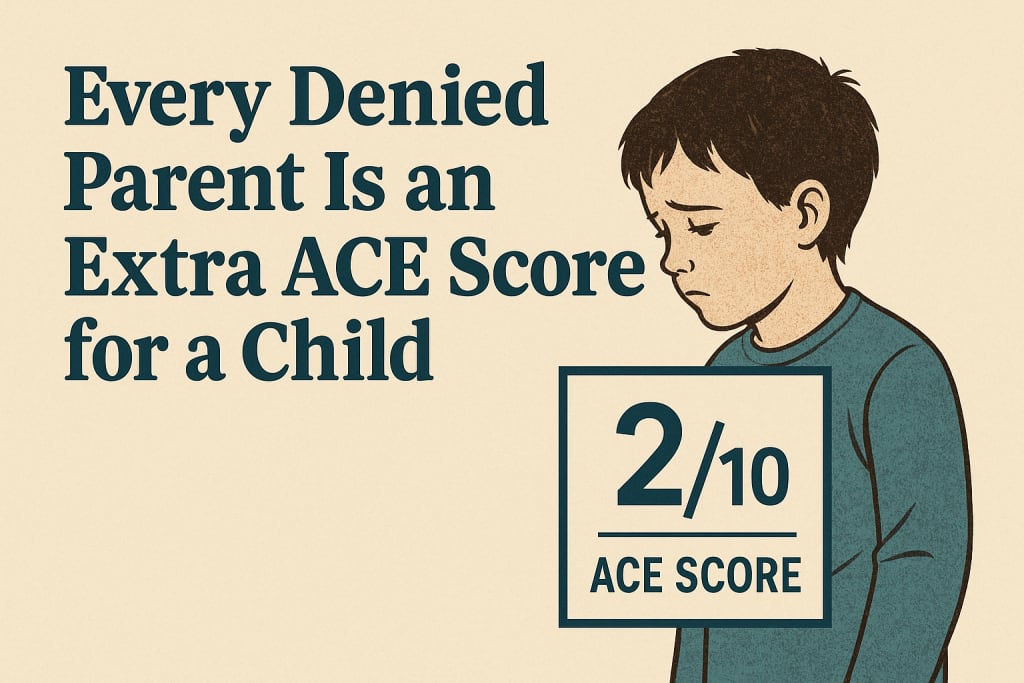
Every Denied Parent Is an Extra ACE Score for a Child

The modern family court system claims to operate “in the best interest of the child,” but in reality, it often does the exact opposite—especially when it allows or enables one parent to weaponize the courtroom to cut off the other. The moment a child is denied meaningful access to a safe, loving, and capable parent—not due to abuse, but because of court dysfunction, false allegations, or parental vindictiveness—that child suffers. And the damage isn't just emotional. It's measurable.
The ACE Score No One Talks About in Court
Adverse Childhood Experiences (ACEs) are not theory—they’re fact. Decades of research show that trauma in childhood leads to lifelong harm, from depression and addiction to heart disease and shortened life expectancy. The ACE questionnaire includes just 10 items, and yet scoring just 2 or 3 increases the risk of developmental, psychological, and medical harm significantly.
One ACE point is automatically added the moment a child loses a parent—whether through death, divorce, or estrangement. The court’s inaction, failure to enforce its own orders, or blind eye to obstruction by the other parent immediately places the child at risk. Denial of parenting time—especially when it’s court-sanctioned—is not a neutral act. It’s trauma. And it’s measurable.
Yet these family courts—slow-moving, understaffed, and often biased—do not account for the emotional cost they’re imposing. They claim they’re protecting children. But how does it protect a child to rob them of a loving parent and force them to live in a home controlled by someone emotionally unwell enough to erase the other?
A Silent Epidemic: Court-Enforced Estrangement
Let’s be clear: a parent who willfully cuts off access between a child and the other parent without legitimate cause is not acting in the child’s best interest. They’re acting out of control. It’s often a form of coercive control—an extension of narcissistic or borderline behavior—designed to punish the other parent through the child. And courts too often let them get away with it.
What do you call someone who floods the system with false accusations, files fraudulent protective orders, manipulates therapy records, or lies to court-appointed professionals just to block a parent from their child?
Not mentally well.
But instead of protecting the child from this instability, courts reward it. Instead of intervening, they defer. Instead of enforcing their own orders, they turn a blind eye—especially when the accusing parent cries “safety” without proof. Meanwhile, the child’s ACE score ticks up to 2: one for losing a parent, and one for being raised by someone with a probable, untreated mental health condition.
That’s before we even get to any other chaos in the home: substance abuse, verbal abuse, emotional neglect, or instability—none of which may ever get documented in court because no one wants to investigate the parent who claims to be the protector.
Denying Access Is Child Abuse
Let’s stop pretending that this is okay. Denying a child access to a healthy parent is psychological abuse. It causes emotional detachment, confusion, self-blame, anxiety, and even physical symptoms like stomachaches and sleep disorders. It breeds future trauma bonds, toxic relationships, and a higher likelihood of self-harm and suicide.
The system pretends this is a “custody dispute.” In reality, it’s state-enabled trauma creation.
No other court would tolerate this. No criminal judge would allow someone to violate an order without consequence. But in family court, it’s routine. Parents are denied weekends, holidays, entire summers—without consequence to the obstructing parent. Judges say they are "focused on the child," yet fail to see the child at all. They ignore the actual psychological science and hand over full control to the most manipulative parent in the room.
Time to Count the Damage
Every time a judge refuses to enforce an order, every time they give a pass to false allegations, every time they dismiss legitimate mental health concerns in one parent because the other parent is “coping well,” they’re helping destroy a child’s developmental foundation.
It's time courts are held accountable—not just by higher courts, but by science, by psychology, and by public opinion. These systems are supposed to protect children. Instead, they’re enabling abuse, incentivizing falsehoods, and slapping ACE scores onto the backs of children like silent scars they’ll carry for life.
The question every judge should be forced to answer before denying access is this:
"Am I about to give this child another ACE?"
If the answer is yes, then they aren't acting in the best interest of the child. They're acting in the interest of convenience, cowardice, or control. And that makes them complicit in the trauma they claim to prevent.
About the Creator
Michael Phillips
Michael Phillips | Rebuilder & Truth Teller
Writing raw, real stories about fatherhood, family court, trauma, disabilities, technology, sports, politics, and starting over.
Keep reading
More stories from Michael Phillips and writers in Families and other communities.
The Fight After the Final Order
On July 14, 2025, the Family Court of Dorchester County, South Carolina, issued its Final Order in the case of Sewell v. Sewell. The ruling awarded sole custody of the couple's daughter to the mother, imposed a $60,000 attorney’s fee against the father, and ordered him to refinance or sell his pre-marital home to satisfy the judgment. For most litigants, this would be the end of a painful process. But for William Sewell, a pro se father with no attorney, no money, and a disability that was never accommodated, the Final Order was just the beginning of a new chapter—a last-ditch legal scramble to protect what little remains of his rights, his home, and his child.
By Michael Phillips6 months ago in Families
Wise~Guys
— Look Behind what's in Front of You ~ Make Good Choices — Hey, So how you Doin'..! Made~Men — Mobster Movies romanticise a distinctive, elegant appearance, impeccable attire style, along with the 'Families' expressive lingo. Making their 'Bones' gave them Panache — with vintage fedoras, tailored pin-striped suits, mirror-polished wing-tip shoes adorned with tassels; with their 'Gun Moll' gorgeous dates on their arms.
By Jay Kantor17 days ago in Families




Comments
There are no comments for this story
Be the first to respond and start the conversation.