
How Domestic Violence Allegations Impact Divorce and Timesharing in Florida
Domestic Violence Impact on Divorce
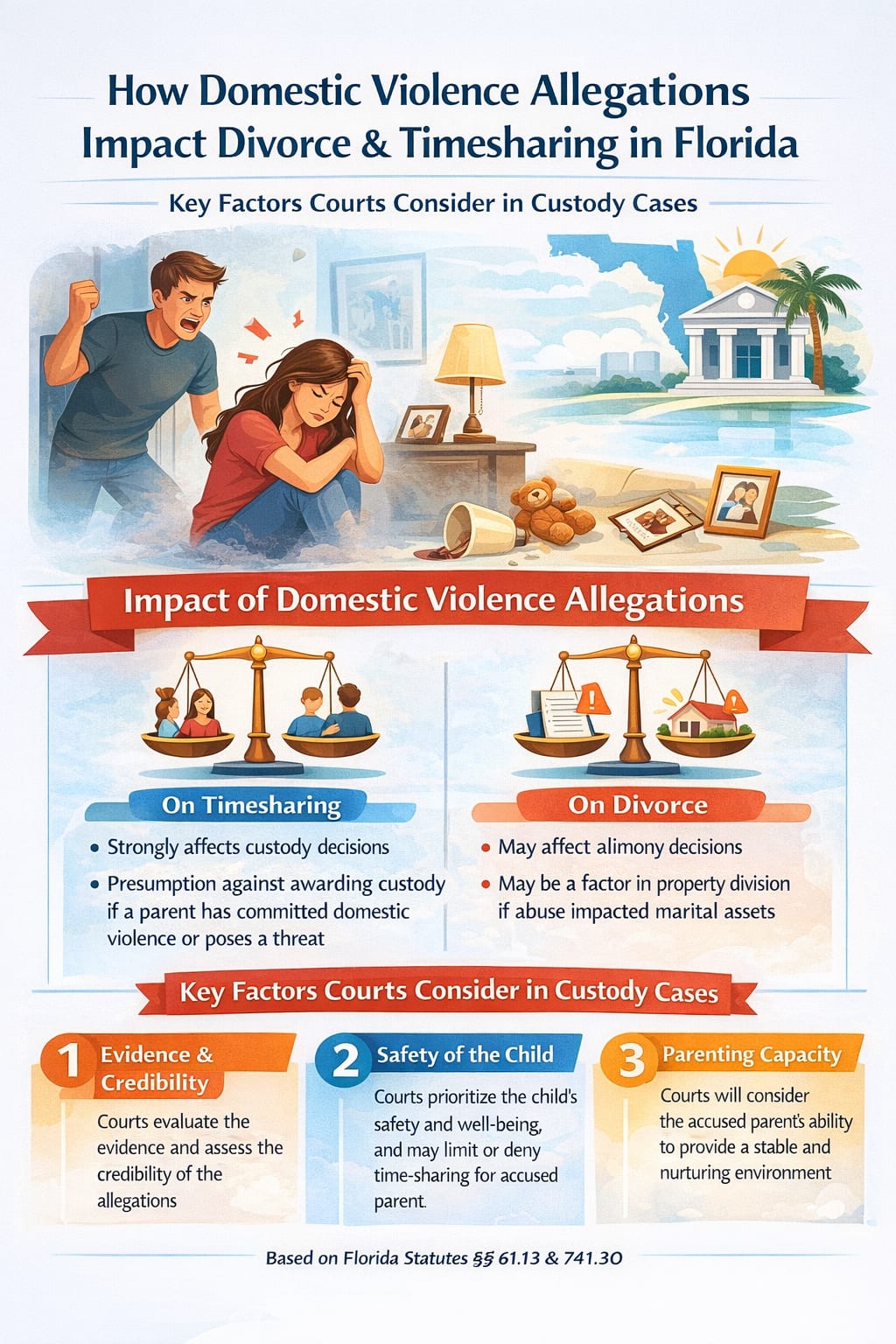
The Serious Role Domestic Violence Plays in Family Court
Domestic violence allegations can significantly affect the outcome of a Florida divorce, especially when children are involved. Family courts treat any claim of violence—whether physical, emotional, or psychological—with the highest level of scrutiny. Allegations may influence timesharing, parental responsibility, access to the marital home, and even the overall progression of the case. Understanding how courts evaluate these claims is essential for anyone navigating a divorce in these circumstances.
How Allegations Affect Parental Responsibility
Florida courts prioritize the safety and emotional well-being of children when allocating parental responsibility. While shared parental responsibility is the legal presumption in most cases, evidence of domestic violence may lead a judge to award sole parental responsibility to the non-offending parent. This means that one parent may be granted exclusive authority over major decisions including education, discipline, medical care, and extracurricular activities.
When Judges Consider Sole Responsibility
A court may restrict or eliminate a parent’s decision-making rights if:
A domestic violence injunction has been issued
There is documented abuse, stalking, or harassment
Law enforcement or medical records reflect incidents of violence
The child witnessed or was exposed to harmful behavior
The court determines that communication between parents would jeopardize safety
The more credible the evidence, the more likely the court is to limit the offending parent’s authority over the child.
Timesharing Restrictions in Domestic Violence Cases
Timesharing is often one of the most impacted areas when domestic violence is alleged. Florida courts will not allow a child to be placed in a situation that endangers their safety or emotional health. Even allegations—before proof is fully established—may result in temporary limitations while the court investigates.
Common Timesharing Outcomes
Depending on the circumstances, the court may order:
Supervised timesharing
Therapeutic visitation with a licensed professional
Suspended timesharing until conditions are met
Neutral exchange locations to reduce conflict
No timesharing in extreme cases involving severe danger
Judges evaluate whether continued contact is appropriate based on the child’s safety and any history of violence.
Protective Injunctions and Their Impact
If a spouse files for a domestic violence injunction, also known as a restraining order, the injunction may affect:
Living arrangements
Temporary timesharing
Access to the marital home
Contact with the child
Firearm possession
Communication between spouses
Temporary injunctions can be granted quickly, often before a divorce case is fully developed, and they can shape the early dynamics of the proceedings.
Court Hearings and Evidence
During injunction hearings, the court reviews testimony, documents, police reports, witness statements, and digital evidence such as messages or recordings. If the injunction is upheld, it may strongly influence how the divorce court views the overall family situation.
How Domestic Violence Influences Property Decisions
While domestic violence does not automatically affect equitable distribution or financial awards, it can play a role in certain circumstances. For example, a judge may award exclusive use of the marital home to protect the safety of a spouse or child. In addition, serious misconduct—such as financial abuse or destruction of property—may affect the final distribution if it impacts the marital estate.
Long-Term Considerations for Children
Domestic violence can leave lasting effects on children, even if they were not physically harmed. Florida courts evaluate whether exposure to conflict might influence the child’s emotional development, school performance, or mental health. These considerations guide decisions about long-term timesharing and parental responsibility.
Counseling and Support
The court may encourage or require counseling for the child or for either parent. While these measures are not punitive, they are designed to support healing, improve safety, and promote healthy communication moving forward.
Why Understanding the Process Matters
Domestic violence allegations can dramatically change the trajectory of a divorce case. Courts must balance the safety of the child and the alleging spouse with fairness to the accused party. Knowing how Florida courts evaluate these cases helps individuals prepare for hearings, gather documentation, and understand potential outcomes. Whether allegations are substantiated or not, the legal process aims to place the child’s best interests and safety at the center of all decisions.
About the Creator
Keep reading
More stories from Grant Gisondo and writers in Families and other communities.
Understanding Florida’s Parenting Plan Requirements
What a Parenting Plan Is and Why It Matters A parenting plan is a legally required document in every Florida divorce or paternity case involving minor children. Its purpose is to outline how parents will share time, responsibilities, and decision-making after separation. Rather than relying on informal arrangements, Florida law requires a detailed plan that reduces conflict and provides clarity for both parents and children. Judges cannot finalize a case involving children until a complete parenting plan is approved.
By Grant Gisondoabout 2 hours ago in Families
Wise~Guys
— Look Behind what's in Front of You ~ Make Good Choices — Hey, So how you Doin'..! Made~Men — Mobster Movies romanticise a distinctive, elegant appearance, impeccable attire style, along with the 'Families' expressive lingo. Making their 'Bones' gave them Panache — with vintage fedoras, tailored pin-striped suits, mirror-polished wing-tip shoes adorned with tassels; with their 'Gun Moll' gorgeous dates on their arms.
By Jay Kantor27 days ago in Families
How Parents Can Find a Child’s Location on Facebook Messenger
In today’s digital world, Facebook Messenger has become one of the most popular ways for children and teenagers to communicate with friends. While messaging apps help kids stay connected, they also raise safety concerns for parents—especially when it comes to knowing where their child is and who they are talking to. Understanding how location works on Facebook Messenger can help parents protect their children while still respecting their privacy.
By Ahmad Hassan6 days ago in Families



Comments
There are no comments for this story
Be the first to respond and start the conversation.