
How a Used Car Dealer Taught Daughter About Entrepreneurship
The Missing Essay

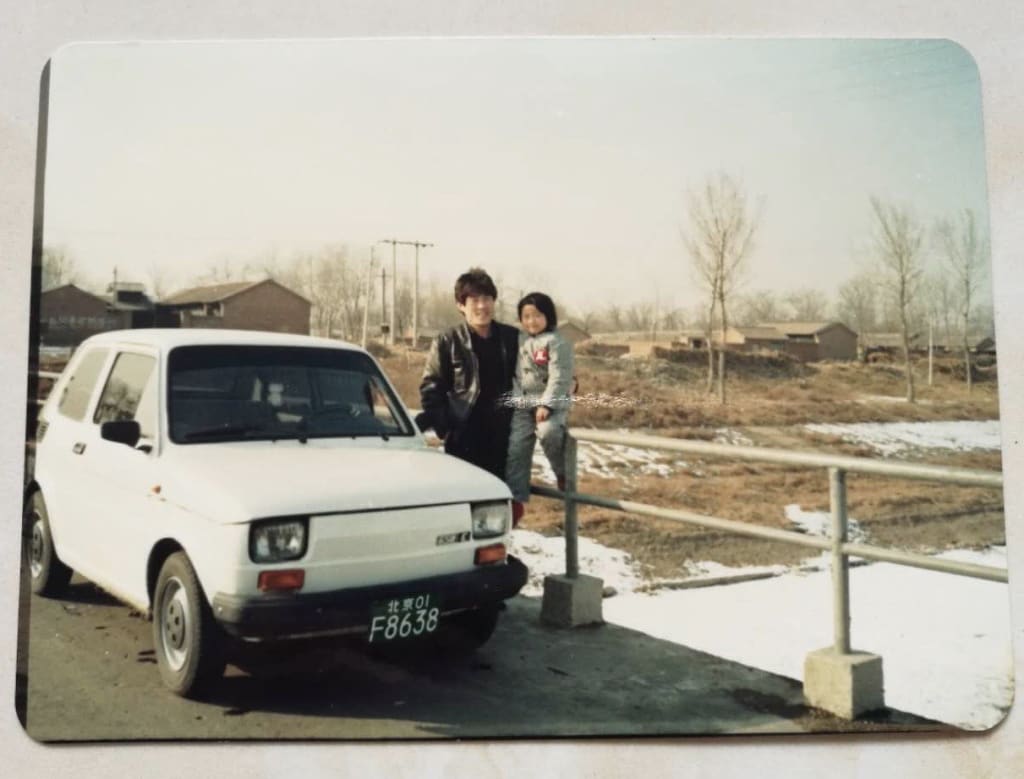
When I was in elementary school, the very first topic that my teacher asked us to write about was our parents. It was easy for me to write about my mother because of her selfless care for the whole family, but not so easy about my father. He was a businessman back then. I didn’t respect his career until I started my own business. What I have been through keeps reminding me of what he told me when I was little. I did not get it and hated to listen then. This month is my father’s birth month. To honor him, in this very personal essay, I would like to talk about many precious lessons he taught me.
My Father
My father grew up in China. He did not have a college degree of any sort. After graduating from high school, he got a job at a state-owned construction company, with a very steady income. On the side, my father used the money that my parents saved up and bought motorcycles — something my father always loved. He quickly found that he could make money in the used motorcycle business by buying low and selling high. Soon he made more money than his salaried job and decided to quit his day job. That was in 1985.
Before 1987, nobody owned private cars in China, except for businesses and the government. My father waited in line in Tianjin, China’s main car import terminal, for several days, until he bought a brand new car — Fiat 126p. My family then became one of the first families that owned a private car. Before then, Chinese families only owned bicycles.
Whenever my father came home and drove by neighbors, they came out and checked out my father's car — It was that rare to own a car back then. Since then, my father got into the used car business. Neighbors continued to come out and check out my father’s car because he frequently changed cars, his cars got better and better, and he parked more and more cars in front of our house.
Although he seemed to make a lot more money than my peers’ parents, I did not think highly of my father’s occupation. It was simply because no one did what my father did for a living. Most of the other parents had steady jobs at state-owned companies. Some of them had better jobs in management because they had college degrees. My father was a businessman. For the kind of work he was doing — trading cars, in China, they had names that made it sound less sophisticated and more greedy. I also thought, “what hard about buying and selling? Studying hard, and getting more degrees (Bachelor, Masters, and even Ph.D.) is harder”. I always avoided talking about my father’s job with my school friends.
I did not ask about my father’s business, because I was not interested at all. However, I overheard a lot when my parents were talking about business. In China, businesses are done on dinner tables. Sometimes when my father came home late after a business dinner, he always asked me to sit with him and just talked about business while he was finishing a big bowl of hand-made noodles that my mom made for him. I often fell asleep while he was talking.
My father ran the used car business for good years. The used car business was in a sweet spot in the 90s. China imposed a high tariff on imported cars to encourage domestic car production. Imported cars cost a lot, but the growing middle class loved them. They were willing to pay high prices for imported cars. In the 2000s, when domestic production caught up, cars became commodities. Used car businesses were not able to make good margins. After 2008, real estate in Beijing started booming. My father quit the used car business and started a real estate business.
My father is still living in China and is now retired.
My Father’s 5 Lessons
Understand the Market
This was a hard-earned lesson for my father. He went into several other businesses and failed. He later told me that a big mistake from those failures was he rushed to the market before understanding the market. He always reminds me of taking small steps to learn the market whenever you are exploring new business opportunities.
When I was in elementary school, on Sundays, my father took me to the car market — a huge parking lot with thousands of cars and dealers. He spent a lot of time walking around the market, asking for prices, and listening to negotiations. I thought it was boring — he did not sell or buy, just walk, stop, and listen. Later I understood. He was figuring out many details about the market — what cars were popular, the price ranges, any good deals, buyers, and sellers’ sentiments. At the same time, he was honing his buying and selling skills as well.
Create Leverages
If you have to chase the deal, it is not a good deal
There is another Chinese saying, “If you have to chase the deal, it is not a good deal”.
During many deal negotiations, my father was surprisingly patient.
“Dad, dad, has the buyer called you yet? When will you call him?” I often asked eagerly.
“Let’s just wait. He will call.” My father answered. Then he turned it to a moment of teaching, and added, “you want them to come to you”.
No matter how much he wanted a done deal, when the ball was in other people’s court, he did not rush. When you rush, you just reveal your desire and weakness so lose your leverage. Time is a way to create leverage. Deals come and go. My father believes that, if it is not your deal, it will go away no matter what. When it is yours, you need to hold on to your leverage and optimize the deal.
Know Your Numbers
My parents kept a record of P&L in a notebook after each transaction: the sale price, the buying price, the cost of repair labor, referral bonus (if someone referred a seller), gas, etc. I have always kept this snapshot of my parents doing accounting at night at the back of my mind.
You would think business people should be good money stewards. It is not the case. Nowadays, many entrepreneurs are blessed too early with massive funding, but they do not really know their numbers. Financial problems are masked by hyper-growth.
I was number ignorant. As I was seeing the company bank account started to sink and our contracting accountant never pointed out any issue, the numbers came to my attention. I realized no one should know more about our numbers than the founders. The numbers reflect the health of a business. Focusing on growth is an excuse for not looking at the numbers. What if your business model would never work? What if you would never reduce the hard cost? How would you know if your business is on a healthy trajectory? At Roxy, I started to read every line item of every invoice. You would be surprised by how frequently people make mistakes or be dishonest in payments. Some manufacturing suppliers may have thrown magic numbers in the invoices. Simple math does not add up.
A famous example is WeWork. WeWork had an insanely high valuation, however, its business model had been known to be expensive and the company had little chance of profitability since at least 2015.
On the contrary, a number of startups (such as Buffer, Gumroad) share regularly and openly about their KPIs, their churn, monthly run rate, user numbers, even though they are still small companies.
Price it right
I would rather price it too high that buyers are scared away, than price it too low
There is a Chinese adage about pricing strategy: I would rather price it too high that buyers are scared away, than price it too low. As it sounds funny, it tells about a simple rule of pricing. It also encourages us to have confidence in pricing and implies pricing skills require calibrating. My father always says that.
Whenever my father bought a car, especially a luxury car, and I immediately felt stressed for him — he must have paid a lot of money on it. However, he often explained to me, he already knew how much he could make out of this car when he offered a price to buy this car. Just as the book Rich Dad Poor Dad says, profit is made when you buy, not when you sell.
Profit is made when you buy, not when you sell
— Robert Kiyosaki, Rich Dad Poor Dad
At Roxy, initially, we planned to make money from hardware devices and the software subscription service (SaaS). While working with customers, I noticed customers spent a lot of time installing the devices, and we spent a lot of time helping them troubleshoot. An opportunity emerged — we could offer clients a provisioning service —pre-programming the hotel WiFi to devices. Hotel clients do not need to do anything, but take the devices and put them in the rooms — done! The need was there. Then the question came to how much we should charge for this service. I did some calculations and suggested a service fee with at least a gross margin of 75% to be worthwhile of our time. My cofounder was skeptical and thought the service should be free as a courtesy for big corporate clients. In the end, we decided to give a try on my pricing model. This upsell service later became the most popular service of all, and 100% of clients signed up after hearing about it. Until this date, launching that service has been my best example of product-market fit. Pricing it right is the vehicle to get to product-market fit. You can always give your customers cheap or free products, and it does not mean your customers need them.
Recognize the opportunities
There is gold everywhere. Most people are not trained to see it.
— Robert Kiyosaki, Rich Dad Poor Dad
My father always says opportunities are everywhere. It is up to you to seize it.
When I was in middle school, I begged my father to buy me a computer. He did. After seeing me browsed the internet and stumbled upon an eCommerce website called Eachnet, my father asked me whether I could list his cars on that website. Back then, no one listed cars for sale on the internet. He told me to type a few catchy lines about his cars’ conditions and his cellphone number. Soon after listing, my father started to get calls from people in Zhongguancun (Beijing’s “Silicon Valley”) and wanted to buy those cars straight out. They did not even negotiate, to my father’s surprise. Now it makes sense. The buyers were highly educated people who were not trained to make deals in the school.
This was the first and only business I ever partnered with my father. This has been a great story for my father to tell for many years. My father later rewarded me 1000 RMB (that was a ton of money for a teenager at that time) for helping him sell the cars at high prices. I bought my Kobe basketball shoes with the money.
Resilience
It was a wild ride growing up with my parents. There were times when my father made a great deal of money and we were going to all fancy restaurants. There were also times when my father lost almost everything and he had to start over.
The most catastrophic one was in 1987 — someone broke into our home and took all the cash that my father used for his business. Not like now, all the payments are transferred electronically. My father always kept bundles of cash with him for the convenience of transactions. On that very day, my dad left the big bag of cash at home and we went out for a short walk. When we got back, the window was broken, and the money bag was gone. I vaguely remember the police came with dogs but did not catch the burglar. They did not believe my father when he told them he just lost that amount of money, and closed the case.
My father had to start over. It was difficult because his business was very cash-intensive. He always says, no money no opportunities. However, he did bounce back and his business was bigger than before.
Money accumulated because of conscious activity puts a person firmly in charge of their destiny. There is no fear that something might happen which causes them to lose it, because even if they do lose it they know how to make it again.
— Karen McCreadie, George S. Clason’s The Richest Man in Babylon: A 52 brilliant ideas interpretation
I didn’t understand what all those failures did to my father until later. At Roxy, everything was not smooth sailing: hardware issues, manufacturer issues, and customer issues. When shit first happened, I was panic. When shit happened again, I felt a little better because I knew panicking could not help. We needed to strategize. When shit happened again, I was calm because I knew I would learn something out of it. The tolerance for failures is built by hard times. To someone who does not fear failure, risks are exciting, because they open up more opportunities.
The strategy for the discoverers and entrepreneurs is to rely less on top-down planning and focus on maximum tinkering and recognizing opportunities when they present themselves.
— The Black Swan, Nassim Nicholas Taleb
My father has also taught me many other lessons: cultivating long-term business relationships, building trust, knowing your friends and enemies in business, and more. I never ever bought a brand new car but always own a used car, because my father told me, a new car is such a depreciating thing that you lose value right after you pay.
On the day when I quit my corporate job and started pursuing my own venture, I suddenly realized that I just made the same decision as my father when he was young, and I was starting to walk what he walked. I started to understand him and respect him even more because I always have his entrepreneurial spirit in me.
About the Creator
Grace Huang
Co-founder and CTO of Roxy. Ex-Amazon. Entrepreneur. Software Architect. Exotic plant collector. Skateboarding enthusiast.
Keep reading
More stories from Grace Huang and writers in Families and other communities.
Why Joining a Startup May Not Be a Good Idea Financially
You are a software engineer, probably making $500k a year already. Startups, from large to small, are trying to poach you to join them. Before you decide to make a move, I would like to help you understand the financial impact of joining a startup, so you can make an informed decision.
By Grace Huang5 years ago in Geeks
Wise~Guys
— Look Behind what's in Front of You ~ Make Good Choices — Hey, So how you Doin'..! Made~Men — Mobster Movies romanticise a distinctive, elegant appearance, impeccable attire style, along with the 'Families' expressive lingo. Making their 'Bones' gave them Panache — with vintage fedoras, tailored pin-striped suits, mirror-polished wing-tip shoes adorned with tassels; with their 'Gun Moll' gorgeous dates on their arms.
By Jay Kantor18 days ago in Families
Buddha's Inner Peace
In a world that never stops moving, the image of Buddha sitting in perfect stillness beneath the Bodhi tree offers something we desperately need: a reminder that true peace exists not outside ourselves, but within. The story of Buddha's enlightenment isn't just an ancient tale—it's a roadmap to discovering the profound calm that lies dormant in each of us.
By Susmit Bhowmik5 days ago in Families




Comments
There are no comments for this story
Be the first to respond and start the conversation.