

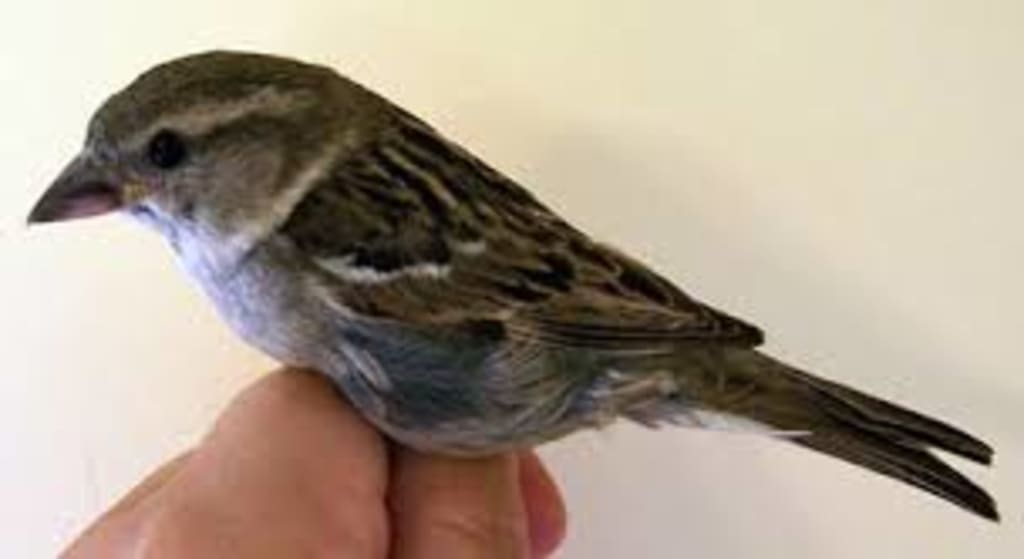
Homer, A Sparrow
She was asleep, warm and safe, dimly aware of the wind howling and the nest moving. The drumming of her mother's heartbeat and the warmth of her body soothed the little one, snuggled in her mother's feathers. She had no feathers of her own yet. One of her brothers squirmed a bit. The storm was far away from her protected world of feathers and nest.
But the howling rose to screaming and the storm came raging down on her tiny world . Her mother sprang upward and was gone. The nest was tossed back and forth until it, too, deserted her into the maelstrom.
She fell.
Landing on soft leaves, she cried out her distress. But she couldn't make more than the tiniest of squeaks. It was dark and cold and wet. Her brothers cried for a while, but then fell quiet. She lay squeaking in the night as her body became colder. The storm eased and the sun rose, but she was still so cold and sleepy.
Noises above roused her. She squeaked for mother. A huge figure loomed over her. She was picked up. Slowly warmth surrounded her again. It didn't smell like mother, but her body responded to the heat and her squeaks turned into louder squawks. She was hungry.
The big one put her in a small, warm place. Raising her open beak, she felt something slide into it. Soft, warm food filled her ravenous mouth. She swallowed and demanded more. And more. And more. Until her belly swelled up so that she looked like a pregnant peanut. Satiated, she fell over sideways, already asleep. She woke later and cried for mother and the huge one came and gave her food. That was the pattern for days; sleep, eat, sleep, eat, over and over, sleep, eat.
Once the tiny bird spent more time awake, a huge one sometimes carried her around in a shirt pocket. She liked that. She was warm and cuddled and the motion made her feel as if she were in a nest again. The smell of the huge ones became familiar, displacing that of her feathered mother. She had bonded.
At times she would lift her head up enough to look out of the pocket. What she saw was confusing. There was so much space. At first it frightened her, but soon she became fascinated by the world around her. She rode with her head up high, causing laughter and smiles wherever she went.
Everyday Mom and Dad would take her to a another place with different smells. Other huge ones came in and talked to her. She was getting feathers now and the big ones liked to pet her gently. She liked that, too. She needed food every hour or two and the big ones obligingly fed her and she grew.
They called her Homer and she understood that she was Homer. It was several months before her Mom and Dad realized that she was a female house sparrow. Her feathers grew in and she became larger. She was moving around more and wanted out of her cage.
Mom started to teach her to fly at the other place, the office, where there were long straight hallways. She opened the door to the cage and stood a little distance away with her hands cupped. Then she called "Homer". Homer balanced on the cage door and squawked. She wanted to go to Mom, but there was nothing but space between them. She flailed her wings in distress and felt herself elevate. Startled, she stopped fluttering and came back down on the cage door. Flapping more raised her up again. She beat her wings harder and she was in the air. Panicking, she flapped as hard as she could and fell safely into Mom's hands.
Mom told her she was a good bird and put her back on the cage door to practice again. The next time was a little easier. Mom started backing away so that Homer had to fly farther each time. It became easier and easier. Tiring of the short flight, she flew past Mom and out the door into the hall. She flew fast with the misplaced confidence of the very young. The right turn in the hall came up fast. Dodging, she flew into the nearest room and landed on a desk, panting, startling a big person who was sitting there. Mom came in and picked her up and carried her back to her cage, talking softly to reassure her.
This became the pattern for her life. Almost every day her parents would take her to the office in her cage, where she would stay in her cage unless Mom and Dad were alone. It was only then that she had the freedom to zoom through the rooms and halls.
She did get out of her cage once during office hours and had a grand time, gliding through the halls, darting in and out of rooms, swooping through the waiting room a few inches above alarmed heads. Mom came and caught her and put her back in her cage.
Sometimes at the office, Homer was placed on Mom's shoulder and taken to see a person, usually a small person, who was making a lot of noise. Somehow Homer knew that she was supposed to help Mom with the small person. The noise would invariably stop shortly after Homer came in the room. The small one's eyes would open wide and a smile would appear. Homer had learned the difference between human happy faces and angry faces early on. Mom would place her finger next to Homer's feet and the bird would hop onto it. Then Mom would extend that finger to the finger of the small person and Homer would hop on the little digit. Sometimes Homer would leap to a diminutive shoulder and gently nibble on an ear. This usually brought forth noises, but softer and happier.
At home Homer was allowed the run of the house during the day. She now understood that she was only to poop in her cage. Mom was very determined about that. But at night she was put into the cage and a cloth was pulled over it and she slept in the safe, soft darkness.
Homer, however, didn't want to go in her cage. Being a very smart and devious sort of bird, every night she would hide somewhere in the house. Mom had to search for her. Sometimes the hiding place was easy. She'd land on top of the cupboards and pretend to be a statuette. She was always spotted and caught, despite her display of fierceness. Homer would spread her wings, fluff out her feathers, lower her head, and open her beak, screaming defiance and a fight to the death. Mom would swing her hand up and grab the fierce eagle. Once she had Homer, she'd bring the bird up to her nose, on which Homer would nibble gently. Then it was into the cage with her for the night.
Other times Homer found clever places to secrete herself. She would get in between the towels in the bathroom. Unfortunately she couldn't resist peeking out with one bright eye. Mom would come in, look around, and start out the door. Then she'd stop and look back at the towels and laugh. A laugh was a good sound. Sometimes Homer would hide in the Dad's desk, holding very still, pretending to be just another part of the mess that always covered Dad's desk. Even though she often blended in well, Mom would spot her and she'd end up in the cage.
One night she slipped into an open drawer with soft cloths in it. She had never been in a drawer before, so she explored. At the back, where Mom would never find her was an opening. She crawled through and found herself in the back of the chest of drawers. It was very dark. Then the light disappeared entirely as the drawer was closed. Homer chirped softly, but no one heard. She could hear Mom calling for her. Mom sounded upset. Homer finally went to sleep.
The next day she woke in darkness. She was still behind the drawers. She heard Mom calling for her but made no noise in the dark. Mom would find her.
Later that day Mom came home from the office and, like she did every day, she automatically whistled for Homer. And like every day, Homer whistled back.
Mom yelled “Homer!” and whistled again. Homer whistled. Mom whistled. Homer whistled. Mom whistled and eventually the drawer was opened. Homer could see some light, then more light as all the drawers were opened. But Homer was still in the back, in the dark. Finally Mom pulled one drawer all the way out. Light flooded into the back of the chest of drawers and Homer exploded out into the light. She never hid in an open drawer again.
While there was always bird seed in her cage, Homer had developed a taste for human food. Dad would sneak bits of food to her at times. She especially loved scrambled eggs and chicken. (Mom accused her of cannibalism.) Often she would sit quietly on a kitchen cabinet while the humans were eating dinner. Then when they weren't expecting it, she would swoop down upon the table, slide across to a plate and grab a bite of human food as she skidded past. Her momentum would carry her to the edge of the table and she would take to the air with her prize. ‘Touch and go’ maneuvers.
Besides playing 'hide and go seek', dive bombing humans at dinner, and riding on human shoulders, Homer loved baths. Mom would wash dishes in the sink every day. And every other day Homer would fly over and land on her shoulder. Then she would scamper down the arm and stand on the wrist, flap her wings, and squawk loudly. Mom would laugh and carefully adjust the temperature and force of the water coming from the tap, cup her hands under it, and wait. Homer would jump in the cupped hands and proceed to flap her wings in the water, splashing about and having a good time, while making a mess of the sink and Mom. Eventually she would hop out, run up the arm to the shoulder and shake vigorously all over Mom. Then, if Dad was in the kitchen at the table, she would fly over to him, crawl under his collar, and go to sleep, warm and safe.
Homer had the strongest bond with Mom and followed her around the house. When Mom took a shower, Homer would fly into the bathroom and stand on the shower door squawking. Mom would throw water on her, calling her a voyeur and the bird would squawk louder. But she wouldn't leave until the door was opened and Mom got out.
Sometimes (not very often) Mom would be able to take a nap. She'd go in the bedroom and crawl into bed and close her eyes. In a short time Homer would fly in and land on her, then walk up to her head and chew on Mom's hair. This caused Mom's eyes to open and an angry face to appear. Homer would be picked up and taken to the door and tossed into the air on the other side. By the time Homer could negotiate the hallway and get back to the door, it would be closed.
This worked exactly once.
The next time Mom took a nap, she closed the bedroom door. Homer pondered the situation for a time and then landed on the floor outside the door. There was a small gap between the bottom of the door and the floor. Homer scooted under the door and flew over to Mom. Very quietly she landed on the pillow next to Mom's head, tucked her feet underneath her, and went to sleep. She was there when Mom woke up, but Mom had a happy face and laughed. Homer stretched and yawned and rode Mom's shoulder when she left the room.
Homer was riding Dad's shoulder one morning when Mom came home from the store. She parked and Dad went outside to help her bring the groceries in. Mom looked at him and saw Homer. She pointed at the bird and started to speak. Meanwhile Homer was looking around at this sudden increase in the size of her world. No walls, no ceiling, no cage.
Before Mom could do more than sputter, Homer launched into the free air of a spring morning and began making lazy spirals up and up. She could hear Mom and Dad calling her from below, but this was too exciting, too new. She couldn't stop. She flew and flew. Mom was running on the ground, chasing after her, calling her name, but Homer was enthralled by freedom. She flew on and left Mom behind.
Mom went walking around the neighborhood, calling for Homer. She saw sparrows, but none seemed to be Homer. She returned home with her feet dragging and her eyes full of tears.
All that afternoon (it was a Sunday so she didn't have to go to the office. She'd already made rounds at the hospital,) Mom worked in the backyard, hoping to see a little bird fly home. She weeded and watered the roses and did some more weeding.
Finally as the sun was setting, she gathered her tools together and started to walk to the house. As she did, she saw a small brown bird fly under the porch cover. Then it flew into a pomegranate tree next to her and regarded her with a cheeky expression and a twinkle in its eye.
It was a female sparrow. Mom reached out and poked the bird's belly with her finger. Homer nibbled on her finger and Mom began to cry. Homer hopped on her shoulder and they went inside and made Dad happy, too.
“There's a special Providence in the fall of a sparrow.” Hamlet; Act V; Scene II
Sparrows live two to three years. And Homer was a sparrow besides being a good friend to Mom and Dad. She couldn't outfly her genes. She was more than three years old when Mom noticed that her flying was a bit wobbly and that sometimes she ran into walls when making turns. Some days, when Mom opened her cage, she'd just sit on her perch and drowse most of the day. She stopped hiding at night. Mom would find her asleep on the couch or on the TV and gently carry her to her cage.
Then one evening Homer was sitting on top of a cabinet. Mom was in her chair, reading. Homer launched into the air and almost made it to Mom. But not quite. She fell to the floor and lay panting, fluttering her wings slightly. Mom and Dad got to her in a second and gently picked her up.
They carried her to the couch and sat close together, each saying good-bye. Homer died in their hands and they cried. For a long time.
Hamlet was right.
About the Creator
Keep reading
More stories from Rhema Sayers and writers in Families and other communities.
Emily
Emily My Dad had pretty much stayed drunk constantly since Mom left a year ago. He was an okay drunk - he was never mean or abusive. Mostly he'd sit at the table, staring at nothing, a bottle at his elbow. Sometimes he'd cry, but not too often. Sometimes he'd paint - for hours, even days, until he fell over from exhaustion and I'd get him to bed. So when Keeson dragged me home by my ear, I really didn't think I'd get in much trouble. But when we got there, Dad was not only upset, he was sober. And he was packing. I sighed, knowing what was coming.
By Rhema Sayers4 years ago in Families
Wise~Guys
— Look Behind what's in Front of You ~ Make Good Choices — Hey, So how you Doin'..! Made~Men — Mobster Movies romanticise a distinctive, elegant appearance, impeccable attire style, along with the 'Families' expressive lingo. Making their 'Bones' gave them Panache — with vintage fedoras, tailored pin-striped suits, mirror-polished wing-tip shoes adorned with tassels; with their 'Gun Moll' gorgeous dates on their arms.
By Jay Kantor22 days ago in Families




Comments
There are no comments for this story
Be the first to respond and start the conversation.