
Growing up with Fiskars
My family always used Fiskars scissors


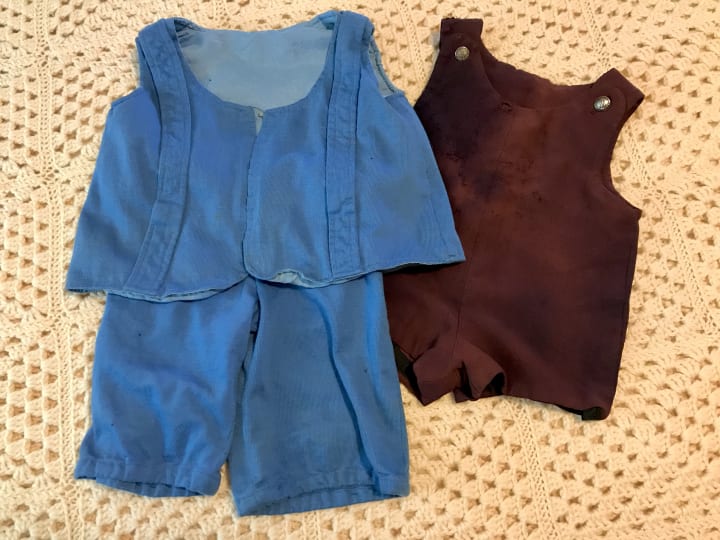
“I would like a sewing machine, so I can sew Travis some little rompers.” My mom, Linda, knew my dad, Paul, would agree without any protest. He probably already suspected that she needed a sewing machine.
It was the summer of 1969 and they were in the little single wide trailer they rented. I was seven months old. They had moved to Fort Walton, Florida when my dad was stationed near there at Eglin Air Force Base after he had served in Vietnam.
When she was a child, my mom had learned to sew from her mother, who I called Mama Jean, and her father’s sister, Aunt Gladys.
When my mom needed a wedding dress, Aunt Gladys pinned big rectangles of newsprint onto my mom to get her measurements and then hand drew the pattern on the paper before sewing the dress herself. It was beautiful and exactly what my mom wanted.
Mama had good teachers.
The big shopping mall in Fort Walton was new. One of the anchors was a Sears Roebuck department store. That’s where everyone bought pretty much everything that wasn’t food.
They had to wait until the end of the month when Paul got paid. Then they went to Sears where they found a new “portable” sewing machine. It was portable in the sense that it was not built to be a free-standing piece of heavy iron furniture like old-fashioned sewing machines. They made a down payment on Linda’s new Singer and charged the remainder.
It had a fashionable, mid-century, modern vibe with square sides and rounded corners. It was painted in that 1960s robin’s egg blue that you associate with consumer products from the 60s. Blue faux leather covered a compact trapezoidal case. The base of the machine had clasps that kept the case secured over it. There was a convenient handle on top for carrying it anywhere you wanted to sew.
Practically speaking, the handle was for decorative purposes only. They needed a flatbed truck and a come-along to move it. Refrigerators weighed less than that sewing machine.
When she had enough money, Mama went back to Sears to buy fabric, buttons, pins, needles and thread. Not scissors. She had a pair of scissors.
Not long after he and Linda got married, Paul was stationed at Lowry Air Force Base in Colorado. They lived in a little house in Denver on the corner of Logan and First that had been split into two apartments. The house is still there.
To pass long days alone in a new, unfamiliar town, Linda decided to teach herself how to knit. They were extremely poor. Paul didn’t make much as a lowly airman in the Air Force, and they had to wait over a month for his first paycheck. To get by, they had borrowed five-hundred dollars from Paul’s parents.
They only had one car: the base model 1967 Camaro my mother bought in the fall of 1966 after she saved money working in a textile mill after high school. It was the first Camaro sold in her hometown. Of course, she had no way of knowing how popular they would eventually be, but that’s a whole other story!
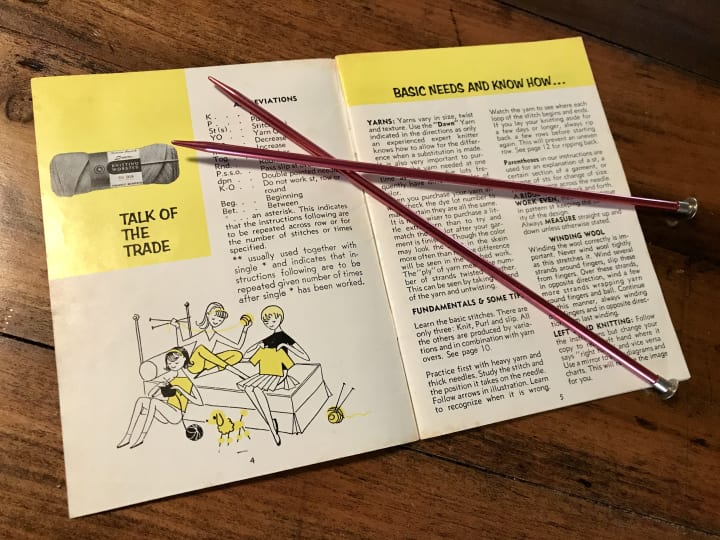
Since Daddy drove the Camaro to work, Mama had to walk anywhere she went in Denver during the day. She decided to walk the two blocks down to the Five & Dime to buy some knitting supplies. At the store, she found a twenty-five cent pamphlet with detailed, accurate instructions that she used to learn how to knit. She also bought a pair of knitting needles and a skein of yarn.
Mama Jean cut hair and owned her own beauty shop. Before Linda and Paul moved to Colorado, she had given Linda some used hair-cutting shears to use for everyday scissors, which was a good thing because her craft budget was depleted. The old ones Mama Jean had given her were not Fiskars.
Two years later, Mama still had those old shears Mama Jean had given her. After she bought all the supplies she needed for sewing my rompers, she went to work cutting the fabric she bought at Sears. It was immediately obvious there was a problem. The old worn out hair-cutting shears were too dull. You need sharp scissors to cut fabric accurately.
Linda had a decision to make. She knew the value of sharp scissors. She went back to Sears on a mission to buy a pair of good ones for her sewing. At the store, she considered her options. The Fiskars looked well-made and they were pretty expensive, but not the most expensive ones. This was a big purchase and a big decision. She finally decided to buy the Fiskars at Sears that day and never regretted it.
Ten years passed.
Like most kids I was crafty. I would dream up some project that inevitably involved cutting paper with scissors. Most people know, though, that the best way to dull a good pair of scissors is to cut paper. I’m sure that at some point I dulled a new pair of my mom’s good Fiskars sewing scissors by hacking away at cardboard all day.
I don’t actually remember a particular occasion when that happened because my mom didn’t get mad at me about it. She just went to Hancock Fabric—the go-to store for fabric and sewing supplies at that time—and bought some new Fiskars. She wanted them to stay sharp, so she hid them in the bottom of her sewing kit.

Over time, as new ones lost some of their edge, she would transfer them to her knitting where a fresh, sharp blade was not as critical. When I asked where the scissors were so I could cut paper for some project, she would give me her oldest scissors in her knitting supplies. Of course I didn’t know the difference.
Then when they were getting too dull for cutting paper—something people often discover around Christmas time—she would move the old craft scissors to the kitchen.
I can’t count the number of times I’ve seen my mom cut up big cuts of cubed steak into little biscuit-sized rounds with a pair of Fiskars scissors before breading and frying them up for Sunday dinner. That works much better for her than a knife.
My dad’s hobby was woodworking. He also studied the tool making technology of Native American peoples. He was a primitive archer. He collected arrowheads that he found in fields or laying on the side of old dirt roads. He taught himself to knap his own arrowheads from the flint rock that is plentiful in our area of the country. Daddy also harvested native river cane and dried it in bundles for making arrow shafts.
What he was really known for, though, was the beautiful long bows he designed and carved. He gave away his bows to friends and family and anyone interested in having one. He had a few of his own that he used for hunting deer.
In our family, old Fiskars go to live out their retirement years in my dad’s shop.
Part of his process for smoothing and putting a final finish on a bow was to shave the wood with the blades of scissors. He knew he could requisition scissors from the kitchen and use them for woodworking. He would take a pair of old Fiskars scissors and break them apart. Then he would make final, careful, adjustments to the shape of a new long bow with a single blade from a pair of scissors.
After I grew up, moved from home, went to college and worked for employers, I always bought Fiskars or requested them when we needed some at work. It was the only brand that I recognized and the only one I wanted to buy.
About twenty years ago, I bought some casual, open collar, button up shirts. The kind that look best untucked. I bought two of the same style of shirt on the same day in different colors. I am fond of that style, and it’s pretty much all I’ve worn for years. But I really liked those two particular shirts I had bought together on the same day better than any others I found afterwards.
Over time, my favorite shirts were wearing out. The folds on all the hems split into two flaps and they were thread bare. I went to my mom with a request.
“Mama, will you teach me to sew? I want to take apart one of my favorite shirts and use it to create a pattern. Then I’ll sew new shirts to replace them.”
I didn’t want to impose on her to do it. I wanted to learn to do it myself.
She was all for it. “OK. I’ve been wanting to replace the covers on the pillows on the porch furniture. Why don’t you help me with that project? That’ll be a good way to learn.”
We spent about a month making back porch furniture pillow covers. I was intent on learning all the details I would need to sew shirts. When we finished the pillow cases, I felt certain that I knew what I needed to know to make my own shirts.
I was excited about getting started on my project. One of my two favorite old shirts was barely hanging together, so I chose it and got to work with a seam ripper taking it apart. As each new panel was liberated, I labeled it with a Sharpie so I would know what it was. I got every single stitch out of the shirt and then ironed all the pieces flat.

Next, I pinned the panels to pieces of heavy gift wrapping paper we had left over from Christmas. Adding a three-eighths inch additional margin to the panels from the old shirt, I drew patterns for the new shirt on the paper. Then I cut out the patterns on the paper with older Fiskars.
When we bought fabric, thread and buttons, my mom had also bought a new pair of Fiskars scissors. In addition, she knew that the sequence for sewing the different parts of the shirt together wasn’t intuitive and couldn’t be ascertained from the old shirt, so she also bought a pattern for making shirts that had all the instructions I would need. I spent hours carefully reading until I understood what I needed to do. Then I modified the instructions a little to make them match the shirt I wanted. I spent a long time planning my sewing.
I may have been delaying on purpose.
It’s intimidating to make that first cut through the fabric; to commit to cutting the pieces. I didn’t want to make errors or get the fabric inside out. With some panels, it’s best to cut two at the same time so that they are exactly the same size and shape. When the time finally came to start cutting, the new Fiskars cut the fabric—even the doubled up fabric—easily. If there were any errors made when I was cutting, I couldn’t blame it on my tools.
Then came basting the panels together, followed by actual sewing on Mama’s (much newer and lighter weight than the first one) Singer sewing machine, pressing the seams open with an iron, all of it.
I can make a perfect button hole, in case you’re wondering. The buttons even line up with the holes. That doesn’t happen by accident.
It was a good experience. I learned a lot. I didn’t quite duplicate my favorite shirt. That three-eights margin that I added to the pattern wasn’t generous enough for my inexperienced sewing, so the finished shirt was too small to wear comfortably. But that’s OK. Maybe I’ll sew another shirt one day.
I’ve completed some other sewing projects. I traded my old car for a 2019 VW Jetta S, the base model, so that I could upgrade to a stick shift! I have driven manual transmission cars about half my life and was ready for another one. However, Jettas with manual transmission were only available in the base model or the top of the line sport GLI, which I couldn’t afford.
The problem with the base model is that it didn’t come with an armrest in the back seat.
No problem.
I went to a junk yard, found an appropriately sized armrest and had the guys there remove it from the car. The main thing I wanted was the plastic cup holders. The original armrest was cantilevered from the seat back and hovered above the middle of the seat. I had to build up a base for the original armrest to sit on so that it would be the right height above the seat. I used stacked and shaped cardboard, and then upholstered it myself with my newly acquired sewing skills.
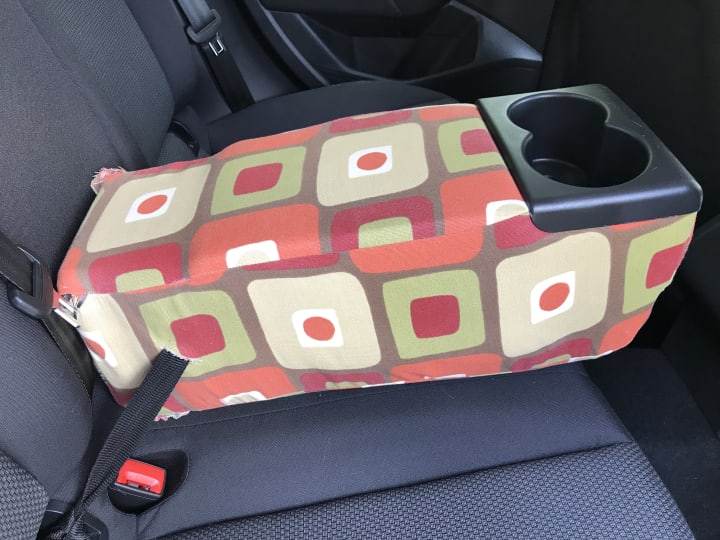
A salvaged armrest from a junked Acura serves as the starting point for this sewing project completed with Fiskars scissors. I really had to have an armrest in the backseat of my neq Jetta. However, it was the lowest trim level and didn’t come with one. I found leftover fabric we had from an outdoor tablecloth project. I also wanted real cup holders.
Daddy passed away in 2016, but his work bench still sits in front of a window down at the shop. Scissor blades and other tools are arranged around the window pretty much where he left them the last time he sat there making a bow.
People will permanently borrow your Fiskars scissors, so I learned to use a Sharpie to write my name on them. Years ago, my mom started writing the year on each new pair of Fiskars she bought, so she would know which ones are the newest ones. The new ones are still for sewing; still hidden in the bottom of the sewing kit.
Occasionally I have looked at another brand when I’m buying scissors at a store. But if they are not Fiskars, what are they? They don’t look right. I suspect that the blades will gap apart the first time you try to cut anything with them. I know that the Fiskars scissors have a satisfying bell-like chime when you cut with them. It’s not really a grating or snipping sound. I think that’s what other scissors sound like when I’ve had to use some off brand.
The ones I always use for everything from cutting gift wrap—I like wrapping gifts not putting them in bags—to a major sewing project are Fiskars. That’s partly because I grew up with them and partly because I trust my mom’s judgement about these kinds of things.
But it’s not my personality to be blindly loyal.
If economic factors in society change, or some other pressure comes to bear, a company may change its priorities and make changes to its products. I may value those changes, or I may not. As a result I could change which product I buy. This is true of everyone. All of us economize based on our priorities, wishes, wants, opinions and values; we get the most bang for our buck based on our opinion of what constitutes “bang.”
Fiskars scissors are not the most expensive ones but, in my experience, they have always been the best quality for the money. My parents would agree that this has remained true for at least the last half century.
Good job, Fiskars.
About the Creator
Travis Williams
From central Georgia at a desk in front of a large window overlooking my back yard, I write Southern, science and historical fiction with Christian themes. Booksbytravis.com
Keep reading
More stories from Travis Williams and writers in Families and other communities.
Christmas Abroad: Celebrating the Holidays Without Family
I moved to South Korea in 2017. I was twenty-two years old and excited to start my career as an English Second Language Teacher. With a Bachelor's degree and six hundred dollars in my bank account, I set off for Busan.
By Kera Hollow29 days ago in Families
Where Love Lives: A Slow Sunday Inside Our Family Home
There’s a quiet magic in ordinary mornings—the kind that doesn’t shout, but lingers in the corners of your heart long after the day has passed. For our family, Sunday mornings are like that: a gentle rhythm of laughter, familiar routines, and soft celebrations of simply being together. If you asked someone passing by our home at 9 a.m., they might mistake us for a movie scene—the scent of fresh coffee, the hum of soft music, and the comforting clatter of plates and cups filling the kitchen. But there’s nothing cinematic about what we do. It’s ordinary. And it’s ours.
By Divexa Exchange4 days ago in Families


Comments
There are no comments for this story
Be the first to respond and start the conversation.