
From a Father’s Hands to a Son’s Chains
When a father's sacrifices build a future, but injustice steals it away.
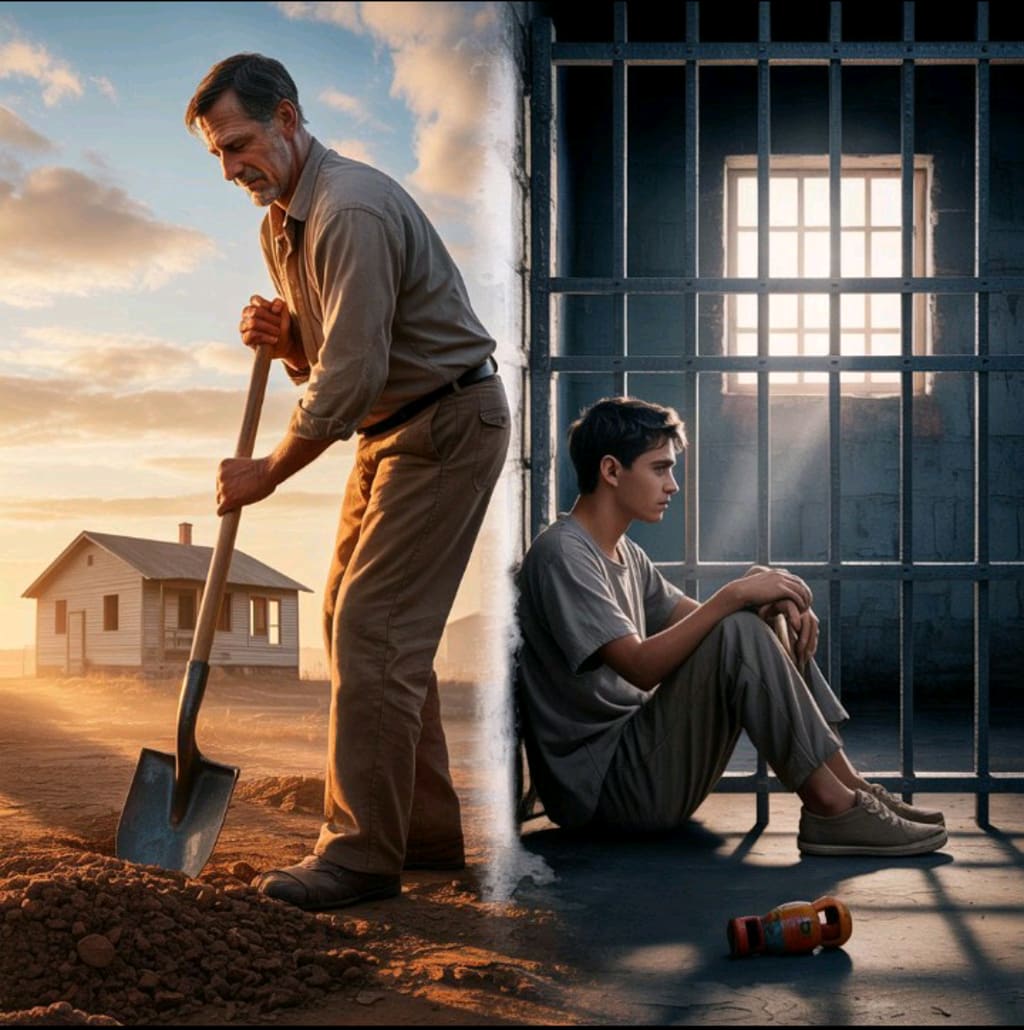
In the dusty streets of a small village in Punjab, a man named Kareem labored from sunrise to sunset. His hands, thick with calluses, spoke of decades of bricklaying, harvesting, and doing whatever work came his way. He was not a wealthy man, but what he lacked in money, he made up for in dignity and love for his only son, Adeel.
Kareem had one dream — that his son would never have to know the pain of poverty. Every coin he earned, every torn note he saved, was for Adeel’s future. He envisioned a life for Adeel where the boy would wear clean clothes, speak fluent English, and sit in air-conditioned offices, far from the heat and hardship that had defined Kareem’s own life.
“A man’s hands should build his son’s future,” Kareem would often say, his cracked palms resting heavily on Adeel’s shoulder.
Adeel was a bright child. Curious, intelligent, and full of potential. He excelled in school and spoke of becoming an engineer. Kareem beamed with pride whenever the neighbors asked about his boy. “My Adeel will one day fly far,” he would say, eyes gleaming.
But time is not always kind to the dreams of the poor.
When Adeel entered his teenage years, things began to change. Influences from the city seeped into the village. New friendships brought shiny phones, fast bikes, and the illusion of easy money. Kareem noticed the shift — the late nights, the silence, the sudden expenses. But he trusted his son, perhaps too much.
“I work so you don’t have to suffer,” he reminded Adeel, handing over his savings when the boy said he needed tuition money.
Unbeknownst to Kareem, Adeel had begun to drift into darker paths. It started with small errands for a local gangster — delivering packages, running messages. The money was fast, the praise intoxicating. And soon, Adeel was no longer running errands. He was making deals.
Kareem remained blind, until one fateful evening.
It was just after sunset when the police came. They barged into the humble house, guns raised, shouting orders. Kareem stood frozen as they handcuffed Adeel, who barely resisted. Cocaine, illegal weapons, gang affiliation — the words fell like stones from the officer’s mouth.
As the jeep drove away with Adeel in the back, Kareem fell to his knees, his hands trembling. The same hands that had lifted Adeel as a baby, that had built homes for others, now covered his face in shame.
Days passed. Then weeks. The village whispered. Kareem stopped going to the market. He sat on the old charpai in his courtyard, staring at his hands. He wondered what had gone wrong.
“I built with these hands,” he whispered. “Why did they lead my son to chains?”
Adeel was sentenced to seven years in prison. Kareem visited him only once. In that cold, steel-furnished room, father and son sat silently, separated by a scratched glass pane.
“I failed you, Abba,” Adeel said finally, tears streaming down his face.
“No,” Kareem said softly, placing his hand on the glass. “You failed yourself. But you are still my son.”
After that day, Kareem began writing letters to Adeel. Every week. Pages filled with stories from the village, advice, and sometimes just silence in written form. He told Adeel about the trees blooming again, about a neighbor’s wedding, about how he still cooked Adeel’s favorite lentils on Fridays.
And Adeel, behind bars, began to change. He read books, earned a diploma in electrical repair, and wrote back with remorse and hope.
Seven years later, when Adeel walked out of prison, a little thinner, a little older, Kareem was there, holding a new kurta and warm food.
“You came to collect your son’s chains?” Adeel asked, half-smiling.
“No,” Kareem said, eyes moist. “I came to give him my hands again — to help him rebuild.”
From that day forward, father and son started a small electrical repair shop. It wasn’t much, but it was honest work. Adeel labored alongside his father, learning not just trade but patience, responsibility, and redemption.
Kareem passed away a few years later, peacefully in his sleep. His hands, once rough and worn, were finally at rest.
And Adeel, now a father himself, held his own son in those same hands, vowing that the chain would break with him — and that from his hands, no more chains would ever begin.
About the Creator
Keep reading
More stories from Muhammad musab and writers in Families and other communities.
A Mother's Prayer and Her Poor Son: A Tale of Sacrifice, Love, and Struggle"
The morning sun rose gently over the rolling hills of the English countryside, casting golden rays across the dew-kissed meadow. Wildflowers swayed in the breeze, and birds chirped softly in the distance. Amid this calm beauty, a woman knelt on the grass, her hands raised to the sky in silent prayer.
By Muhammad musab7 months ago in Families
Wise~Guys
— Look Behind what's in Front of You ~ Make Good Choices — Hey, So how you Doin'..! Made~Men — Mobster Movies romanticise a distinctive, elegant appearance, impeccable attire style, along with the 'Families' expressive lingo. Making their 'Bones' gave them Panache — with vintage fedoras, tailored pin-striped suits, mirror-polished wing-tip shoes adorned with tassels; with their 'Gun Moll' gorgeous dates on their arms.
By Jay Kantor19 days ago in Families
Blue Room 🛏️
Loneliness has never been about being alone. I have felt it in crowds, in homes full of family, in rooms buzzing with voices. It is not the silence of solitude I know—it is something older, deeper, stitched into my chest. It is a weight in my stomach, a tightness around my heart, a companion that clings when I try to laugh or speak or reach for someone. It has been with me since I was a child, a shadow from the very beginning.
By Saiydaa Hayesa day ago in Families
Miss Persephone's Manual to a Seemingly Ordinary Life
Miss Persephone was found at the dining table, her blue eyes swollen, her tears arriving and retreating like the tides of the ocean. Earlier that day, her family had visited her in the retirement home where she had lived for eight years. It was her eightieth birthday.
By Imola Tóth5 days ago in Fiction




Comments
There are no comments for this story
Be the first to respond and start the conversation.