

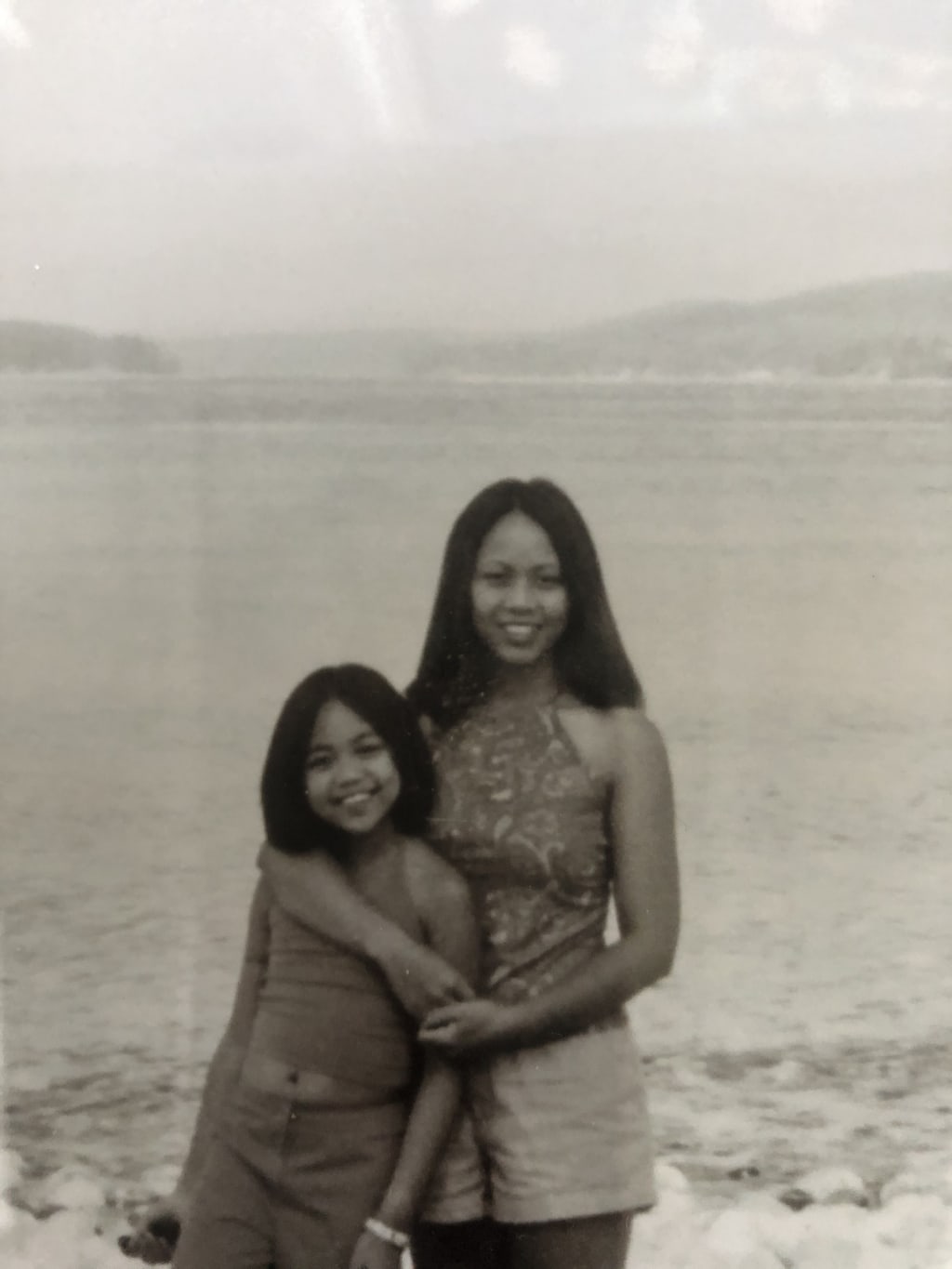
Maybe the word cold doesn’t necessarily provoke the most endearing of sentiments, but it’s the truth of where this story starts.
She birthed her child out of surprise. An unexpected life initially bathed in shame that flowed first from her young age, second from her Catholic immigrant Filipino family, third from the standards that society upheld for a young woman. Be personable. Be non disruptive. Be clean. Be modest. Close your legs. Don’t dare have sex before marriage. What will God think of you? Work hard. Get a stable job. Find a man. Get married. Give him a family. Be a good wife.
She had only ten years prior moved with ten of her fourteen siblings to a new land, Canada, leaving behind a life of very few means. They had moved for better opportunities, attempting to build a brand new life with no foundation set. No jobs, no friends, relatives, or awareness of what life in the western world entailed. Her first memory was stepping off the plane, she distinctly remembered it: cold. It’s funny how the same feeling reemerged now that she was moving into a new uncharted territory: motherhood.
At twenty, before she could even build a life of her own, she made the decision to build an unexpected one inside of her. Her initial conception of motherhood, she thought, was instinctual and effective. Raised in a four bedroom home, housing thirteen people, mothering came in the form of care, which was ever present. Love on the other hand, was limited. Sometimes it’s hard to distinguish between the two, especially when you’re bred into a culture that tells you what to think, and negates how you feel. Care can be exhibited through acts: cooking meals, giving gifts, cleaning up. Love, on the other hand, is emotional expression and transparency; and in this immigrant family, those things were avoided at all costs.
So she mothered this child. She did what she knew, she cooked, gifted, cleaned. Ever still, love seemed void. She didn’t ask how her daughter felt, or expressed how she herself was feeling. She let comments slip through her mouth like, “don’t ever have children”. She was oblivious to the impact it made when she met her child’s straight A’s not with a, “congratulations!” but a, “you could do better next time”. Every comment seemed soaked in passive aggressiveness, in this subconscious angst. Every confrontation met with a righteousness. No objections were allowed.
So the child adapted. She learned to work hard, too hard. She was never satisfied. She learned emotions should be caged. She never asked how her mother felt, or expressed how she herself was feeling. She learned that women can be independent, and in turn she didn’t need anyone. As years passed she kept trying, and pushing. Always seeking to fill the void of love and approval from everyone, unaware that it was really to fill the void of love and approval from her mom.
Things don’t get repaired unless you repair them. The mind and body can fall down a rabbit hole of toxicity if you don’t catch them before they do. That child was me, and I was coming to the age that my mom was when she birthed me. Though not far in age, we had grown far in our relationship. I held this inherent fury towards her, taking everything she said as an attack. I felt that our relationship was one of exchange. I was always observing both her positive and negative efforts before I showed mine, and vice versa. A debt of expression you can say. The thing is eventually you get tired of the tally, of building up a wall strong enough to house both the love and the anger you want to express. It starts to crack, and at that moment you need to start repairing.
For years I wondered why my mom’s blanket of “love” had a thread of anger woven throughout it. I blamed myself. There must be a reason, I must not be good enough, smart enough, working hard enough. I went through mental gymnastics trying to put together the right combination to finally get a winning score. Have you ever thought about the moment you become an “adult”? I like to think that one moment is when you realize that your parents are no longer your superiors. When you start to understand their behaviours, because you’re finally starting to understand your own. You uncover your traumas, your pains, the reasons for your actions, and inherently you start to uncover theirs. I was starting to delve into my reasons for being, to see who I really was, and in the process of doing so, I finally saw my mom:
A young girl, who moved to a new country at such a pivotal age, learning to survive rather than thrive. Raised in a crowded family that wasn’t taught to express their love, they had to stay strong. They were a family that was riddled with silenced intergenerational trauma extending from colonialism and poverty.
She learned to suppress. That expression was weakness.
She wasn’t the brightest student, just getting by, finding school a bit difficult. She then became pregnant at the age of twenty, having to muster up the courage to tell her Catholic family that she was with a child and out of wedlock. She faced judgement and shame from those that are supposed to accept you no matter what. She then lost her parents before she could even show them the life she could build for herself.
She didn’t live up to their standards.
She made the decision to preserve my life, instead of preserving hers. She came to realize that her partner was an addict. Unreliable, and unwilling to step up. She became a single mother to keep me safe.
She learned she didn’t need anybody.
She worked multiple jobs so that she could give me a joyful life, putting aside her dreams so that she could ensure I had the opportunity to reach for mine.
She sacrificed.
Resentment is a powerful weapon, usually invisible to both the one that yields it and the one that receives it. At that moment it became visible to me. She, through giving me life, sacrificed hers. Whether she consciously knew it or not, she felt it, and though not explicitly, she expressed it. It became clear to me that as we become adults, we are all, in many ways, the products of our environments, and finally I was able to see hers. One full of suppression, of expectation, of independence. As these thoughts flooded my mind, they compounded, along with all of these emotions that I had held back for so many years. So I pushed on. Repair.
I sat with my mom as we let tears escape our eyes, flowing down our faces around the mouths through which our emotions escaped. She admitted her sacrifice, expressed her truths. I absorbed them trying to bypass my conditioned behaviours to perceive them as aggressions. I told her mine, and I saw them pierce her heart, as she started to understand how much power her words yielded, and how much pain they caused me. I watched as she awakened to her resentment, both of us letting out even more tears to release the pain. Then, she surprised me by saying, “as much as it was difficult, and I realize I’ve made mistakes, I would never regret having you. I love you.”. We embraced, and what did we feel? Warmth.
I’m not going to lie and say that our relationship is perfect, because it’s not. It’s progress. The difference now is that I finally see her as what she is: human, and sometimes the greatest heroes are just that. She is strong, resilient, beautiful. She has traumas, she works through things, she evolves. She seeks a full life, she is brave. She is learning to love openly and understand her past. She did for me what she could, with the tools that she had at the time. If ever there was a person I’d want to emulate, it’s one that has all of those traits. So the truth of how this story ends? It ends in healing, love, warmth, and a to be continued, as all things should.
About the Creator
Mal
www.maltayag.com
Keep reading
More stories from writers in Families and other communities.
Wise~Guys
— Look Behind what's in Front of You ~ Make Good Choices — Hey, So how you Doin'..! Made~Men — Mobster Movies romanticise a distinctive, elegant appearance, impeccable attire style, along with the 'Families' expressive lingo. Making their 'Bones' gave them Panache — with vintage fedoras, tailored pin-striped suits, mirror-polished wing-tip shoes adorned with tassels; with their 'Gun Moll' gorgeous dates on their arms.
By Jay Kantor22 days ago in Families
Why Are Teachers Leaving Education?
As someone who is new to teaching, I will not sit here and pretend to fully understand everything veteran teachers have endured over the years. I do not yet have decades of experience to draw from. However, I can speak honestly about what I have observed in my year and a half in the classroom, and what I have learned in that short time is both eye opening and concerning. Teaching today is no longer just about teaching content. It has evolved into a profession that often requires educators to act as the judge, the juror, and the executioner, so to speak, all while being expected to maintain patience, professionalism, and compassion at every turn.
By Kimberly Nightengale5 days ago in Families



Comments
There are no comments for this story
Be the first to respond and start the conversation.