

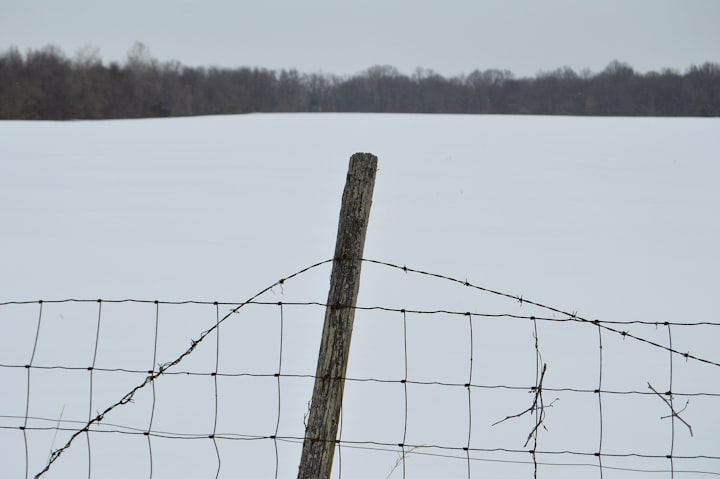
When he left me, I was still calling his name. Deaf or indifferent, what did it matter to me? My brother was halfway up the hill, no sign of turning back to help. I tried again to free my scarf from the barbed wire fence, but the sharp jacks just tore through my gloves. Between the cool snowflakes sticking to my eyelashes and the hot tears welling up, the world was losing focus. With my face and shoulder strung above the ground and the rest of my five-year old body stretching out toward the icy pond, I could feel the hum of low voltage close to my ear. I stopped trying to push through and sank backwards to my boots. I broke free of the plaid noose stretching taut between the wire and my neck. Jesse would be walking in the front door about now; my parents would be asking him where in the world I was. I stood by the frozen pond, staring at the red threads hanging there between the breeze and the twisted wire.
Jesse would have been twice my age, easily double my weight and height at that point. He wasn’t always trying to kill me, at least not actively. True, he did almost let me drown the summer before at our family reunion. I was too afraid to climb the high ladder on that water slide, so he went first, teasing and cajoling me the entire way. He promised to catch me when I reached the lake. He was standing there smiling, arms held out in mock reassurance. I sank like a stone. His excuse, when retelling the story in later years, was that he could not understand what the lifeguard was shouting about. After all, the lake was near the Canadian border and the lifeguard was speaking French. My motionless form on the bottom of the lake just did not convey the proper sense of alarm. He told that story on himself so often, I just had to laugh somehow.
But the barbed wire and the scarf -- I hadn’t thought about that for years. The traumas of childhood don’t obey the tilt of our planet; their tangents are steep and their seasons trace different pathways through the emptiness of space. That pond, in some ways, may never thaw. There is a place in my heart where it has carved an eternal winter.
One year, I must have been nine by then, we had so much snow that it was hard to even open the doors against the drifts. Jesse scooped snow in by the armloads from the roof above our porch and carried it into the bathroom we shared. Before Mom could figure out what we were up to, we were making snowballs in the tub. We had all the makings of an epic snowball fight -- inside the house.
That year, Jesse made huge tunnels and forts in the snow. I liked the tunnels so much better than the forts, of course. I could explore the tunnels and just look up at the sun shining around the rims of snowbanks. But the fights were never even. I would end up with a chunk of ice to the face, then the tears would come and that was the end of that.
Later that winter, when the novelty of the snow settled into a long weariness, we went for a walk along the power lines. Me and Jesse, just walking under one of those skies that defies timing and description. Everything was cloudy without being white, a wintry fog that wrapped trees and powerlines and the uneven hillocks in a gauzy haze. I had to put my feet into Jesse’s tracks to have any chance of making the trip. Without warning, we heard the small crack of a rifle in the woods behind us. I can remember that sound of ammunition whizzing past my head. We stopped in our tracks and took in the silence of the fields. Maybe it was an accident, someone out hunting. Or was someone trying to scare us off, or teach us a lesson?
In the mist, one thing became clear: this world is too filled with hate for me to turn on my brother. He makes tracks for me in the snow. He sets up snowball fights in the house. When he grows tired of the tears I spill or takes offense when I blame him for not taking better care of me, he keeps his distance. But he knows, and so do I, who stands with me when the bullets are flying. He’s my brother.
All these years later, I stand here trying to make sense of so much in this world that makes no sense at all. So much more hate than I ever knew possible. I stand here staring into the distance and feel that old fence right here in front of me.
The lightning bugs are out tonight, fading in the firmament of the old birch. The pond rings with ripples from the water spiders. Where icy sheets once filled the craters at the edge of the pond, tadpoles swirl in impossible abundance. Downstream we can catch minnows and crayfish between the clay bank and the fallen swamp oak. Maybe tomorrow Jesse and I can fix up the old tree-fort that fell down in the lighting storm that took out the barn.
Then I catch sight of shreds of red plaid, angel fire reminding me of the old hum of barbed wire. The fading sky shows where the surface of the pond stands apart from the pasture. Just there, in the center of the water, submerged under the sunset reflection, a shelf of ice floats beneath the surface.
Why did you go on up that hill? I'm drowning and this ice is the only thing keeping me from the bottom. You must be at the homeplace by now, with Mom and Dad. But I'm still here, Jesse, still calling your name.
About the Creator
J W Knopf
JW enjoys travel, singing, hiking, ice cream and being around water. Favorite reading and writing subjects include philosophy, theology, spiritual well-being, history, biography, political theory, mental health and disability issues.
Punch the Macaque: The Baby Monkey Who Found Comfort in a Plush Friend
Today we look back at one of the most unexpected viral stories of 2025—a tale that began quietly in a zoo in Japan and grew into a global symbol of resilience and tenderness. It is the story of Punch, a Japanese macaque born in July 2025 at Ichikawa City Zoo in Chiba Prefecture. His life began with hardship, but what followed has touched millions across the world.
By Haroon Pasha7 days ago in Families



Comments
There are no comments for this story
Be the first to respond and start the conversation.