
Couples vs. Individual Therapy: Which One Fixes the 'I' and Which One Fixes the 'Us'
Couples Therapy vs. Individual Therapy: What’s the Right Key to a Stronger Bond?


Sometimes, love hits a tough spot where not talking only makes the ache linger. It may calm things for a while, but heartfelt words can truly help bridge the gap. When this happens therapy can be viewed as a lighthouse helping individuals or couples navigate toward the light. It is difficult to decide between couples therapy vs. individual therapy, because both methods serve distinct goals. Both foster understanding and cooperation and help increase individual insight.
Healing together can transform connection, yet healing individually can restore balance within. The right path depends not on one being better, but on what the relationship truly needs. A deeper look reveals how both forms of counselling shape stronger, healthier bonds.
The Difference Between Couples Therapy vs. Individual Therapy
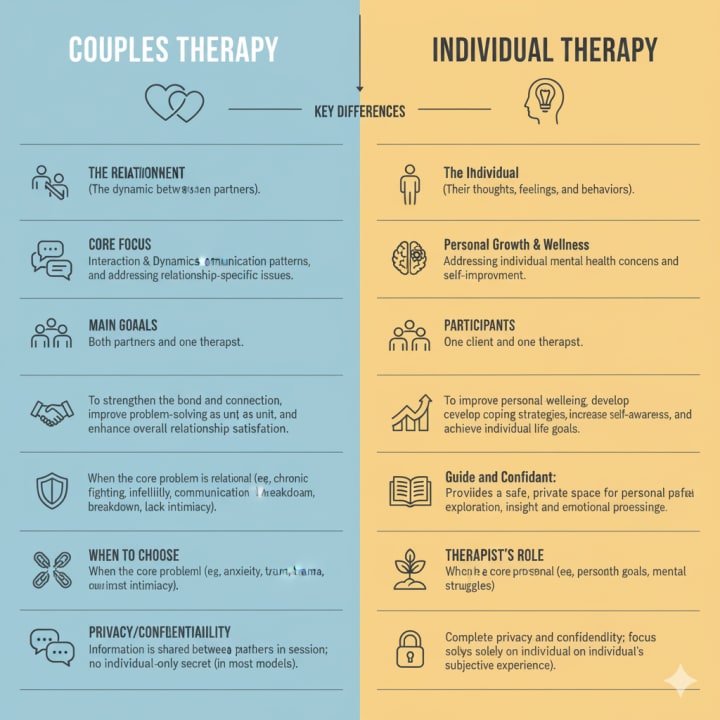
Counselling never carries a single definition. Each form reflects a distinct mirror through which struggles are understood. Individual therapy for relationships allows individuals to express their feelings with no interruption. Couples therapy, on the other hand, creates an open space in which conversations once lost may be reconstructed.
The difference often lies in perspective. Individual sessions highlight inner battles, i.e., fears, past wounds, and personal triggers that affect how love is expressed. Couple sessions focus on the relationships between two individuals which reveal unspoken grievances or communication barriers.
Both therapies seek healing, but the approaches are different. Individual counseling often reveals the roots of behaviour, whereas couples therapy focuses on sharing relationships. One emphasizes self-discovery, the other mutual repair. In relationship counselling comparison, this distinction becomes crucial, since what feels broken may not always rest between two people, it may rest within one heart.
Understanding Couples Therapy
Couples therapy serves as a bridge for people moving in the opposite direction of miscommunication. The conflict over intimacy, communication or trust can lead to invisible walls. Counselors can provide neutral grounds in which both voices are given equal value.
This work is highly effective: studies show the average success rate of marriage counseling is around 70% for improving relationship satisfaction, with some models like EFT reporting even higher recovery rates
It's less about blaming others and more about revealing secret requirements. Couples are taught to listen with no defenses and to speak freely with confidence. This dialogue often softens tensions and encourages empathy where resentment once grew.
Sessions also highlight recurring cycles that keep arguments alive. Identifying these loops allows healthier ways of connecting to replace harmful patterns.
Benefits of Couples Therapy
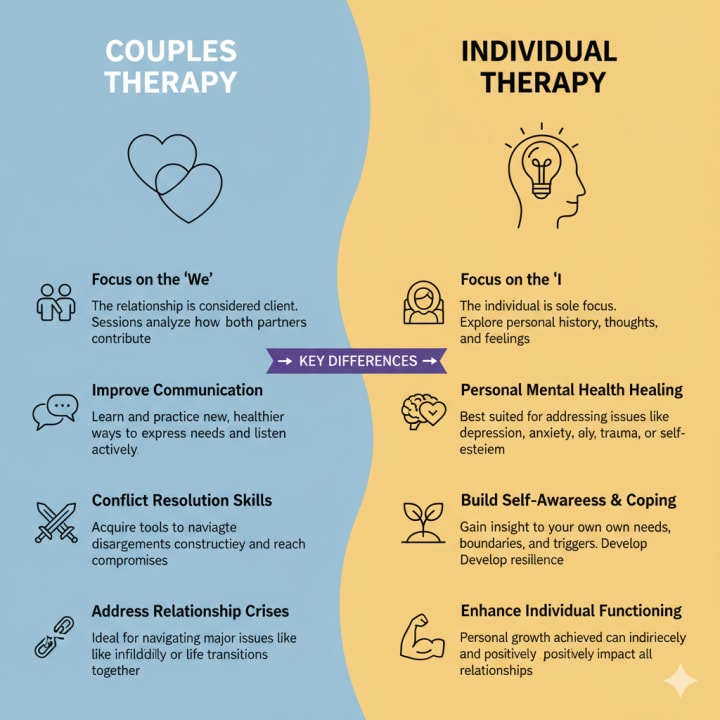
The benefits of couples therapy reach beyond fixing little arguments. It is a method that provides couples a space where they feel respected and confident to share their issues and are guided towards a happier relationship. Instead of just focusing on conflicts, therapy builds the relationships' foundation by helping couples regain the trust and connection they have built. It also prevents the possibility of future problems.
- Better Communication: Participants learn how to clearly communicate their needs and actively listen without judgment. In fact, up to 90% of couples report an increase in their emotional well-being after completing therapy, validating the environment of safety.
- Emotional Safety: Therapy provides an environment of safety where the vulnerability of a person can be discussed with no fear of ridicule or rejection.
- Rebuilding Trust: Little steps taken during sessions gradually build confidence in the bond, strengthening relationships.
- Conflict Resolution: Couples develop skills to resolve disagreements in a constructive manner instead of letting them grow.
- Shared Goals and Teamwork: Sessions encourage the alignment of values, roles and the long-term direction of the team's relationship.
- Resilience for the Future: The skills learned continue to aid couples long after therapy is over which reduces the likelihood of repeat patterning.
With these effects couples counselling can transform tensions into more bonded, stronger couples that can withstand the constant stressors.
Understanding Individual Therapy
Individual therapy for relationships creates an intimate space in which individual struggles can be discussed with no judgement. The unresolved experiences of childhood, the fear of loss, or secret anxieties can influence the way how a person gives and receives love.
These sessions allow deeper self-awareness. By exploring emotions openly, individuals begin to understand how personal histories shape current conflicts. Therapy helps to define experiences that previously were difficult to express.
Individual therapy helps ensure that one's emotional health contributes positively to the bond. Personal growth often spills over the other side, creating better interactions within relationships.
Benefits of Individual Therapy
The benefits of individual therapy for relationships are often undervalued. But it plays an essential role in forming stronger relationships. When focusing on self-awareness and the development of their emotions, people can discover patterns that could have been unconsciously impacting their relationships to a person. The process of healing oneself can lead to healthier, better relationships.
- Personal Clarity: The therapy helps to identify the triggers and fears that affect one's life as well as emotional barriers that affect the way people interact with their partners.
- Better Conflict Management: Through learning how to control emotions in a private setting individuals avoid carrying conflict-related frustrations they have not addressed into their relationships.
- Reducing Emotional Burden: Dealing with personal issues independently eases pressure on a person's shoulders to bear the burden of those experiences.
- Enhanced Boundaries: Therapy increases the capability to define and sustain healthy boundaries. This helps prevent emotions of resentment.
- Greater Emotional Availability: When self-doubt as well as past hurts are addressed, people become more attentive and active in their relationships.
- Ripple Effect on the Relationship: Growth at an individual level usually leads to positive shifts in how individuals relate to one another.
With these effects, individual therapy for relationships is often the base for deeper relationships, as self-healing can aid in healing shared with others.
Choosing the Right Therapy
The decision between couples therapy or an individual therapy is a matter of careful reflection on the root cause of problems in the marriage. Each path offers unique strengths, and the right choice depends on whether struggles arise within the relationship dynamic or from personal difficulties that affect it. Understanding this distinction ensures that the support received aligns with the true needs of both partners.
The decision is critical, especially considering the average couple waits an alarming six years after problems arise before seeking help, a period when resentment can deeply set in. Recognizing whether the struggle rests 'between two people or within one heart' is essential for timely, effective intervention.
- The nature of the conflict: When disagreements in communication, lack of communication or the distance are predominant, couples therapy offers a place for shared and understanding.
- Personal Problems: When tension, trauma, or personal issues affect the relationships of a couple, therapy by an individual can be more beneficial.
- The readiness of both Partners: Couples sessions demand the participation of both partners and individual therapy permits progression even if one partner isn't ready.
- Goals of Therapy: It is dependent on if the primary goal is fixing the bond as a group or building personal stability in the first place.
- Combined Approach: Both forms can complement each other, with some beginning in individual sessions before transitioning to joint counselling.
In every relationship counselling comparison, the most suitable choice reflects not the superiority of one approach but the alignment of therapy with the couple’s unique situation.
Key Takeaway
Relationships not only require love and affection to be successful, but also patience, understanding, and conscious efforts. Therapy is a structure for this endeavor and provides structured assistance through a variety of ways. Couple sessions facilitate dialogue that encourages partners to bridge emotions and re-build trust.
At the same time, individual therapy for relationships provides the opportunity to reflect on oneself and allows personal difficulties to be dealt with prior to affecting the relationship. Both paths show that growing in love is not always accidental, it demands commitment and choice.
No single answer defines whether couples therapy is more effective or individual therapy. Healing often unfolds in the place it is most needed; sometimes within the individual, and at other times between two people. A partnership may thrive when shared communication improves, while another may flourish once personal wounds are healed. Therapy, in either form, becomes less about comparison and more about alignment with the relationship’s needs.
In every relationship counselling comparison, the focus should remain on what strengthens the bond most authentically. The growth may come through the midst of vulnerability, or through the personal healing process that spreads to others. What is lasting isn't necessarily the therapeutic process but the trust, resilience and connections it creates.
Reaching out to professional mental health therapists near you is not a sign of weakness, but a step toward a powerful investment in yourself. With over 70% of people worldwide with mental illness not receiving treatment, choosing to get help is a courageous act that puts you on the path to healing.
About the Creator
Town Psychological Services
A mental health clinic serving residents of Oakville and the surrounding GTA areas. We provide a wide array of psychological services for individuals, families, adults, and couples. Learn more about us at https://townpsychology.ca.
Keep reading
More stories from Town Psychological Services and writers in Families and other communities.
Inside Couples Therapy: What to Expect
A relationship often brings joy, but storms can sometimes arise between two hearts. Couples therapy works like a safe harbor. A guided space is created where unspoken fears, broken trust, and recurring disagreements can be understood. Healing begins not by changing the past but by shaping how tomorrow is shared.
By Town Psychological Services7 months ago in Families



Comments