

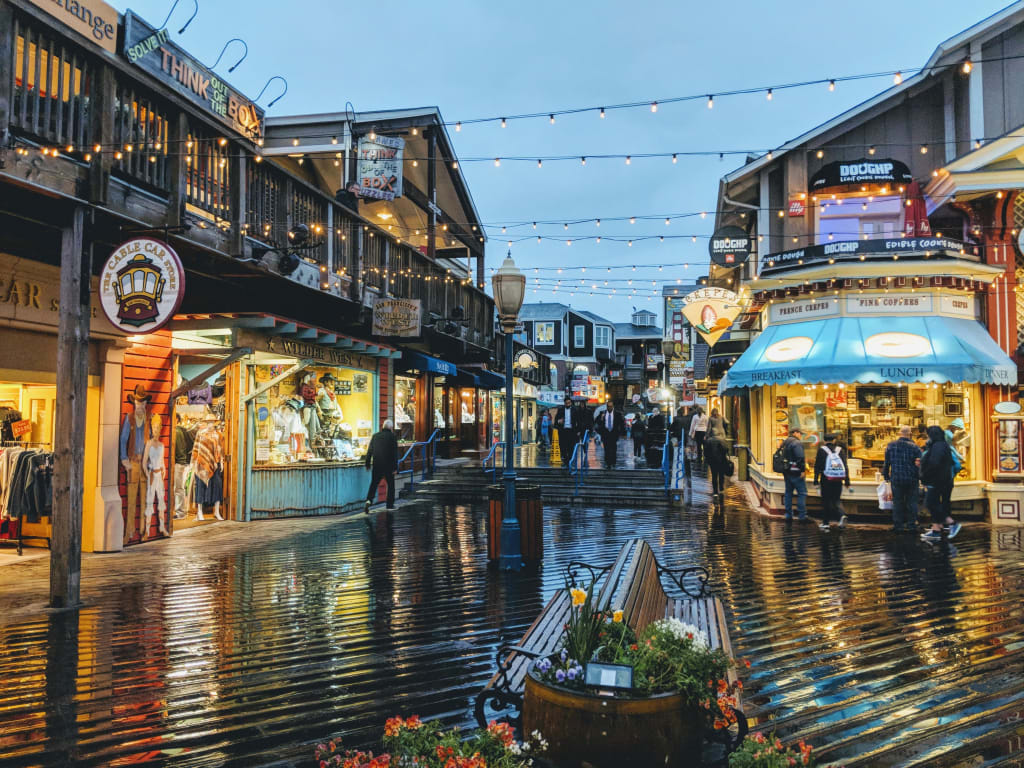
“When I get out of here I’ll take you to Pier 39. They have clam chowder in a bread bowl, sourdough, your favorite.”
There’s a lot to unpack here, as there often is with my mother. She said this the last time I visited her at The Oaks, which, if you’re not an avid news watcher or, are like my sister and never bothered to look beyond the stock photo brochure with clichéd slogans, is the local snake pit (industry lingo) where families send their demented relatives once its too much effort to play along any longer; it’s the one that just lost that big lawsuit.
First, although The Oaks is basically a prison, she was not serving a minor stretch. She would live there indefinitely; there was no: “When I get out of here.”
Second, I hate clam chowder. The first and last time I tried it was on an away rotation in Boston, well into my twenties, when I had no time to share such experiences with her.
Third, and this is just a well-educated guess, my mother has never been to San Francisco.
I know it’s overkill picking apart my mother’s nice gesture. She thought I was her bus driver from twenty years earlier. If my sister and I were on speaking terms, it would have been a funny story to share on my way back to the hospital. Funny but sad but still funny. She’s pleasantly confused. Repeat these phrases. Avoid thinking about her terrifying existence. Justify not visiting for three years.
Last week I got a call from Vegas. My mother’s friend, Martha, updated me on the lawsuit against The Oaks. Turns out there were snakes in the snake pit. My mother was one of the many plaintiffs alleging neglect. She went on to live in another facility, then my sister’s, and was now with Martha. There was a settlement, a modest one, but really this was Martha’s way of telling me she couldn’t take care of my mother any longer. I needed to figure something out.
“I can’t keep doing this,” Martha said. “I know you’re busy with work and your family… I understand all that… I just…”
“Martha, it’s fine,” I said, “you’ve done so much already…”
“When can you get here?” she asked, skipping the false modesty.
I had recently completed my fellowship and wasn’t going to start my new position for a couple of weeks. For the first time in nine years, I did have time to take this on.
“I can drive over early and get there tomorrow morning.”
“Thank you,” Martha said, “ she’ll be happy to see you, Dan. It will make her week.”
There was a pause. Neither of us was convinced.
“Right,” I said. “I’ll see you then.”
My mother had always been small and full of energy. In the lingo, you might call her a firecracker, or, since not too long ago, an LOL (Little Old Lady). I tried not to think of how her living conditions warranted a lawsuit but took comfort in the fact that she probably gave them as much hell as they gave her.
When I walked into Martha’s living room, however, I gestured toward the woman sitting on her plastic-covered couch. “That’s…” I began to ask. Martha nodded, smiling. My mother was neither a firecracker nor a vegetable, but something in the middle, between my childhood memories and the somber impression from the previous morning’s phone call. She was writing in a little black notebook like the one I bought her several years earlier. “She looks great,” I said to Martha. “Do you know what she’s writing?”
“I haven’t asked,” she said. “But yeah, this is the first time she’s been up like this in days. She’s bearing weight. I had to stop her from making a family-sized breakfast this morning, but overall she’s on her best behavior. Maybe she knew you were coming.”
There were a million reasons why my mother would suddenly improve, like an extrasensory perception that better conditions lie ahead. No more Oaks. No more helpless Martha. Maybe aliens abducted her and removed some of those pesky amyloid plaques. Of them all, the least convincing was that she heard her long lost son was coming. Martha was more mistaken than she knew.
No matter how many people I treat, no matter how many lives I save, it will never change the fact that I left my mother’s shattered self in the hands of my junkie sister and that hellish facility. It is unforgivable. This is why, there in Martha’s living room, seeing the same eager face that promised me a trip to the pier and how the reflection in her eye was not of me but someone else, I shuddered to think that I would never receive the punishment I deserved. A life spent raising me, inspiring me, but never an opportunity to confront me. I dodged a reckoning. I could have easily wiped my hands of the whole thing. She didn’t know who it was standing in front of her and it would have been that much easier to place her in another facility while I spent her newly acquired damages.
“Merv! That you?” my mother asked.
“Yes,” I said, reflexively, ready to reprise my role as The Bus Driver after all these years. The debate over feeding into your relative’s delusions (“Yes”) or trying to ground them in reality (“No mom, it’s me, Dan, your son.”) is a pressing one with certain ethical considerations. Although I appreciate the negative aspects of lying, it was after I spent an hour arguing that the bench in The Oaks’ lobby was not the bus stop, and that I was not her driver, that I decided playing along was worth the risk. “I’m here to pick you up.”
“Pick me up? It’s my day off.”
“Typical Jean,” I chuckled, turning to Martha for added effect. “Don’t you remember what today is? What you promised me?”
“Promised? Oh…” she put her finger on her chin and looked away.
“The soup bowl…” I said, saving her from embarrassment.
“Oh…”
“You know, sourdough? The pier?” I asked. “‘As soon as I get out of here…’ you said. ‘Chowder in a bread bowl…’ San Francisco, you and me.”
“San Francisco? Now? I got work on Monday… the kids need to get ready for school. I can’t just up and leave.”
“Ah, c’mon, Jean. I’ve been looking forward to this. You know it’s my favorite.” I was really hamming it up now, convinced that an adventure was the best way to get her out of Martha’s. The literature probably says if you’re going to lie, you should avoid twisting any arms, but there I was. “Besides, I’m the one that’s taking you to work on Monday, remember, so we should get a move on.”
She sat quietly, with a look of contemplation, then a smile.
“Jean, I have all your stuff packed and ready to go,” Martha said, barely hiding her enthusiasm. The lie was working. Not wanting to break a promise, or miss an opportunity to get away, my mother followed me to the car as I carried her luggage.
I wasn’t her son, but she was still my mother. She deserved to live the rest of her life with as much dignity as possible. She would start by showing her old friend the best bowl of soup he could imagine. The damages she won, around twenty-thousand dollars, was to be spent fulfilling promises, recovering lost time, and living so freely that memories wouldn’t be necessary. We would spare no expense.
An hour into the car ride I convinced my mother to take her Ativan (“for cholesterol”). I didn’t want to risk a sundown in the desert. We checked into our suite at the Fairmont around dinnertime. Exhausted after the ten-hour car ride, I asked the bellhop where we could find the coveted soup. Fortunately, enough people seemed to care for this meal that the place survived from when my mother thought she promised it. He gave us directions. I chose a booth in the corner as we waited for our order.
“So when’s the last time you were here?” I asked, clumsily. A look of confusion slowly appeared. I recognized the internal struggle, attempting to seem on top of it all. She clearly had no idea where she was, let alone any recognition from an earlier time. “Well, I think it’s terrific. I can’t tell you how much this means to me, Jean. Thank you.”
“Oh…” she smiled, still a little groggy. “Of course.”
I was supposed to be Merv, who I’m sure was an interesting guy, but all I had to work with was that he drove a bus and liked clam chowder. “Say, Jean, I was wondering, what’s in that black book you’re always writing in?”
“Black book?”
“Yeah, I saw you writing in it earlier. You put it in your purse.”
“Oh. This? I just keep my little thoughts and lists in it. Groceries, stuff for the kids.” She sat up and her eyes gleamed the remaining benzo fog away, “Danny’s birthday is next month and he’s already told me fourteen different things he needs. Then Jess gets jealous and asks for fourteen things herself. I’d tell them there’s no way but they are just the best kids, Merv. They help out around the house. Danny’s on the all-A honor roll, again. Jess always has her head in a book. Couldn’t tell you where they get it. Not from me, that’s for sure. Sure as hell not from Stan.”
“Can I see it?” I asked. She looked skeptical. “I was thinking of getting into journaling. They say it’s good for the mind, but you probably know that.”
I opened the little notebook to a random page. It was the same one I gave her when she first moved into The Oaks. The earlier pages were dated, neat, and described her days. Phone calls, lists, visits from friends, a sunset through her alarmed window. As I turned, the entries became more cryptic. Fewer words, no more dates, mostly times. An endless list of times in different sizes, inks, and angles began to cover the pages until there was no more room on them. I flipped to another page, about two-thirds through now, and saw my own handwriting: a large “6:15 pm” in blue ink. “That’s when the bus will get here, mom,” I remember saying. “It’s running late today.” I left right at six that night, when visiting hours ended, leaving maybe enough time for her to wait alone and forget I was there. I flipped through the rest of the pages filled with three years of times, three years of the staff’s little white lies, with no mention of what else went on between them.
Our bowls arrived soon after.
“Merv? What’s the matter?” my mother asked. “Don’t you like it?”
“No, no, sorry… it’s terrific. It’s perfect, really. Better than I could have imagined.”
“I’m glad to hear you say that. You had me worried for a second.”
“No reason to worry, Jean. Glad we got to do this… And think, tomorrow we’ve got the whole day to do whatever we want.”
“Sounds like fun,” she said. “But we gotta get back home at some point, remember?”
“I remember, Jean. I’ll make sure you get back home.”
About the Creator
Keep reading
More stories from writers in Families and other communities.
Wise~Guys
— Look Behind what's in Front of You ~ Make Good Choices — Hey, So how you Doin'..! Made~Men — Mobster Movies romanticise a distinctive, elegant appearance, impeccable attire style, along with the 'Families' expressive lingo. Making their 'Bones' gave them Panache — with vintage fedoras, tailored pin-striped suits, mirror-polished wing-tip shoes adorned with tassels; with their 'Gun Moll' gorgeous dates on their arms.
By Jay Kantor25 days ago in Families
🅼🅸🅳🅽🅸🅶🅷🆃 🆂🅽🅰🅲🅺🆂
"It's 10 in Tuscon! We all know what that means... It's Time for Midnight Snacks with your man, Gerald Gee! Ready to spend the night together? Me too! I'm full of snacks and can't wait to regurgitate them all back into your hungry ears. Crack a brew! Pop some corn! Anything to get ready for one hell of a show where the talk maybe cheap but the words cut deep...
By Lamar Wiggins3 days ago in Fiction



Comments
There are no comments for this story
Be the first to respond and start the conversation.