
Chinese Cinderella
The Secret Story of an Unwanted Daughter

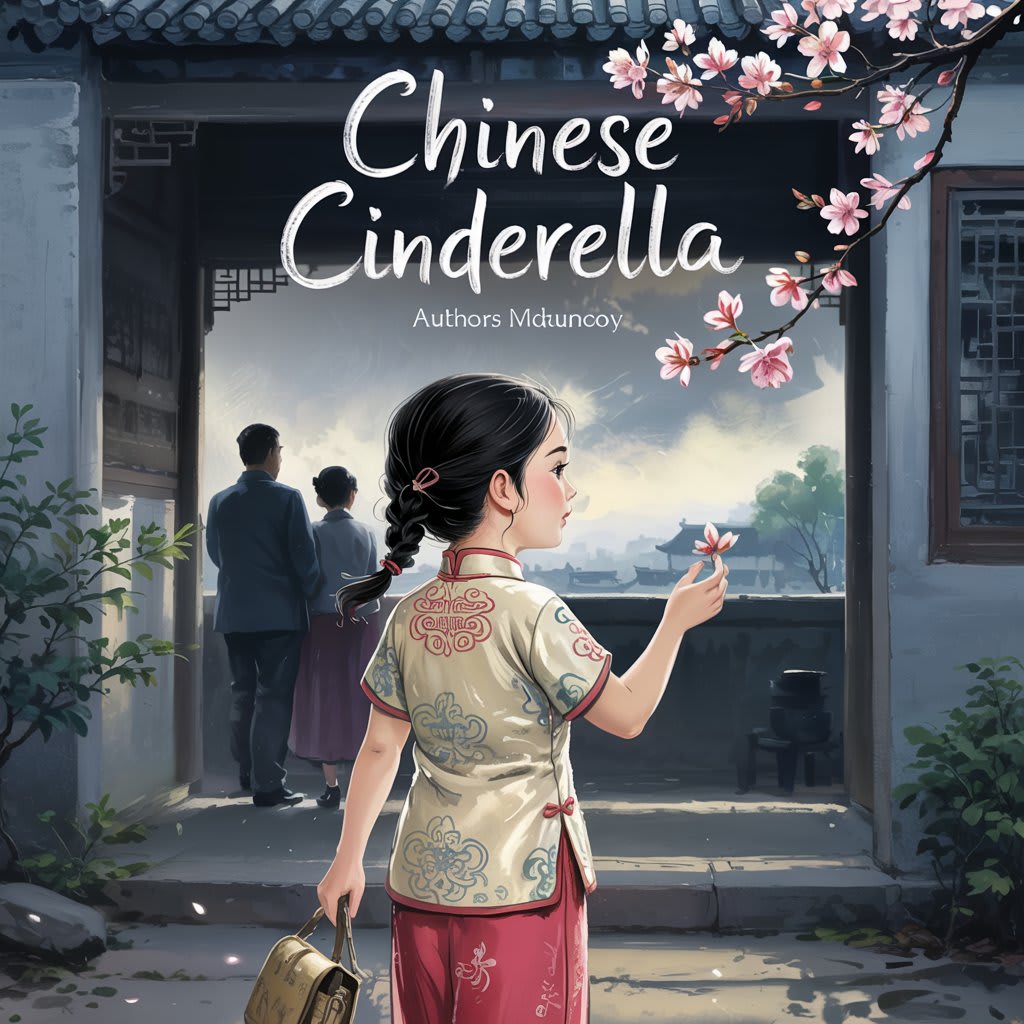
(A Story Inspired by Adeline Yen Mah’s Memoir)
Once upon a time in the bustling city of Tianjin, China, there was a little girl named Adeline. She was born the fifth child in her family, just days after her mother died of complications from childbirth. Though the tragedy wasn't her fault, Adeline’s family seemed to believe that her birth had brought sorrow upon the household. From the very beginning of her life, she carried a heavy burden—a deep sense of being unwanted.
Adeline’s father was a wealthy and powerful man, a successful businessman who later married a beautiful Eurasian woman named Niang. Niang was young, stylish, and cold-hearted. She had little patience for the children from her husband’s first marriage. Adeline and her siblings soon learned that their lives were divided—Niang and her own children were treated with privilege, while the others lived in shadows.
From an early age, Adeline showed signs of brilliance. She excelled in school and won top honors in her classes. But unlike many children whose achievements would bring joy and pride to their parents, Adeline’s accomplishments were ignored. Her father paid little attention to her, and Niang often punished her harshly for the smallest offenses.
At home, she was lonely. Her siblings, too, were afraid of Niang, and some, like her older brother and sister, joined in teasing her just to avoid trouble themselves. Adeline’s only comfort was in books and her schoolwork. In those pages, she found escape. In classrooms, she was seen. Her teachers praised her, and the gold stars she earned gave her the strength to keep going, even when things were difficult at home.
Despite the challenges, Adeline continued to shine. Her school achievements were unmatched. She won a medal for topping her class in kindergarten, and more awards followed in elementary school. But still, at home, her accomplishments were met with silence or even resentment. She longed for her father's approval, but he remained distant—more impressed with her brothers or preoccupied with his work.
When Adeline’s grandfather, Ye Ye, was still alive, he offered her the rare gift of love. He saw her potential and treated her kindly, telling her to never give up. “You can be anything you want to be,” he said once. Those words stayed with Adeline, becoming a light in her darkest moments. But when Ye Ye passed away, Adeline felt more alone than ever.
The family eventually moved to Hong Kong, and life became even harder. Niang’s cruelty deepened, and Adeline was often left out, treated as an outsider even in her own home. Once, when the family took a vacation, they left her behind without telling her. She returned from school to find the house empty.
One of the most heartbreaking moments came when Adeline was sent to a boarding school and abandoned there. While her brothers and sisters were brought home for holidays and special occasions, Adeline stayed alone at the school, week after week. The headmistress would ask, “No one came to pick you up?” and Adeline would quietly shake her head.
But fate, it seemed, had a twist in store.
One day, when she was about fourteen, Adeline entered a writing competition. She had poured her heart into the piece—a thoughtful and eloquent play that impressed the judges. To her surprise, she won first prize. When the news reached her father, he was astonished. He called her to his office, and for the first time in years, he looked at her with interest.
“You wrote this?” he asked, pointing to the paper.
“Yes, Father,” Adeline answered, her heart pounding.
After a moment of silence, he spoke again. “You have talent. What do you want to do with your life?”
Adeline hesitated. It was a dangerous question in a house where dreams were rarely allowed. But she took a breath and said, “I want to be a writer.”
To her amazement, her father agreed to send her to study in England. It was a turning point, a moment of unexpected grace in a life filled with rejection. And though he never said the words she longed to hear—that he was proud of her, that he loved her—his approval meant everything.
Adeline left for England and began building a life of her own. She worked hard, became a physician, and eventually a successful author. But even as she achieved great things, she carried with her the scars of her childhood. She never forgot the pain of being treated as unwanted, nor the strength it took to rise above it.
Years later, she wrote Chinese Cinderella, a memoir of her early life, so that others might understand what it meant to be an “unwanted daughter.” She told her story not with bitterness, but with honesty and hope—showing that even in the darkest circumstances, there can be light. Even in the most unloved child, there is worth.
Her story is one of quiet courage, the power of education, and the enduring hope of being seen. In telling it, Adeline offered a voice to so many children who feel invisible. She proved that words, even those written by a lonely girl in a forgotten corner, can reach across the world and touch hearts.
About the Creator
Keep reading
More stories from Muhammad Asad and writers in Families and other communities.
The Last Sleep
The hospice room was quiet, save for the slow, mechanical rhythm of the oxygen machine. A muted winter sun filtered through the curtains, casting faint lines across the bed where Eleanor Grant lay, her body fragile, folded into the bedclothes like a forgotten letter.
By Muhammad Asad10 months ago in Families
The Day I Saw My Father Cry
Most of us grow up believing that our parents are unbreakable. As children, we see them as pillars of strength—people who always know what to do and how to solve every problem. Especially fathers. They are often seen as the strong ones, the protectors, the people who never show weakness. For most of my life, I believed that about my father. Until the day I saw him cry.
By Shoaib Afridiabout 4 hours ago in Families



Comments
There are no comments for this story
Be the first to respond and start the conversation.