

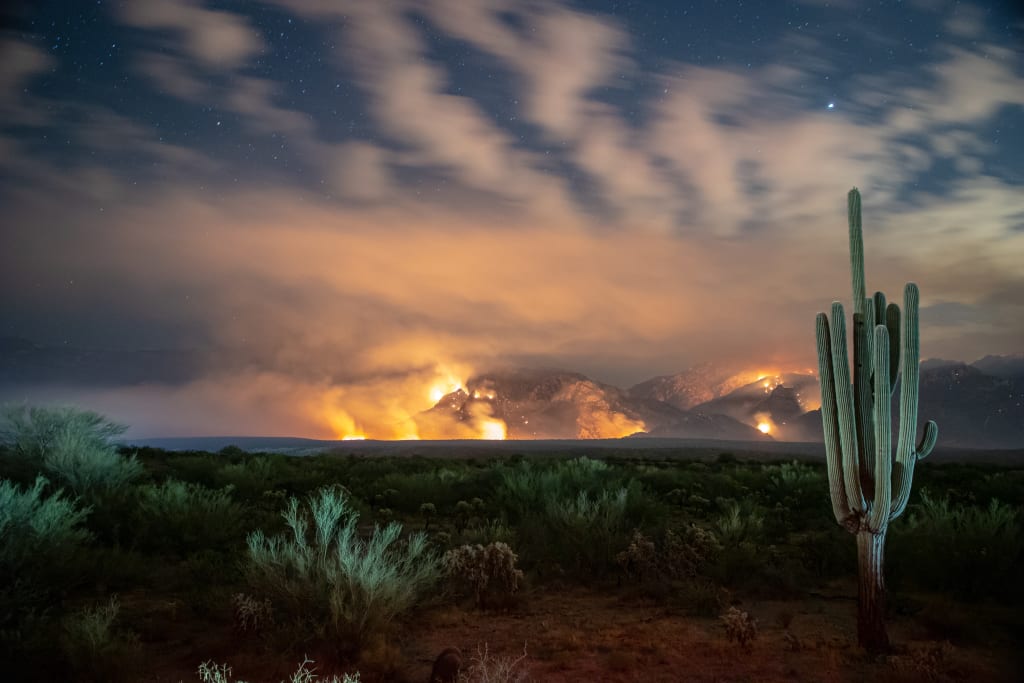
We first found out my dad owned my grandma’s condo when it burned to the ground. A result of poorly fabricated insulation and improper installation, the fire started in the building’s attic and quickly spread downward. My grandma lived on the top floor, and her home was soon engulfed. The flames didn’t abate until the hoses were hooked up, and by that time, they were eating away at the garden level, having wound their way down the concrete of the Brutalist apartment building like orange and yellow vines. Everyone was surprised that a building with so much concrete could burn so quickly.
Everything she owned was gone in a matter of minutes. The firefighters were able to salvage a few picture frames, but the faces in the photos—her great-grandparents and everyone who came after—were unrecognizable, warped with heat and smeared with black.
Two years earlier my parents had gotten divorced. Irreconcilable differences they refused to share with my brother and me. The announcement arrived on Thanksgiving shortly after the turkey was carved. My brother Noah and I were both in college, he a senior and me a freshman, so there was no need for a custody battle. We were spared the court proceedings and the truth.
One of the main points of contention was my maternal grandmother’s condo. She had lived for over fifteen years in a single-bedroom unit in a building that invoked the bleak towers of the Soviet Block. The complex stood nestled in a stand of pines behind the Kohl’s just off the Beltline. Whatever her squatter’s rights may have been, my dad was the technical owner, his signature stamped across all of the paperwork, and with he and my mom’s familial bond severed in court, my dad no longer felt comfortable owning her mother’s home. Whether that sentiment came from a good heart or a guilty conscience, I’ll most likely never know. He and my mom colluded one last time and decided to sign the condo over to my brother and me. They did so without our knowledge. My grandma was in spectacular health for her age, there was no reason to believe we would see the money for at least another ten to twenty years. They didn’t want the knowledge of an inheritance shaping our behavior at such a formative stage.
A two-year skip of the needle on the record of time and my grandmother’s life was a pile of ashes and I suddenly had twenty thousand dollars in the bank. Half he insurance money. I called my brother.
“What do we do with it?”
“We give it back to grandma, duh. It’s not like she’s got another house.”
“Right.”
I felt lousy for not reaching that conclusion on my own, but Noah and I were in very different places in our lives. He was living on a reservation in North Dakota teaching high school chemistry under the umbrella of Teach for America. He didn’t make good money of course, but his life was cheap, his overheard nearly nil—he didn’t need this unexpected windfall. I, on the other hand, was failing out of college at breakneck speed. Me and academia simply didn’t click.
I had once gone into the Philosophy Department to get help with a paper on Heidegger that I had been working on for nearly a month when I overheard two of my professors discussing my work as I was leaving. Both agreed that I my ideas were “out there,” and that I was “weird on a fundamental level, even for a philosophy major.” I found these observations to be trite coming from otherwise distinguished professors, but I bit my lip and held back my tears as I walked out into the cold November night. On a campus as large as Ohio State’s it was no easy feat earning a reputation. I decided to be proud that I had not gone unnoticed.
But now I was ready to go. Period. There was no need to finish college. Not with twenty thousand dollars in the bank. It could easily float me until I figured out what to do next. But I didn’t dare vocalize this germ of a plan to Noah. He was right. We had to give the money back. I was at least smart (if not decent) enough to pretend I agreed with that plan. We resolved to conference call my grandmother. Then we thought better of it. There was a significant chance that two voices on the phone at the same time would overwhelm her—she was the closest thing our family had to a tried-and-true Luddite—it would probably be better if only one of us called. Spotting my opening, I asked Noah if I could do it, and he found no reason to argue.
“Hi grandma,” I said. “How are you?”
“Hi dear! I’m good. Just putzing around your aunt’s. Trying not to get in the way.”
“Must be a big change,” I had to bite my tongue to stop myself from saying at your age. “Listen, Noah and I talked, and we want to give you the money back.”
“No! I won’t hear of it.”
Maybe this would be easier than I had assumed. Still, I had to be a touch more tactful than that. I couldn’t lay all my cards on the table all at once.
“We don’t feel right keeping it. Get a new place. One all to yourself.”
“How much is it? The insurance money. Just out of curiosity?”
“Twenty thousand. Well, that’s my half. Forty between me and Noah.”
“What am I going to do with forty thousand dollars? I’m old, Roy. I’m not going to last much longer. There’s really no point in starting over. And this isn’t fatalism talking. I’m only addressing reality. I’ve still got social security and my pension from the post office, and if I’m not mistaken, I qualify for subsidized housing. Once your aunt gets tired of me, I’ll head over to HUD and get in line for the place they’re opening up on Kalamazoo.”
She didn’t sound like someone who would be knocking on death’s door anytime soon, but I decided to believe her, knowing it could only help me.
“Do you have dreams, Roy?”
“Yes,” I lied.
“Then go and finance them. Twenty thousand dollars probably seems like a great sum of money to you at your age. And I don’t want to say it’s not, but you’re better off believing it is for now. Eventually you’ll learn that no sum of money can make you feel secure, can get you across thresholds that you’re afraid to cross. Take the money and run. You’ll put it to much better use.”
I spent fifteen minutes making her promise me she was sure before I hung up. Noah had told me to call him after I spoke to her to let him know how it went, but I decided that could wait. If Noah did eventually submit to taking grandma at face value, all he was going to do with his half of the money was put it into a savings account anyway. I’d toss him a half-cent for the couple-days-worth of lost revenue and call it even.
The first thing I did with my twenty thousand dollars was go to Barnes and Noble and buy a small black notebook. Usually, when I had thoughts or feelings I considered worth recording I went and bought yellow legal pads from the Rite Aid near school, but I was momentarily flush and decided to splurge, spending fifteen dollars on a beautiful pitch-black Moleskine. It was pocket-sized, the perfect obsidian abyss in which to dump my aimless thoughts.
The next thing I knew I was at the Greyhound station in downtown Grand Rapids buying a one-way ticket to Los Angeles.
If there was one thing I had learned in college, it was that I was weird (or at least that was the general perception) and Hollywood had a reputation as a safe haven for weirdos. I thought of Andy Kaufman and wondered if I had the courage to lose myself in a character, to blur the boundaries between life and art. If I was already “out there,” comedy was probably my best bet.
Once I hit Chicago, I felt like I had enough miles in the rearview to safely inform my brother of my plan. At first, he tried to talk me out of it, even drove down to meet my bus in Denver so he could make his case face-to-face. We ate lunch at Denny’s—Grand Slamwiches, coffee and milkshakes—and he begged me to reconsider.
“Hollywood’s not what you think it is.”
“Have you ever been there?”
“No.”
“Then how would you know?”
“Roy. I love you. You’ve got a light inside you and that’s undeniable—and I would never root against you—but you’re an Innocent. I don’t think you understand how many people are behind the scenes taking care of you.”
“What does that mean?”
“Mom. Dad. Me. We’re all on the lookout for you. Constantly and vigilantly.”
“What about grandma?”
“Grandma, too.”
“Well, I have grandma’s blessing.”
“Grandma’s grieving the loss of her home. The loss of everything she ever owned. Her ties to the past. She’s in no position to—”
“Maybe that’s exactly why she’s in a position to see clearly!”
“I wasn’t going to say ‘see clearly.’ I was going to say offer advice."
“Same difference. Grandma’s endured a massive cleansing fire. It’s purged her soul. There’s nothing material left to stand in the way of her vision.”
It was about this time that Noah took seriously my resolve and relented. Either that or he was frightened by the flicker of lightning in my eye. After he told me that he didn’t think I understood the true value of twenty thousand dollars, he offered to pay for the meal. I let him.
“Take care of yourself,” were his final words.
I spent the rest of the trip scribbling jokes in my notebook. Some were ones I remembered from late night monologues and HBO standup specials (I wasn’t going to steal them, I just wanted to learn the structure and absorb the cadence) and some were all my own. I wrote character sketches and developed scenarios that I believed to be ripe with evergreen humor. I flipped to the front of the notebook and beneath the line where it read In case of loss, please return to: I crossed out Roy Koetje and wrote Muhammad Ali. I wondered if people would get the joke. Later, I realized they probably wouldn’t. Anyone with the impulse to return the book most likely would respect the owner’s privacy, and someone who was indelicate enough to read the contents of a stranger’s private notebook surely didn’t care about others enough to figure out who it belonged to.
Oh well, it was my early material. Even Muhammad Ali didn’t land all of his punches.
I closed my eyes and thought of the miles and miles of curved earth churning below me, lulled into a trance by the purr of the Greyhound’s tires perpetually peeling at the asphalt. I had spent my life thinking and failing to think. I was tired of thinking. Pretty soon I would be creating.
I had no idea what would happen to me when I reached the West Coast. On TV, there were reports of devastating wildfires in and around Los Angeles, and I had seen pictures on the news of hills burning on either side of the major freeway that ran north and south, bisecting the city. Videos of horses ushered onto trailers, fleeing engulfed Malibu ranches. A museum nested atop a small mountain surrounded by encroaching flames—millions, maybe even billions, of dollars of priceless artwork in jeopardy of being destroyed forever.
But I didn’t let it bother me much. So far, I had been the beneficiary of the fire in my life.
About the Creator
John Lars
Originally from the Midwest. Currently living in Los Angeles with my wife, daughter and two dogs. I write fiction.
Wise~Guys
— Look Behind what's in Front of You ~ Make Good Choices — Hey, So how you Doin'..! Made~Men — Mobster Movies romanticise a distinctive, elegant appearance, impeccable attire style, along with the 'Families' expressive lingo. Making their 'Bones' gave them Panache — with vintage fedoras, tailored pin-striped suits, mirror-polished wing-tip shoes adorned with tassels; with their 'Gun Moll' gorgeous dates on their arms.
By Jay Kantor18 days ago in Families
The Farmer and His Three Sons
In a quiet village surrounded by wide fields and dusty paths, there lived a hardworking farmer. His hands were rough from years of working the land, and his face carried the marks of long days spent under the sun. Farming was not just his work; it was his life. Before the sun rose each morning, he would already be walking toward his fields, and after sunset, he would return home tired but grateful.
By Sudais Zakwan7 days ago in Families
Ludacris and Nelly draw backlash over bookings at MAGA-coded music festival
Ludacris and Nelly headlining a mostly right-wing event is good for them. It’s also great for the genre of hip hop. The two rap veterans have showcased their talents on other stages. Why can’t they perform for mostly MAGA folks and grab that bag?
By Skyler Saunders4 days ago in Beat



Comments
There are no comments for this story
Be the first to respond and start the conversation.