
Bridges We’ve Crossed: Lessons in Steel, Stone, and Soul
Story about bridges and Bridges... and more Lessons :)

The Brooklyn Bridge & A Question That Started It All
It all kicked off five summers ago when my youngest, Kvitka, then about four, was perched in her car seat next to me as we drove across the Brooklyn Bridge. Sunshine poured through the suspension cables, tourists clicked photos, and the East River glinted below. She stuck her tiny finger into the air.
“Daddy,” she said, licking Nutella off her thumb, “why do people love bridges so much? They’re just… roads in the sky.”
I glanced at her, smiling when I saw her eyes bright and curious. That tone: a four-year-old fundamentally challenging my world view.
“Well,” I said carefully, “okay, they are roads in the sky. But—they’re also far more magical than that.”
She narrowed her eyes. “Hmm.”
I recognized the look: four going on fourteen. That’s when I realized: this wasn’t a question she’d forget. And I didn’t want it to be a boring answer.
“What if bridges are connections?” I offered. “Connections between cities, between people, between your world and mine.”
She paused, thoughtful—impressive for a kid glued to sugar. Finally shrugs. “But do people shout from a bridge?” she asked. “Like, ‘I’m on.. a bridge!’?” :)
We both giggled. But the seed was planted. What are bridges, truly? And what do they symbolize for a wanderer dad raising four amazing daughters across 39 countries and 11 languages?
Venice & The Bridge of Broken Gelato
Fast‑forward two years. We’re traipsing through Venice in matching straw hats, perched on our luggage cases, crossing the Rialto Bridge just at sunset. I imagined the four girls lined up in a perfect travel brochure shot while I declared, “Belllissimo!”
Reality was a full comedy sketch.
Marichka, always dramatic, insisted her gelato had ‘melted into the pavement,’ so she marched straight to the piazza fountain in her sneaker socks.
Uliana managed to lose one of her shoes—left it on the bridge’s stone edge as we crossed.
Dzvinka was negotiating with a pigeon over bread crumbs in fluent baby pigeon-speak.
Kvitka, strapped in her stroller, loudly proclaimed, “Venice smells like old fish! Yaaki...”—making all Venetians in earshot glare at us.
Yet by the time we wound up in a tiny corner pizzeria, grease‑stained menus in hand, they were all laughing and hugging. What did we learn?
Plans often fail—especially when sugar and heat are involved. But you can still pivot to pizza.
Connection over perfection. No travel ad ever shows a shoe tragedy in the sunset.
Cultural “bridges”—learning to eat local food, speak a few words in Italian, even role‑playing as pigeons—bring us closer to places we visit.
Japan’s Vine Bridge & Lessons in Trust
Leaving Italy behind, a few years later we found ourselves in Japan’s Iya Valley, hiking toward the Kazurabashi Bridge—a centuries‑old vine bridge swaying 45 feet above a river canyon.
Standing there, Marichka looked pale.
“You want us to cross that? Are you serious or just having another dad moment?”
(“Dad moment” = when I do something ridiculous for the sake of a memorable story.)
Dzvinka, quiet but intense, mumbled, “I’m going to haunt your dreams if I fall.”
Kvitka, ever irreverent, said, “So it’s like a samurai roller coaster?”
I told them tales of feudal Japan, when warriors crossed these vine bridges during retreats. That got them a bit puffed up with excitement—or bravado.
Still, stepping onto the first plank was pure terror. We screamed. We clung. We coached each other across.
Once on the far side:
We realized trust matters—in the bridge, in each other.
We learned slow and steady beats nervous hesitation.
And most important: fear+support = growth.
I turned to them and said, “This bridge proves you can cross fears if you reach out—hold tight to your sister’s hand.” Even Kvitka nodded, though inwardly plotting her next prank.
London Fog & A Bridge Named Courage
Years later, in London, we saunter across Tower Bridge in a chilly mist. The girls attempt awful British accents:
“Blimey, Papa! T’ old London Bridge is fallin’ down!” No way!
We stopped half‑way, wind whipping.
Kvitka laughed, “Does bridge fog make us brave or cold?”
I told them about big rivers, family history, and how industrial revolution engineers built these colossal spans.
Lesson:
Bridges reflect ambition. They’re monuments built to decode distance, to make the impossible reachable.
Curiosity is connection. When the girls asked about cables, counterweights, bascules—it turned sightseeing into a physics lesson.
Courage isn’t absence of fear, it's stepping forward anyway. Especially useful when you're raising global citizens.
Budapest’s Chain Bridge & Music Across Borders
In Prague and Budapest, we crossed bridges sparkling over the Danube. On the Chain Bridge, we heard a violinist play Csárdás on the bank, strings echoing between towers.
Without waiting, the girls started dancing:
Uliana tried traditional gypsy steps.
Marichka improvised Twinkle Twinkle Little Star in Hungarian. Nice try :)
Dzvinka practiced her sassy Hungarian accent.
Kvitka declared herself “Chief Bridge Dancer” and demanded five coins for autographs.
We joined in. Tourists clapped. The musician tipped his hat.
Lesson:
Language is music, bridging communication.
Art connects strangers. We spoke no Hungarian, but our energy said “thank you.”
Confidence evolves when you let yourself move—even imperfectly—on a public bridge.
Hanoi’s Power Outage & A Lightless Bridge
In Vietnam, we walked along the Red River, approaching a bridge just as the city’s lights flickered out—a blackout.
No streetlights. No cars. Just lantern glow reflected off wet pavement.
Marchka gasped, “Daddy, is Tokyo better with electricity?”
I told her: "Sometimes, darkness teaches you more than light."
We made shadow puppets on the bridge wall by phone flashlight, sang folk songs from four countries, and turned off the panic.
Lessons:
Resilience: a blackout isn’t the end, just a different story.
Imagination blossoms in darkness.
Shared stories connect across cultures—because story is humanity’s true bridge.
Golden Gate & The Weight of Connection
Back in the U.S., somewhere near San Francisco, we found ourselves on the Golden Gate Bridge—famous, red, and magnificent.
Kvitka asked, “Papa, do you think bridges get tired of holding people up?”
That cut through the fog in my heart. We all paused.
I replied: “Maybe. But that’s what love is—holding people up even when it’s heavy.”
Massive lesson for little minds:
Responsibility: like a bridge, support matters—even when it's weighty.
Sustainability: maintenance, care, repair—essential in relationships too.
Legacy: like the thousands crossing daily, our choices echo in our children’s lives.
Reflections—What Bridges Have Taught Us
From Brooklyn to Budapest, vine rope suspension to steel giants, each crossing offered:
Adaptability — vehicles change, we do too.
Language learning — a bridge between cultures, literal and linguistic. (Eleven languages? That’s partly bridge-building!)
Empathy — understanding a lost shoe, a fearful sister, a local violinist.
Teamwork — we crossed together, held hands, pulled each other forward.
Courage — climbing, walking, speaking, dancing before strangers.
Resilience — managing meltdowns, malfunctions, feeling lost... and recovering.
Humility — you don’t know everything, and that’s okay. Ask directions, ask stories.
Joy and silliness—because laughter built more connection than perfection ever could.
Real‑World Skills Built One Bridge at a Time
These stories aren’t just travel tales—they’re life lessons:
Fear management: Facing a shaky vine bridge taught calm confidence.
Cultural fluency: Saying “Bellissimo” or a Hungarian “Köszönöm” changed how locals smiled at us.
Problem solving: Lost shoe? We improvised. Gelato disaster? Pizza.
Adaptation: Unexpected blackout? Time to sing.
Creativity: Dancing in Budapest. Shadow theater in Hanoi.
Communication: Explaining physics at Tower Bridge. Using humor to cross gaps.
Responsibility: maintaining unity, safety, respect across four different temperaments.
The point: crossing many bridges in life—literal or metaphorical—equips you with real skills you carry across future ones.
A Bridge to the Future
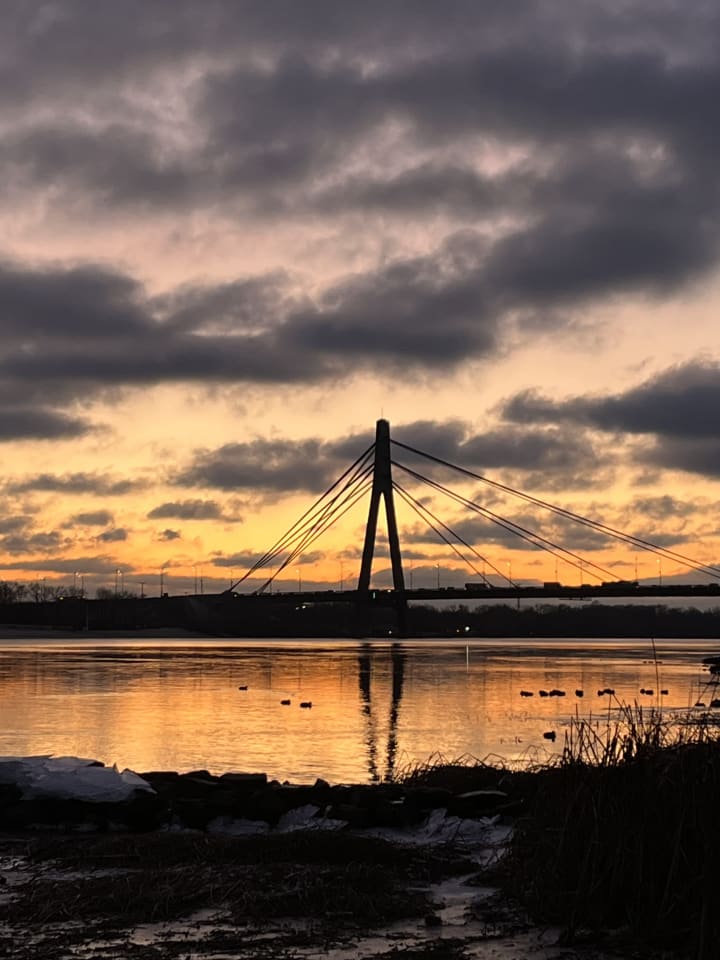
My grandfather, a civil engineer in Soviet Ukraine, used to build roads and bridges. But in his old age he told me something more profound:
“The most important bridge you’ll ever build is between your children and your past. Don’t let it collapse.”
That hit me later—especially after I started having daughters, raising them bilingual, globetrotting. I realized: stories connect generations. By telling them, I pass on not only genes, but resilience, curiosity, laughter, humility.
Each time we cross:
I share family stories from Ukraine, travel mishaps, daredevil ski runs.
They respond with their own versions—girl power antics, modern protest chants, emoji-laced Descriptions.
We blend them, like steel and cable. That’s our family’s evolving bridge.
The Best Bridges Are Invisible
We’ve now traveled to 39 countries, immersed in languages, cuisines, climates, and customs. Among all those physical bridges, the most enduring ones are invisible:
The bridge between siblings, built on shared jokes, late-night whispers, and mutual protection.
The bridge between father and daughters, spanning continents and parenting styles.
The bridge between generations, threading my own childhood to theirs.
The bridge between past mistakes and future dreams, because we learn, move on, and build again.
Kvitka may one day say, “Papa, remember how Venice smelled like fish?”
Marichka may pout, “Dad, you ruined my shoe—but you gave me courage.”
Dzvinka might whisper, “You scared me, but I crossed anyway.”
Uliana might holler, “Did someone say gelato?”
As long as those bridges exist—between tantrums and triumphs, silence and shared laughter—the story continues.
Epilogue: In Bridge‑Formulas
Curiosity + Humor = Connection
Fear + Support = Growth
Curating memory + story‑telling = Legacy
Crossing physical bridges = training for life’s invisible ones
So yes, bridges are roads in the sky. But in the right hands—family, curiosity, love—they also lift your heart a little higher.
Here’s to crossing many more.
About the Creator
Boris Lozinsky
Father of four amazing daughters. I love exploring the world and learning new things together as a family. Passionate about mountains, water sports, and all things extreme. I've learned 11 languages and traveled to 39 countries—and counting
Keep reading
More stories from Boris Lozinsky and writers in Families and other communities.
Why We Always Choose Experience Over Souvenirs
We live in a world where you can buy almost anything — except the things that actually matter. Strangely, we travel thousands of miles, collect boarding passes, snap photos, and then line up at the souvenir shop before we even know how the place smells in the morning or sounds at night.
By Boris Lozinsky7 months ago in Families
Wise~Guys
— Look Behind what's in Front of You ~ Make Good Choices — Hey, So how you Doin'..! Made~Men — Mobster Movies romanticise a distinctive, elegant appearance, impeccable attire style, along with the 'Families' expressive lingo. Making their 'Bones' gave them Panache — with vintage fedoras, tailored pin-striped suits, mirror-polished wing-tip shoes adorned with tassels; with their 'Gun Moll' gorgeous dates on their arms.
By Jay Kantor19 days ago in Families
Why Are Teachers Leaving Education?
As someone who is new to teaching, I will not sit here and pretend to fully understand everything veteran teachers have endured over the years. I do not yet have decades of experience to draw from. However, I can speak honestly about what I have observed in my year and a half in the classroom, and what I have learned in that short time is both eye opening and concerning. Teaching today is no longer just about teaching content. It has evolved into a profession that often requires educators to act as the judge, the juror, and the executioner, so to speak, all while being expected to maintain patience, professionalism, and compassion at every turn.
By Kimberly Nightengale2 days ago in Families



Comments
There are no comments for this story
Be the first to respond and start the conversation.