
Before I Die, I Just Want to Hug You Once
A heartbreaking journey of sacrifice, migration, and a mother’s last wish that remained unfulfilled.

Ali was my close friend’s nephew—simple, hardworking, and his mother’s dearest son. His eyes carried dreams, his heart was full of ambitions, and a pure smile always adorned his face. Yet behind that smile lay a wound carved by poverty: a mud house, a leaking roof, and a small piece of land that barely fed the family.
One day, a boy from the village went to Italy and started posting pictures on Facebook—branded clothes, luxury cars, and bundles of euros. That lit a fire in Ali’s heart. “I’ll go too, I’ll give my mother everything she deserves,” he repeated to himself every day.
But dreams need money to fly. All Ali had was soil and the crops that barely grew on it.
His mother’s wedding gold jewelry—her dearest possession—was sold. Ali still remembered the tears in her eyes when she handed it over, but he consoled himself: “This sacrifice is temporary. I’ll send euros and buy it all back.”
The family’s small ancestral land was sold. And the hardest goodbye was to his beloved buffalo—the animal whose milk once bought his mother a scarf and his sister a pair of shoes.
Ali wasn’t alone. His two friends, Zafar and Khalid, were also with him. Zafar spent his sister’s wedding savings, and Khalid sold his mother’s jewelry. Together they paid millions to a human smuggler who promised, “In two weeks you’ll be in Europe. Just be brave.”
Their first stop was the Iran border. Walking through mountains at night, hiding in caves during the day. One bottle of water for three men, dry bread for food. Stones and thorns underfoot, fear of being caught overhead.
In Turkey, the snow began. Temperatures below zero froze their bodies. Zafar fell sick—cough, fever, breathless nights. They tried to wrap him in clothes, but he grew weaker. One morning, he simply didn’t wake up.
The smuggler ordered, “Leave him here. If you stop, all of you will be caught.”
With tearful eyes, they buried him under snow and kept walking. Ali’s heart sank as if he had left behind a brother.
To reach Greece, they had to cross the sea. A broken boat, dozens crammed inside, cold winds, and darkness. Suddenly a giant wave struck. Khalid fell overboard. He couldn’t swim. Ali reached for his hand, but the next wave swallowed him whole.
Ali screamed, but the ocean drowned every sound.
Somehow Ali reached Greece. But it wasn’t the heaven he had imagined. Refugee camp life was worse than slavery—dirty water, cramped tents, cold nights, and constant fear of police deportation. Jobs were nonexistent, and he had to lie to his mother over the phone: “Everything is fine, I’ll send money soon.”
Every night, memories of Zafar and Khalid haunted him. “If only we had stayed in our village and worked hard, at least we’d still be alive, together.”
Still, Ali did not give up. He worked odd jobs—dishwashing, loading warehouses, hard labor day and night. Slowly, life improved. Money started flowing in. Hope breathed again.
Then came a call: “Your father is sick. Send money.” Ali immediately sent what he had. But the illness worsened. Hospital bills, medicines… until one day, the news came: his father had passed away.
Ali collapsed. He couldn’t hug his father one last time, couldn’t attend the funeral, couldn’t put soil on his grave. He just sat against a wall and wept in silence. Around him, only one thing remained—loneliness.
Time rolled on. Ali worked harder, built a business, earned more money. Yet in his heart, there was always a void. He longed to return to Pakistan, to hug his mother, to rest his head in her lap. But he couldn’t—because he was illegal.
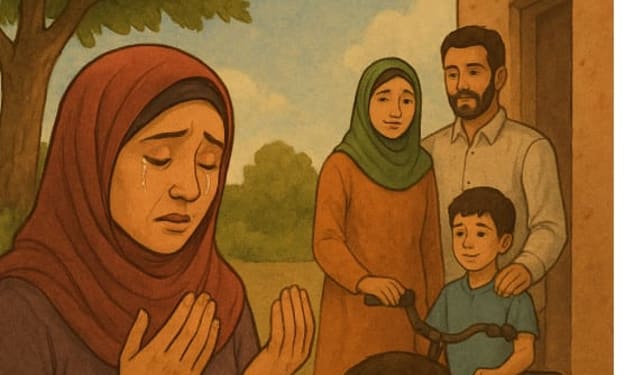
Then came another call: his mother was sick. His sister’s sobbing voice echoed in his ears. Ali cried for days. He called his mother every day, and she always said the same words:
“Before I die, I just want to hug you once.”
One day, his aunt called. Her voice trembled:
“Son, your mother is taking her last breaths… but her soul won’t leave. She keeps looking at the door… maybe she’s waiting for you.”
But death’s angels showed no mercy. They freed her from the torment of waiting.
Now Ali has wealth, a business, and respect. People call him successful. But when the lights go off at night, silence whispers in his ears:
“The ones you went for… they’re all gone. Now who is all this for?”
Whenever he thinks of sending money to Pakistan, one image strikes his mind—his mother on her deathbed, eyes fixed on the door, whispering:
“Just come once…”
And Ali wonders, “Even if I return, who will I hug? Who will I give these euros to, when their price was two graves and an empty home?”
In his cupboard lies his mother’s old scarf, still carrying her scent. Sometimes he presses it against his face, and that fragrance turns into tears. Euro notes scatter on the table… but they can buy neither a grave, nor a mother’s embrace.
---
Related Picture Ideas:
A lonely young man sitting in a small dark room, holding an old scarf close to his face.
A refugee camp tent at night with a dim light inside.
A mother’s wrinkled hands holding the doorframe, waiting.
A symbolic image: euros scattered on a table beside a framed photo of a mother.
About the Creator
New stAr writer
💌 If you love romantic stories, subscribe to my page and be part of a new story every day.
✨ Feel every shade of love — only here!
Keep reading
More stories from New stAr writer and writers in Families and other communities.
Christmas Abroad: Celebrating the Holidays Without Family
I moved to South Korea in 2017. I was twenty-two years old and excited to start my career as an English Second Language Teacher. With a Bachelor's degree and six hundred dollars in my bank account, I set off for Busan.
By Kera Hollow27 days ago in Families
Moving On From a Toxic Narcissistic Relationship Is Hard And That Reality Deserves Honesty
People talk about leaving toxic narcissistic relationships as if walking away is the finish line. As if once you leave, everything suddenly becomes clear and easy. But the truth is, leaving is often the smallest part of the journey. The real work begins after. The silence. The confusion. The moments where you question your own memory and wonder how you stayed for so long.
By Eunice Kamau3 days ago in Families
A Failed Artist, A Disillusioned Poet, An Underpaid Game Show Host
I took my son and niece to Gori, a small town in Georgia where Joseph Stalin was born. They talked me into visiting the Stalin's Museum, the largest in the post-Soviet space. I had resisted going there because I just can't stand the monster and know enough about him, or so I thought.
By Lana V Lynx6 days ago in FYI


Comments
There are no comments for this story
Be the first to respond and start the conversation.