
Baber’s First Aid Adventure: Learning Life-Saving Skills
How a Kite-Flying Mishap Taught Baber the Importance of First Aid

Baber’s First Aid Adventure: Learning Life-Saving Skills
BY:Ubaid
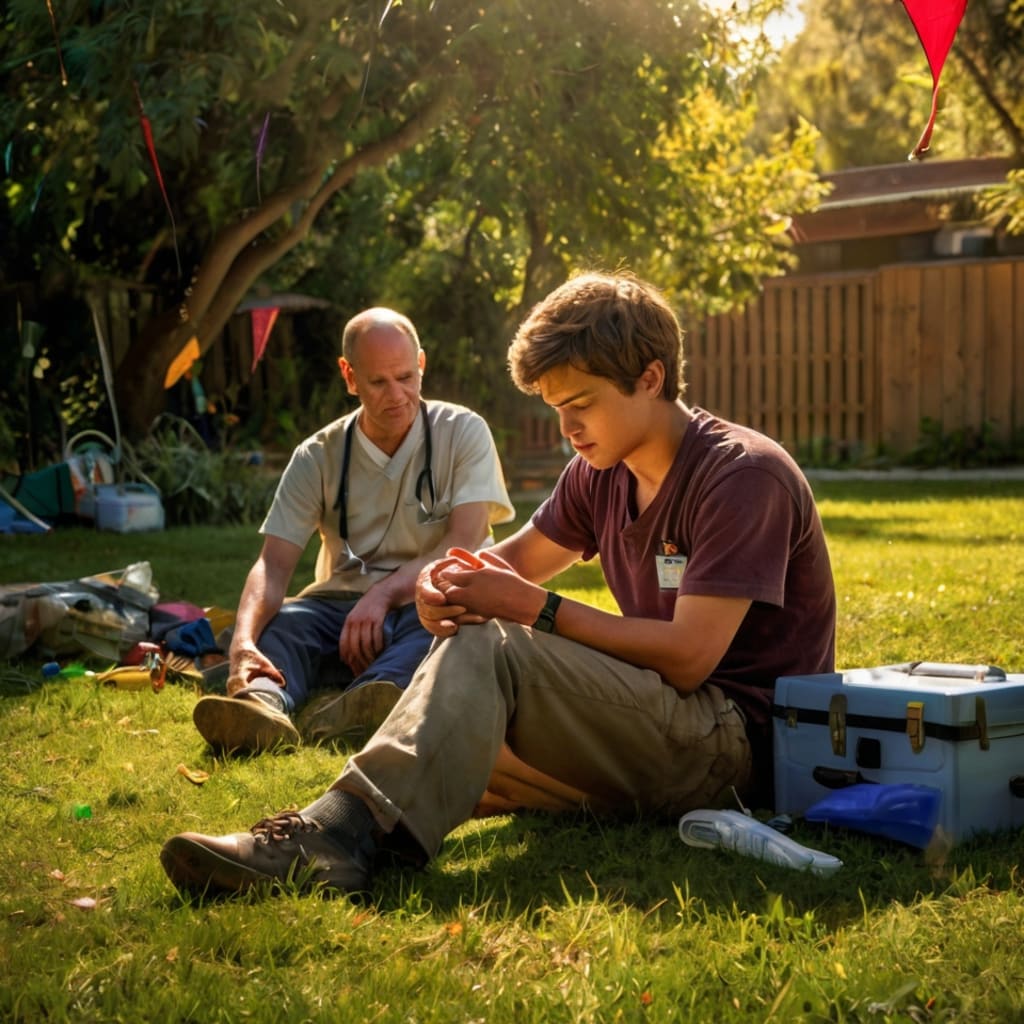
Salim Farooqi and Baber were flying kites with intense concentration on a sunny afternoon. The strings of their kites got tangled in mid-air, and in the excitement of cutting his opponent’s kite, Baber stepped backward. He suddenly lost his balance, stumbled over the edge of the garden boundary, and fell hard to the ground. Immediately, when he tried to get up, he couldn’t—he felt a sharp pain in his foot. His family quickly rushed him to a nearby clinic.
The doctor at the clinic recognized Baber immediately. Without wasting a moment, he began examining Baber’s foot. After a thorough check, he said, “It seems you have a sprain.” Baber, curious, asked, “Doctor, what exactly is a sprain?”
The doctor explained patiently, “Baber, think of the human body as a machine. Most of its parts are made of proteins, while the bones are made from calcium compounds. Just like a machine made of metal requires metal for repair, our body needs protein and calcium to heal. For example, when the skin burns or a wound occurs, germs consume the proteins in our body. Similarly, if a bone is fractured, calcium becomes essential for recovery.”
He continued, “Now, a sprain occurs when the joints of a bone move out of their proper position. It causes severe pain, swelling, and sometimes even changes the color of the skin. The first step in managing a sprain is to cover the joint with a clean cloth and apply a pressure bandage to prevent further swelling. Sometimes, the sensation feels like a sprain but is actually a pulled muscle. In such cases, applying gentle heat and massaging upward lightly can help. If swelling occurs, a cloth soaked in cold water or a cold pack, such as ice in a rubber bottle, should be applied to the affected area.”
As the doctor examined Baber’s foot carefully, Baber asked another question. “Doctor, once my younger brother had a pea stuck in his throat. What should be done in such cases?”
The doctor adjusted Baber’s foot to set the joint in place, which caused Baber to let out a sharp cry, but the doctor calmly reassured him, “Yes, throat emergencies can also be very painful. If an object gets stuck in the throat or airway, it can block breathing and endanger life because the brain won’t receive oxygen. In such situations, the international Red Cross first-aid technique called ‘Five and Five’ is used. It involves giving five back blows between the shoulder blades with the lower part of the hand, followed by five abdominal thrusts. This Heimlich maneuver is repeated until the object is expelled.”
He added, “If you are alone and something gets stuck in your throat, place one hand above your navel, make a fist, and place the other hand over it. Bend over a hard surface like a chair or stool and press your fist inward and upward five times. Repeat until the obstruction is removed.”
Baber, eager to learn, asked yet another question, “Doctor, what if someone gets burned by fire or hot water?”
While tying a bandage on Baber’s foot, the doctor explained carefully, “When a burn occurs, the skin becomes red, hot, and swollen. Tiny blood vessels expand, reducing fluid in circulation, which may lower blood pressure. If the brain does not receive adequate blood, unconsciousness may follow. Fire quickly breaks down the proteins in the cells into amino acids, which send pain signals through the nerves. For first aid, applying lime water or a solution of baking soda can provide relief. If the clothing sticks to the skin, never remove it. In severe burns, cover the affected area with a clean cloth or sterilized gauze soaked in an antiseptic solution. Never apply oil on burns. Even the blisters caused by burns should not be popped.”
Just then, an elderly patient entered the clinic, and the doctor turned his attention to them. Baber carefully got up, paid the doctor’s fee, and thanked him before leaving.
Although Baber had learned everything about first aid during that visit, he had never put it into practice before. As he walked back home, he resolved firmly that he would prepare a dedicated first aid box with all necessary medicines and tools. He understood that emergencies could happen at any time, and being ready could make the difference between life and death.
From that day on, Baber felt not only more knowledgeable but also more confident. He realized that understanding basic first aid and knowing how to respond calmly in emergencies was as important as flying kites or playing sports. And with his first aid kit ready at home, he promised himself he would be prepared for any unexpected accident in the future.
About the Creator
Should Children ALWAYS listen to Adults?
Many people believe children should always listen to adults because adults have more experience and knowledge about life. Adults have faced many situations and learned from their mistakes over time. Because of this, they often try to guide children and help them avoid problems. However, others argue that adults are not always right and that children should also learn to think for themselves. Children are individuals with their own thoughts and ideas, and sometimes they may see things differently from adults. This text will explore both sides of the argument to understand whether children should always listen to adults.
By *+*+*~Teja~*+*+*6 days ago in Families
Worth the Wait: Puerto Viejo, Costa Rica
Beach bumming in a small Caribbean beach town sounded like a perfect way to end our 6-month trip through Mexico and Central America. Or so we thought. The foul, fishy stench of rotten seaweed hit our nostrils as we stepped from the cramped bus and looked out at a rather depressing, empty, and underwhelming black sand beach. It was pouring with rain, and we had to quickly fish out our ponchos. We thought, this couldn’t be it, could it?
By Sh*t Happens - Lost Girl Travel6 days ago in Wander




Comments
There are no comments for this story
Be the first to respond and start the conversation.