
ASD Snapshot: Humbled by Hormones
~ A moment in time that defines: seeing through labels and stereotypes


Grade 9 arrives, and with it, its soundtrack: The Barenaked Ladies’ “This is me in Grade 9 . . .” Erik cannot believe it: he’s a minor niner. He is fourteen, in high school! We are now eight years into the autism odyssey.
In Grade 9 math, something is percolating beyond pedagogy. Erik is struggling over a word problems unit, and I put his poor performance down to language. Too many words. Kids with autism struggle with too many words. I also wonder whether the teacher, who via her website seems exceptional, is explaining via diagramming. Erik is visual, and he needs to be taught this way. I go in to check out my theory, convinced I know the answer before I have seen the evidence.
I discover I am wrong. Completely and utterly wrong.
What I see has nothing to do with math or methodology. I see before me a pretty teacher. I also see my teenaged son heated and flushed, absorbed not with numbers but with smooth, pale skin, pinkish lips, soft reddish-brown hair and a scented sexuality. She bends over his desk and her hair falls forward, eclipsing part of the word problem, which is the problem—and to Erik, the solution. Oh joy. I thought I knew. Now I really know.
This cascade of hair might put him over the top. My mind flashes to the birthday masher and to other energy bursts that seem to take hold and detonate my son. I can hardly focus on the teacher-student demo, wondering what liftoff might look like in the heat of arousal. Erik, meanwhile, is rapturous, vacantly acknowledging her efforts with glazed smiles and mumbled yeses when I know for sure he has not been listening. The only input is sweet and feminine. He isn’t absorbing anything numerical. How can he be?
It is then that I notice his gaze, away from the flow of auburn hair and beyond, to her jeans. I trace the path and notice it, too: the patch, the tiny red embroidered heart sewn onto her jeans. It is a delicate and pretty little patch and would be innocuous except for where it is: adjacent to the zipper on her jeans. All I can think of at that moment is real estate: location, location, location. Why is it there? Is it covering a hole? There?
Stop your thinking, Teresa. I feel like I’ve stepped into Erik’s head. We are both locked on, rapt, wondering what the heck the miniature heart is doing there and why it has come to school, riding this pair of jeans. Does she wear these often? Does he cherish these heart days? I cannot look at Erik, or the jeans, or the teacher. Somewhere in the background, math swirls. She keeps up her explanation and does try her best to untangle the words. Erik floats higher and higher, and on multiple levels, the problem is never solved.
In the van on the way home it bursts out, as I knew it would. Erik, erupting in laughter, says, “Did you see the heart? Where it is?”
“Yes,” I say. “She wears a heart; I did notice.” Do I downplay or laugh along, but possibly escalate the heart to perseveration status? “She wears a heart,” I say . . . and with a quick glance in the rear-view mirror I add, “and it’s not exactly on her sleeve, is it?” I peek at the mirror. He lights up at the wordplay, face euphoric.
The little patch lives on and becomes our meme for clothing choices. It is also put to rest, down the line, in something we call the finished box.
The math unit is a bomb. No amount of diagramming and academic accommodation is going to solve this. We are up against sweet-smelling hair and a hormonal surge. I go home and report to Frank.
“Too many words?” he muses.
“Nope. Curves!” I reply.
He throws back his head and laughs. He likely had a math dish, Erik’s term, at one time or another, too. Go figure. I had been so focussed on autism that I had forgotten who Erik is more than anything else: a teenaged boy. My respect for hormones as a change agent is cemented.
I am humbled by this lesson. Humbled by hormones. And this is good for me, this human comeuppance.
When I think I know, I become vulnerable to knowing little.
____________________________________________________
Points to Ponder: How do labels, stereotypes and preconceived expectations affect the way we see a person? What happens when we cast those filters aside and tune into the human being in front of us? Trying is believing.
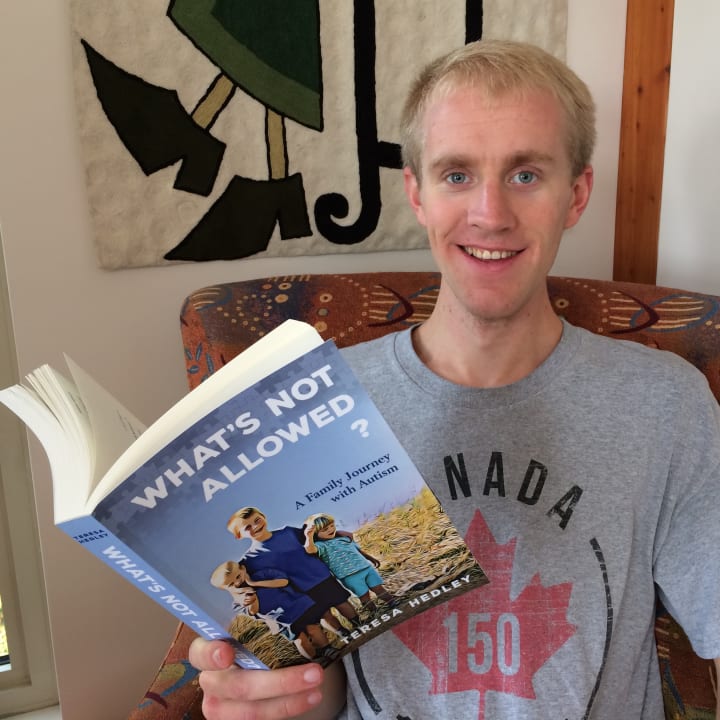
Teresa Hedley is the author of What’s Not Allowed? A Family Journey with Autism (Wintertickle Press, 2020), a memoir which offers an uplifting approach to mining the best version of each of us, autism or not. Teresa is also an educator and a curriculum designer. Teaching stints in Canada, Japan, Greece, Spain and Germany have shaped her perspective and inform her writing. Teresa and son Erik co-wrote a twenty-article series for Autism Matters magazine, “I Have Autism and I Need Your Help.” Additionally, Teresa worked directly with families and school boards in Ottawa as an autism consultant and advocate. She and her family live and play on Vancouver Island, Canada.
"A must-read for parents of children with autism, professionals and the general community."
–ELLEN YACK, occupational therapist, consultant, author and speaker; Toronto, ON, Canada
About the Creator
Teresa Hedley
Greetings from the beach... where you'll find me exploring, reading, writing, hiking and kayaking with our local seals. I'm excited to share my stories with you via What's Not Allowed? A Family Journey With Autism. Now on Amazon + Chapters
Keep reading
More stories from Teresa Hedley and writers in Families and other communities.
ASD Snapshot: Eight Crane Toilets
I am in the women's change room at the local pool. Stepping into my bathing suit, I enjoy the familiarity of the half-lockers, pocked and dented; the tiled floor, two-toned—aqua and blue—and the wooden bench where I rest my tote bag. It's odd to be back, twelve years later, to where our children learned to swim.
By Teresa Hedley5 years ago in Families
March is here.
Here we are in another new month. Looking at the calendar already has dates that must be kept, in this month it has it up and down. It starts with many birthdays to be celebrated and then it turns to darkness with people that passed away in my family as it gets smaller and smaller every year.
By Terri Rosall6 days ago in Families
Love That Acts, Not Love That Speaks
When Love Became a Language Instead of a Practice In modern parenting culture, love is increasingly defined by what is said rather than what is done. Emotional affirmation, verbal reassurance, and constant validation are treated as the primary evidence of care, while less expressive forms of love are often overlooked or misunderstood. A parent who says “I love you” frequently and validates feelings consistently is assumed to be providing something essential, while a parent who demonstrates care through sacrifice, consistency, and enforcement may be perceived as distant or emotionally limited.
By Peter Thwing - Host of the FST Podcastabout 22 hours ago in Families
Review of 'Man on the Run'
My wife and I saw Man on the Run, a nearly 2-hour documentary on Amazon Prime, about Wings, Paul McCartney's group that flew around the world from shortly after The Beatles broke up in early 1970 to shortly after John Lennon was murdered at the end of 1980, making a Beatles reunion forever impossible.
By Paul Levinson7 days ago in Beat



Comments
There are no comments for this story
Be the first to respond and start the conversation.