
Art In An Emergency
Isn't it comforting to know that, for thousands of years, others have made art to wrestle through the dark before you?


We called her Mutti Oma.
German words that mean "Mom Grandma."
As a war refugee, a widow twice over, and a woman who buried her infant son - my great-grandmother knew how to survive hard things. She persevered all the way to her 99th birthday, when she passed away in a nursing home bed.
I didn’t know of her hardship when I was young, and - as is often the case - instead of recognizing her resilience and generosity, I only noticed the dumb details kids do. Like the time she killed a wasp in our house with her bare hands. Or the fact that she always added a boiled egg to instant ramen. Or how she seemed visibly offended by Darth Vader.
During the last years of her life - when she was unable to move or remember much - her final act of sacrifice was to crochet each of her seven great-grandchildren a blanket. As the firstborn, I often wondered if she’d make it down the line to the last. But of course she did. She was Mutti Oma.
Even when she was making those blankets, I remember feeling amazed she could still produce so much when she was already unravelling in so many other ways. Though she couldn't always remember who I was, somehow her stitches stayed in tact; the rare missed loop scooped up by my Oma, her daughter, who would garnish each finished piece with a decorative border.
Now that I am twice the age that I was when I got my blanket, olive green with a lime edge, I think I understand her drive - her obsession to continue - a little more. I have it too, after all.

* * *
The same winter I was given my blanket, I was young enough to think I'd just lost everything. (Everything being a boy I loved, a close friend who got very sick, and the fact that I had no idea what to do with my life).
I had recently graduated from university, and where school had once been a safety net for over two decades, without it - days seemed too empty and adulthood too large. That was the winter I felt the initial waves of depression crest - a feeling I would come to know well in the future (and later better equip myself to tread). At the time, though, all I could do was lie in the dark, my brain weighing heavy, causing me to fixate on whether I’d ever feel okay again. I had too little structure, answers, and - it turns out - serotonin.
It was during those hard hours that I felt intensely pulled to the only resource I knew could take the edge off my sadness: the act of creation. Making things, quite literally, saved me.
Has it saved you?
* * *
Let me ask you something else.
When you hold a pair of scissors, how do you feel? When you slide your fingers around the two plastic handles, move the sheaths, hear, feel - the satisfying snip - do you also sense the optimism of possibility? That the tool is an extension of yourself?
Isn't it comforting to know that, for thousands of years, others have made art to wrestle through the dark before you?
There’s something about physically making an object - about removing, reframing, reclaiming - that has significantly changed my life, forever imbuing it with meaning and satisfaction. It’s the creative escape my body and mind craves, both in times of sorrow and joy. It’s an impulse I cannot ignore.
* * *
When Covid-19 arrived like a hurricane, I was ready. (That is, I knew a little of what to do to shelter in place). This time, the movement and the art that rescued me came in the form of collage.
In an unpredictable world, I spent my evenings cutting and pasting pieces of paper exactly where I wanted them. I spent hours making collages, and they became the perfect distraction for my clouding anxiety. The act of choosing the right colours, designs, and layout became meditative. My depression would ebb during those times. I experienced the relief of flow.
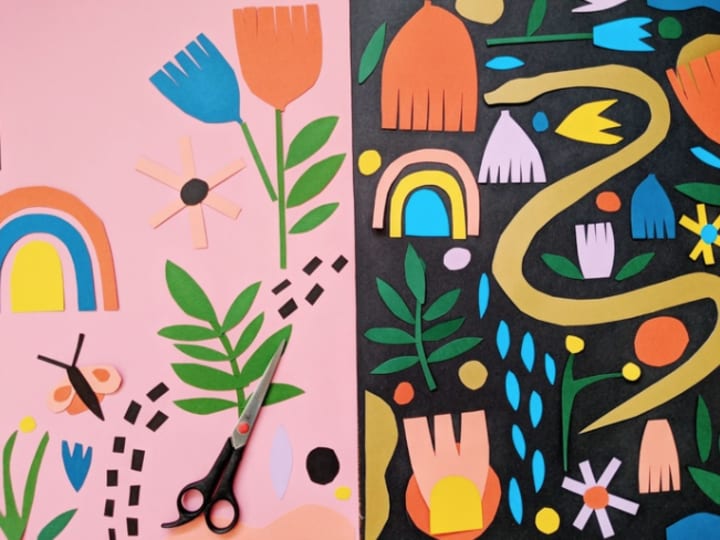
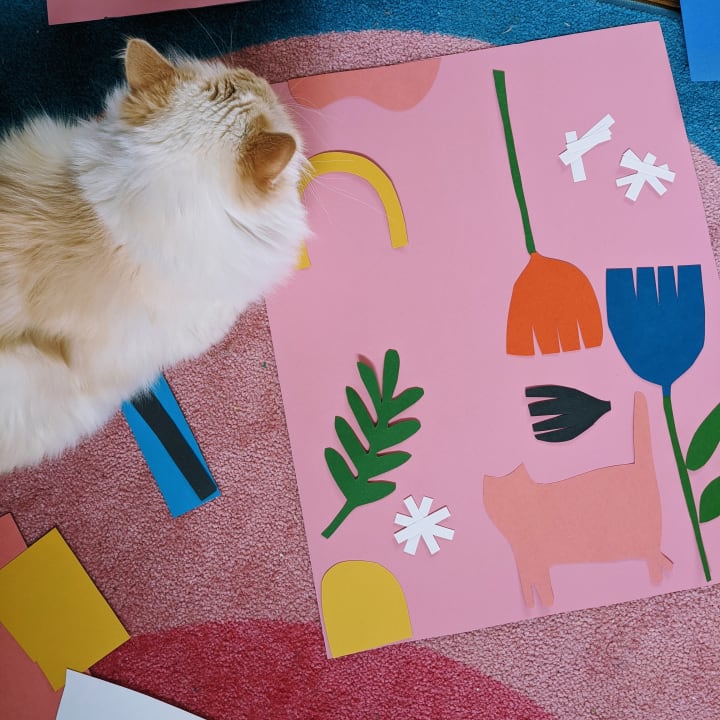
The first pair of scissors dates back to over 4000 years ago (long before those oversized ceremony cutters, scalloped scrapbooking shears, and garden clippers). I like to think that maybe there was an earlier version of me back then, too, repurposing what I could get my hands on - making art to survive.
Before the blankets, Mutti Oma similarly kept her hands and brain busy with another, seemingly endless crocheting project. I think she was the only person on the planet to labour over handmade covers for coat hangers, but they must have instilled her with a sense of purpose and calm; she completely filled our church basement with them, and I still have several of them in my house.
My collages soon found their way outside of my house, too, into the homes of friends and family. I wanted those close to me to look at their walls this year and feel less alone. Three of my closest friends had babies, and all of them received a collage as a gift: a small token to thank them for their ongoing friendship, to temporarily replace the company we’d otherwise spend together.


* * *
When it comes to mental illness, many of my friends regularly feel the same heaviness as me. We see therapists and take antidepressants and have found other ways to get through. When it comes to depression and my family, however, I have often felt alone with my sick brain. I thought I was the only one to experience these things.
I’ve come to realize, though, that even though no one else really speaks of it - that doesn’t mean the struggle is not also there. I can see it in my dad, in my Opa, in my mom. I try to help where I can, to share my own experience and remedies. What families sometimes lack in words, I’m realizing, they share in other inextricable ways.
My mom recently began talking with me about her own anxiety, as we’d go on long ravine walks during quarantine. I think I was the first person she’d ever shared those thoughts with.
During the last few months, I have noticed another shift: that I feel slightly more balanced. Instead of making things for hours on end, to quell and ignore what’s inside me, I have begun to know when to stop crocheting the proverbial clothes hangers. I have discovered healthy ways to care for myself, to soften other destructive edges, and I know art has undoubtedly been a healing bridge.
* * *
When I was a kid, I never wondered about Mutti Oma’s creativity; but, I do now. Did she feel the same deep satisfaction as I do, whenever she picked up scissors or a rolling pin or thread? Is this passion knitted into our family line?
Though I wish I could ask her - and though I wish I could go back and learn a whole lot more - I think I do know the answer.


About the Creator
Carmyn Effa
Carmyn is a teacher and artist living in Edmonton, Canada. Her writing has appeared in Funicular Magazine and East by Northeast Literary Magazine. www.carmynjoy.com.
Keep reading
More stories from Carmyn Effa and writers in Families and other communities.
The Last Letter From My Mother
Life moves very fast. Sometimes we are so busy chasing our dreams that we forget the people who love us the most. A few years ago, I was living in another city because of my job. My life was busy. Every day, I worked long hours, met new people, and tried to build a better future. I thought success and money were the most important things in life. I had little time for anything else, and I often ignored the small things that truly mattered.
By Muhammad Tanveer7 days ago in Families
TUS NUA - ch 53
TUS NUA – ch 53 New Beginnings – Mia and Midnight (*)(*)(*) Finola knew Ali’s brother-in-law needed to put his mind at rest. She fed her arm through his and led him outside. “We’ll sit here. If you like, I can put a block around us so our conversation will be private.”
By Margaret Brennan4 days ago in Fiction


Comments
There are no comments for this story
Be the first to respond and start the conversation.