
Art as Resistance: How Sindhi Folk and Rap Musicians are Turning Climate Crisis into Cultural Call-to-Action
In rural Sindh, amid devastating floods and scorching heat, two young female artists folk singer Sham Bhai and rapper Urooj Fatima (Sindhi Chhokri) are leading the climate conversation through music.

Art as Resistance: How Sindhi Folk and Rap Musicians are Turning Climate Crisis into Cultural Call-to-Action
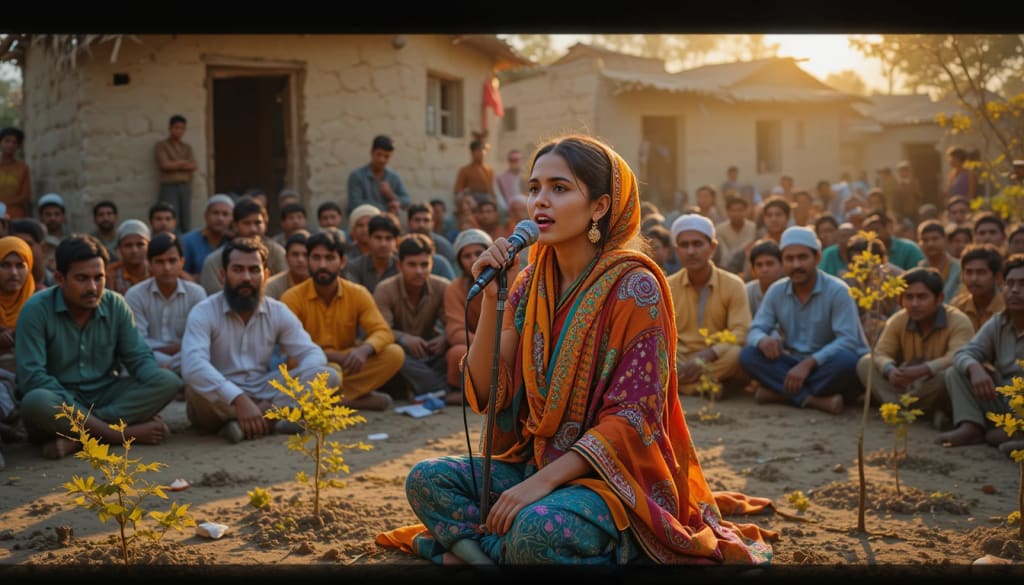
Cold, ragged winds sweep through Umerkot’s dusty lanes. But when Sham Bhai begins to sing, the wind carries more than dust it carries awareness. With her voice rising above the squat, mud-walled houses she travels to, the 18-year-old folk singer turns the language of climate collapse into song.
We are the people of the south. The winds seem to be blowing from the north. The winds seem cold and warm. My heart is burned from seeing the collapsed houses in the rain. Oh, beloved, come home soon. Her lyrics, in Sindhi the language her audience understands best aren’t just poetry. They are the whispered reality of climate grief brought alive.
The Power of Cultural Resonance
Sindh, often pounded by extreme weather from flash floods to heat waves is one of the most climate-vulnerable regions in Pakistan. The catastrophic 2022 floods alone caused more than 1,000 deaths in Sindh, destroying homes, roads, and infrastructure.Coupled with 2024’s lethal heatwave that pushed temperatures above 49 °C, which led to hundreds of fatalities, Sindh is living in the harsh glare of climate reality.
In this battered context, Sham’s songs deliver climate science with soul. She opens her performances with familiar upbeat folk tunes hooks to draw in the audience then transitions to mournful climate ballads that reflect lived experiences, like destroyed mud homes and disrupted rhythms of livelihoods . In rural Sindh with a literacy rate around just 38% this kind of artistic translation of climate knowledge is vital
Her impact? Immediate and tangible. “People are acting on our advice; they are planting trees and making their houses strong to face climate change,” Sham shares. “Women and children suffer a lot during bad conditions, which damage their homes.”
Rap as Revolution: Urooj Fatima’s Bold Anthem for Climate Justice
Beyond folk, a new wave of resistance surges in rap. Urooj Fatima, known as Sindhi Chhokri, infuses hip-hop with climate activism rooted in her personal trauma her village was flooded in both 2022 and 2024 . In a cultural landscape where female rappers are rare and rhythm is often romantic or traditional, Urooj’s voice is a bold disruption.
We can engage a lot of audiences through rap. If we go to a village and gather a community, there are a maximum of 50. But everyone listens to songs. Through rap, we can reach out to hundreds of thousands of people through our voice and our message.
One of her most searing tracks, written after the Balochistan floods of 2022, doesn’t mince words:
There are potholes on the road; the roads are ruined,” she raps.
Where was the Balochistan government when the floods came? My pen thirsts for justice. Now they've succeeded, these thieving rulers. This isn't a rap song, this is a revolution.
Her activism extends far beyond the stage. Alongside her sister, Khanzadi, Urooj organizes tree-planting drives, village outreach, and protests all while demanding that the Sindh government invest in climate education in rural areas
Women First, Always
Both artists highlight how climate disasters disproportionately impact women and girls. Sham notes that women are the most vulnerable during floods tasked with fetching water, caring for children, and often left alone when men migrate for work . Urooj underscores how climate instability compounds challenges in education, hygiene, and nutrition, entrenched in gender inequality
Their music isn’t only about disaster it’s about community resilience and inclusion. Music becomes a safe, emotional conduit for solidarity and survival in places where formal systems fail.
A Symphony of Social Change
This artistic movement doesn’t just tell stories it mobilizes action. Villagers start planting trees, reinforcing homes. Conversations spark, local governments take notice, and slow but meaningful change begins. In the absence of widespread internet or institutional support, Sham and Urooj’s songs cross distances, bypassing barriers no text or bureaucratic poster ever could.
Their art preserves Sindhi linguistic heritage, stirs climate resilience, and amplifies voices that history often overlooks. It’s activism encoded in melody and verse authentic, accessible, and unforgettable.
About the Creator
Farooq Hashmi
Thanks for reading! Subscribe to my newsletters.
- Storyteller, Love/Romance, Dark, Surrealism, Psychological, Nature, Mythical, Whimsical
Keep reading
More stories from Farooq Hashmi and writers in Families and other communities.
The Man Who Cycled 500 Miles Just to See His Family
A Real Life Story Part 1: Lockdown and Loneliness March 2020. The world came to a halt. Streets emptied, shops shuttered, and fear spread faster than the virus itself. In the bustling city of Delhi, where millions of dreams breathed under layers of dust and neon lights, one such dream belonged to Ram Lal, a 32-year-old migrant worker from Bihar.
By Farooq Hashmi7 months ago in Families
Christmas Abroad: Celebrating the Holidays Without Family
I moved to South Korea in 2017. I was twenty-two years old and excited to start my career as an English Second Language Teacher. With a Bachelor's degree and six hundred dollars in my bank account, I set off for Busan.
By Kera Hollow27 days ago in Families
Where Love Lives: A Slow Sunday Inside Our Family Home
There’s a quiet magic in ordinary mornings—the kind that doesn’t shout, but lingers in the corners of your heart long after the day has passed. For our family, Sunday mornings are like that: a gentle rhythm of laughter, familiar routines, and soft celebrations of simply being together. If you asked someone passing by our home at 9 a.m., they might mistake us for a movie scene—the scent of fresh coffee, the hum of soft music, and the comforting clatter of plates and cups filling the kitchen. But there’s nothing cinematic about what we do. It’s ordinary. And it’s ours.
By Divexa Exchange3 days ago in Families


Comments
There are no comments for this story
Be the first to respond and start the conversation.