

I can’t remember when or how I first learned to stitch. It was probably on a thick piece of cardstock with an outline of a camel or maybe a horse on it, and bright yellow or maybe orange yarn pre-threaded on a huge plastic needle. A specially made kit for kindergarteners, in a box that proclaimed that you could sew just like mom! No scissors required. When you finished one, you simply took the yarn out and did it all over again. It was like a dot-to-dot picture, with yarn.
Soon enough I graduated to real stitching, a pillowcase or a tablecloth. My mother taught me how to do basic “crossed stitches” and later worked with me on embroidery, laying down a straight line of thread to create a stem, a leaf, or a ribbon. The pattern was ironed on the fabric in mimeograph blue ink. There were no particular colors to use; you used whatever you wanted. It was pretty simple, where there was a blue line, you covered it with a stitch. It enchanted me even then at the ripe old age of 10 or so. I couldn’t get enough; I felt like I was a grown-up sitting on the couch and listening to the television while I stitched. There was no “wrong way,” except when I accidentally concocted big knots on the back of the fabric, with so many threads going every which way. My mom was stumped at my knots. “How did you get a knot so big?” she would ask and I would just shrug. The only fix for those huge knots was to get her big orange scissors and cut it all off and start again. When I finished my pillowcase, I asked for more. Soon I was finishing off my mom’s pillowcases and other projects. I presented her with one when she came home from work with a big smile and “See! I finished it for you!” Not quite realizing then, that the real pleasure was in the doing, not the “done.”
There were only so many pillowcases and tablecloths a person can stitch and soon I found myself pining for something more, a new challenge. At a friend’s house, I saw pictures of needlework hanging on the wall, pictures made out of the same needle and thread I was using! Pictures made just for the fun of it, not for putting on your pillow or Sunday table. Maybe a picture of a red barn with a white rail fence and some black and white cows in the distance. Or perhaps a picture of some kittens playing in a basket full of thread with a pair of scissors sticking out in the corner, always with exactly one strand of thread hanging across its head. I told my mom about the pictures but she couldn’t tell me what they were or how they were made. She suggested that perhaps I had seen a painting that was somehow made to look like it had been done with needle and thread. No, that wasn’t it either, because I could reach out and touch the threads in the frame. But I resolved to find out.
I fortunately didn’t have to wait too long. Some time later, my mom and I went to visit my Aunt Opie, who was always doing something crafty. I told her about the so-called paintings that I had seen with the red barn and the basket of kittens, and that they seemed to be made with needle and thread. She went digging through some of her old magazines, pulled one out and asked me if it was something like this. The magazine was old and the pages were starting to come loose, but there was a picture of a woman stitching a picture of a fish. The fish looked real, just like it had jumped out of the water and onto her cloth. Yes! I said, just like this! My aunt said this was counted cross stitch and she would be happy to teach me how to do it if I brought a pattern I would like to do and some fabric and thread.
Mom said I could use my allowance to get the fabric and a pattern at the store next week. That week seemed interminable. I went to school and completed my homework but the long days stretched before me. When it was finally Saturday I was out of bed and raring to go. At the shop I picked out a pattern of a bald eagle in flight and a tube of white fabric. I even had a couple dollars leftover, so I bought myself a pair of orange long-handled stitching scissors; I felt like I was in the major leagues now.
Back at Aunt Opie’s house, she taught me how to “read” a pattern. Counted cross stitch is called that because of all the counting involved. She showed me the key, which is the list of colors the designers used in creating the chart. Each color was represented by a specific symbol, like a number or a star or an asterisk. It seemed a bit like the Dot to Dot stitching on cardboard I had done when I was five, except that you had to find the “right” dots in the midst of so many others. She showed me how to fold the fabric into quarters to find the center point of the fabric, and then to follow the marks on the chart to find the center point of the pattern. She showed me how to thread the needle without putting a knot in it like I was used to with embroidery. She taught me about the count of the fabric. The fabric I bought was 32 count, which meant that there were 32 tiny stitches to the inch, while 11 count fabric would only have 11 larger stitches in an inch of fabric. And she taught me how to follow the pattern much like a city map, counting over three spaces to do a stitch and then up five spaces to do three more.
I used a shade of brown to put my first halting cross stitch in the exact center of the fabric. The big V in the exact center of the chart matched where I should place my stitches; there was a line of seven V’s just down from there. I carefully looked at the pattern, then at the fabric, and then back again, before finally making my move, as hesitantly as a brand new driver starting out on her own. I gasped when the thread came all the way out once, then twice, and asked for help. Aunt Opie showed me how I was supposed to secure the first stitch in place by tucking the end of the thread underneath other threads as further stitches were made. When I finally completed the center starting point stitch and the line of seven V’s just down from there, I held up my fabric and compared it next to the printed pattern before me. Something wasn’t quite right. The center stitch seemed to be in the right place, but the line of seven seemed to be wrong. I counted them again. Yep, there were seven. Only the pattern showed that the line should be going to the right of the center stitch, and mine were going to the left of the center stitch. I again asked her for help and showed what I had done. How do I fix this? I asked her, and she said there were two ways. One way was by pulling each stitch out laboriously one after the other, and that would preserve the thread so I could use it again. Or I could use my pretty orange scissors to carefully cut them all out and start all over again. Since I only had a little bit of brown, I decided to pick the stitches out, using my needle to undo the stitches. Even as I was picking out the stitches I was thinking that this was much more fun than embroidering a pillowcase ever was.
Having learned the basics of counted cross-stitch from my aunt, I set about stitching more and more. I stitched my bald eagle and learned the hard truth about counted cross-stitch. Some stitches were often laid out in a skeletal or frame like manner so that other stitches could be “hung” on the bones of the first stitches. And once those stitches were done, there were some finishing stitches made to complement that corner of the design. But if the first count was off, then everything else was off. If one wing of the eagle called for 10 stitches in this Brown framework stitch, and only 9 stitches were done, the whole wing would be off. Worse still, if the finished wing was used as a guide for where to put the tail feathers, then they too would also be off. Errors caught early were fortunate. Errors caught late were time consuming and frustrating. An hour spent stitching could be undone in 2 hours of ripping out stitches with my scissors and needle. I learned to check and double-check the number of stitches I should be making, and where the end of a given row should be. Even after double-checking, I still messed up and that’s how I knew that the error was farther down. At one point I had most of the eagle completed, only to have to rip it all out and start over because a branch was up farther than it should have been and it was blocking the location of the tail feathers, which was in turn blocking the wing feathers.
And then there were the knots. The times that I pulled the needle through the fabric only to find a great big knot in it. Once or twice I managed to stitch the fabric to the embroidery hoop I was using, requiring more unpicking of stitches. I’m not even sure how I managed to stitch the hoop to the fabric. Despite these occasional setbacks, I still found it great fun and enjoyed seeing a picture coming to life, stitch by stitch. I learned to unpick knots and feel when the thread caught itself on the hoops. As always, my scissors stood ready and waiting to be called into action on a moment’s notice.
When I finished the bald eagle project, I passed it off to a friend in a cheap frame. I couldn’t wait to start something else. I stitched a calendar, a grouping of cats, a lighthouse for my brother, a Mother’s Day memento for my mom and a similar project for my grandma. I learned that counted cross-stitch was not just a hobby but big business with several industry magazines, hundreds of needlework shops, designers and artists.
Going off to college did not dampen my appetite; it only gave me new shops to linger in. I actually ditched a few classes, not because I was sick or wanted to sleep in, but because I was obsessed with getting more time to stitch. My mother complained that I had a large pile of patterns stacking up in my bedroom at home. I also had my own stash of thread that I kept in a shoebox in my closet. I pored over the magazines and taught myself to do various stitches, working over two threads to make a bigger stitch, French knots, half stitches and quarter stitches. My big orange scissors were good for cutting thread but not so good for cutting out knots, so I traded them in for a smaller pair about half the size and better at cutting tiny knots out. When I was stitching I was truly happy. A few stitches in and I could start to see the curve of an ornament, the arc of a skirt, or a kitten’s fuzzy tail. The weight and worries of the world fell away for a while. It was a mesmerizing hobby as addictive, and more satisfying, as any drug.
The drive inside me to stitch only came to a halt when I met my husband. Dating a handsome young man, going to college, and working full time all contributed to a new and exciting lifestyle for me, but did not allow time for stitching. When I had my two children, that further eclipsed all of the free time I had. It pretty effectively kept me away from stitching for a long while. My extended family knew that I missed stitching, and asked me about it from time to time, but I just couldn’t get myself back in the game. Finally when my children were teenagers, I started to work on a simple project. It was only a few colors and didn’t require a lot of counting, so it was like taking baby steps after being gone from it for almost 20 years. I was hesitant, afraid to make a huge mistake which would rob me of motivation. I needed not have worried, it was like riding a dusty bicycle, all of the old skills came rushing back. I had started with a Christmas tree ornament, but with the success of that I jumped back in the deep end. I found a design I loved and set to work on it, working on linen, a new fabric for me. A few minor miscounts and I was back in business. I was so proud of what I had made this time, a woman holding an infant, that I immediately took it to be professionally framed. She hangs in my home now, my celebration of being a mother who stitches.
My children, in\dependently of each other, asked me to teach them how to cross-stitch, and I took each of them out to the store to pick out a special kit. My son picked a frog, my daughter a kitten. Then I sat with each of them and showed them how to read the pattern, find the center, and select the right color. I let them thread the needle and very carefully make their own hesitant crossed stitches on the little square of Aida fabric. From there, I showed them how to find where the next stitch should go and sat nearby and watched patiently while they learned by doing as I had so many years before. My son’s frog ended up in knots, a few tears, a declaration of “I don’t like this,” and a hug. My daughter finished her kitten and said, “Okay, now what do I do?” She too had been infected with the stitching bug. I showed her my large collection of patterns and magazines, and she browsed through them before settling on a medium-sized design. She is perhaps not as excited as I get about stitching but she does enjoy it.
My husband asked me what I wanted for my birthday and I sat and thought on it for a bit. I had just recently acquired some new embroidery scissors made by Fiskars, a tiny silvery pair great for ripping out the tiniest of mistakes or knots. I told him that a collection of the floss would be great, and he indulged me with one skein of every color so that I could sit down and start a project without first having to wonder if I had the thread (floss) for it first.
My mother saw my picture of the woman holding an infant and asked who I was giving it to, and I said no one. She said something to the effect of it’s been a long time since you stitched anything for any of us, we’d all be tickled pink if you were to stitch us anything like this. I told her I would take that into consideration. No one had ever asked me to stitch them something before. I thought about what I was going to stitch next, and I didn’t have a good answer. I had never actually stitched anything for Aunt Opie, the one person who had taught me how to do counted cross-stitch. I resolved then to do something for her, but what?
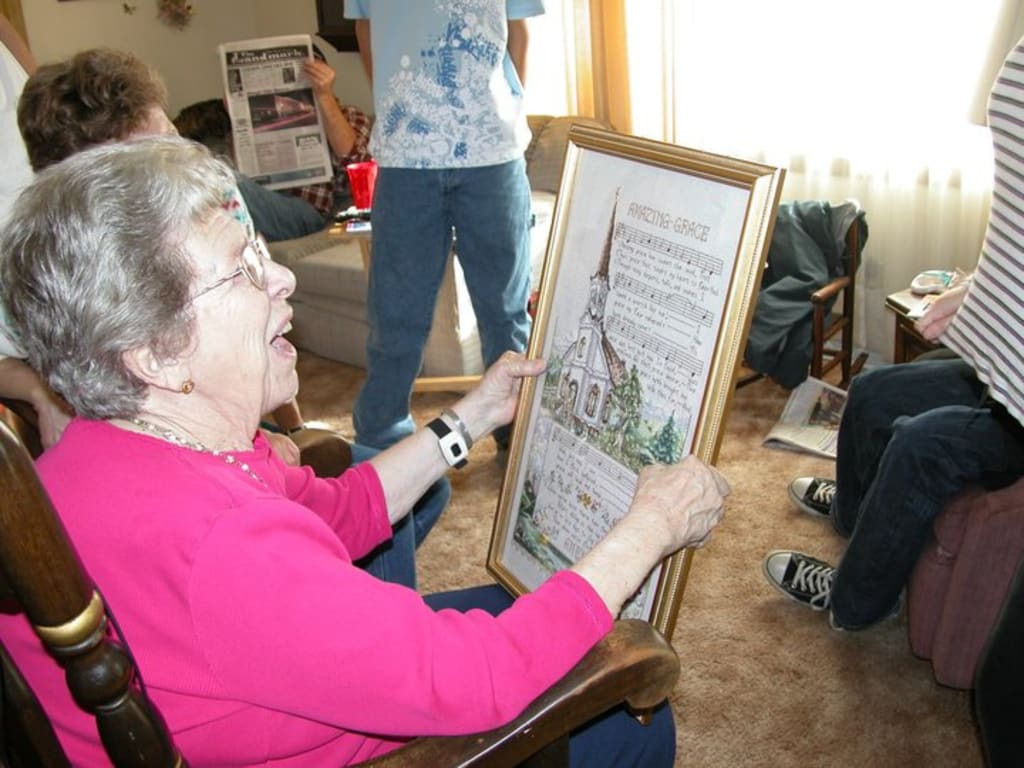
I pondered what to stitch for her for a good long while. She was getting older and more frail and so I needed to move quickly. She attended a Christian Assembly Church in our hometown. I called her and under the guise of asking about Easter services, I asked her what her favorite hymn was of all time. She said oh, “Amazing Grace” had always been her favorite.
I used the internet to find a booklet that had patterns made from various hymns. There was one for “Amazing Grace,” but I didn’t like the look of it. It was just musical stanzas dressed up with flowers on the edges, and I wanted something that was more of a challenge. I found another pattern which had a musical stanza and the words in a corner, but that was dwarfed by a large picture of a church, with flowers, also a golden cross, and Jesus holding a lamb. The hymn was not “Amazing Grace,” but something else entirely, and not even one that I recognized. I could do this, I thought to myself, and I could change out the music to “Amazing Grace.” It couldn’t be that hard to do.
I set about ordering the fabric I wanted to use and laying out the threads. This project would be a treasure, I could feel the enormity of it inside of me. I wanted to get on the phone and tell everyone what I was doing. But of course I couldn’t; this was going to be a surprise, a gift to the woman who had given her time to teaching me how to count stitches in the first place, and I couldn’t risk anyone spilling the beans. There was going to be no room for error. I got out my best hoop and my Fiskar’s embroidery scissors. I bought a pad of graph paper to diagram the chart for the “Amazing Grace” hymn which would be the last section of the pattern to be completed. The pattern also called for a few gold charms which I also purchased and set aside for the time being.
The stitching of the church was the most immediate part of the pattern, and it was where the chart began, as part of it was in the center. I worked faithfully on it everyday for weeks. There were many frustrating problems, mostly caused by very similar colors. The church was white, but not entirely white; many of the surrounding colors were very, very similar. This made it very easy for errors to occur (and they did). The roof of the church was done in shades of brown, which also lent itself to many errors. By the time I was halfway done, I had already ripped it out in its entirety no less than three or four times. I was wholeheartedly dedicated to finishing this project for my aunt, and stitching made me happy, but my morale on this project was waning. My embroidery scissors were being used more often than my needles, it felt like. What should have been a fairly easy piece to stitch took months. Sometimes I put it down and could not bear to pick it back up. I was starting to feel burned out and I hadn’t even gotten to the music part yet. My husband suggested that I start on another side of the pattern and work towards the area that I was struggling with, and I did that for some time. I began to lament the day that I chose this pattern because it was a challenge.
It was at about this time that Aunt Opie went into the hospital. I don’t know what was going on, only that she had to have some sort of neck surgery. Something went wrong during the surgery, and she ended up in the ICU for several days. There was talk that she might not make it. This scared me, and goaded me into finishing the project like never before. What if I worked on this project for her, only to have her die before I finished it? I couldn’t bear to think of it. I vowed to pay more attention to what I was doing and to be less distracted so that I could finish it and not have to rip it out. I prayed for more time with my aunt alive on this Earth.
And then one night, it was done. I grabbed for the hymnal and graph paper at my side. The pre-existing hymn had four verses, the same as Amazing Grace. I used the font of the pre-existing hymn, just changed the words. It didn’t take too long to graph out the words. Then the musical stanza gave me pause. The stanza showed notes where they should be for the pre-existing hymn. I wasn’t sure if Aunt Opie knew how to read music, or if in the future, anyone looking at this would know that the music would not be for “Amazing Grace” but for some other hymn. I decided it would be best to put in the actual music for “Amazing Grace” and end any future arguments about it right then.
So that’s what I did. I graphed out the music, which fortunately wasn’t too complicated in the hymnal I was using, and then I went to work with my needle and thread again. Doing the lettering and the stanza itself was just backstitching, which is very similar to embroidery; it’s just a single line. I attached the gold crosses and charms with fishing twine which is essentially invisible when stitched into a project. It took me a couple of nights to get the hang of stitching with fishing line, and more than a few jokes from my husband, the fisherman in the family. By the time that I had reached the music, the stitching was all downhill from there. It took only a few days to finish the music and then it was off to be professionally framed.
A few months later, I presented “Amazing Grace” to Aunt Opie at our family Thanksgiving dinner. She held it and looked at it for a long, long time, pointing out the tiny little details to the nearest person. She said that she didn’t know what to say; “Thank you” wasn’t quite enough. I told her that I kind of felt the same way about her; “Thank you” wasn’t quite enough from me to her. She gave me a bit of her time and taught me how to count stitches; I was merely repaying the favor. We shared a big hug and some tears. She took it home and hung it in her living room.
Aunt Opie passed away about a year later. She slipped away quietly in the night when no one was looking. “Amazing Grace” was there on her living room wall, right where she could see it from her favorite chair. When they came to clean out her home and take away her furniture, “Amazing Grace” went to my grandma, Aunt Opie’s sister. There it hung on the wall, where my grandma could see it from her chair for a few years. When my grandma passed away and they came to clean out her home and take away her furniture, “Amazing Grace” went to my mother. That should have been the end of this story, but my mother passed away unexpectedly recently, and when they came to clean out her home and take away her furniture, “Amazing Grace” was returned to me. It hangs in my home now, alongside several other treasured pieces.
Stitching still has the ability to make me happy like no other hobby or pastime. Despite my grumblings about occasionally stitching with fishing twine or trying to get something just right, it is still a pursuit of happiness. Earlier this year I worked on an undersea project which called for the stitching of a Manta Ray, whose pattern was on two separate pieces of paper. I stitched that Manta Ray once only to realize that it would not align with the other half of the pattern, so ripped it out and stitched it again only to repeat the mistake, just from a different angle and have to rework it. I must have stitched the single Manta Ray six or seven times enough to create it's own school before I managed to get it right. I have told my husband and children that when I pass away, to make sure that my stitching supplies are donated to a person or organization that actually knows about counted cross-stitch and will enjoy the supplies as much as I have. I’ve told my children to at least donate the completed pieces to charity or Goodwill. My daughter surprised me by stating that she and her brother have already talked about it and have no plans to do any such thing. They plan to keep my pieces as their own and make them a part of their homes. I cannot think of a higher compliment.
About the Creator
Keep reading
More stories from writers in Families and other communities.
Wise~Guys
— Look Behind what's in Front of You ~ Make Good Choices — Hey, So how you Doin'..! Made~Men — Mobster Movies romanticise a distinctive, elegant appearance, impeccable attire style, along with the 'Families' expressive lingo. Making their 'Bones' gave them Panache — with vintage fedoras, tailored pin-striped suits, mirror-polished wing-tip shoes adorned with tassels; with their 'Gun Moll' gorgeous dates on their arms.
By Jay Kantor24 days ago in Families
Rage
Content Warning: Domestic Violence, Assault Rage D. A. Ratliff “Who did this?” My voice echoed through the house. All I wanted was a cup of tea, but one of the twins, running through the house like maniacs, knocked it over. My nerves tingled, and every muscle in my body felt coiled like a spring. Survival seemed out of reach.
By D. A. Ratliff5 days ago in Fiction



Comments
There are no comments for this story
Be the first to respond and start the conversation.