
After a stroke, a British woman speaks Italian when she wakes up.
If they are unable to obtain specialized assistance, stroke victims can, when appropriate, use basic techniques to aid in their rehabilitation.

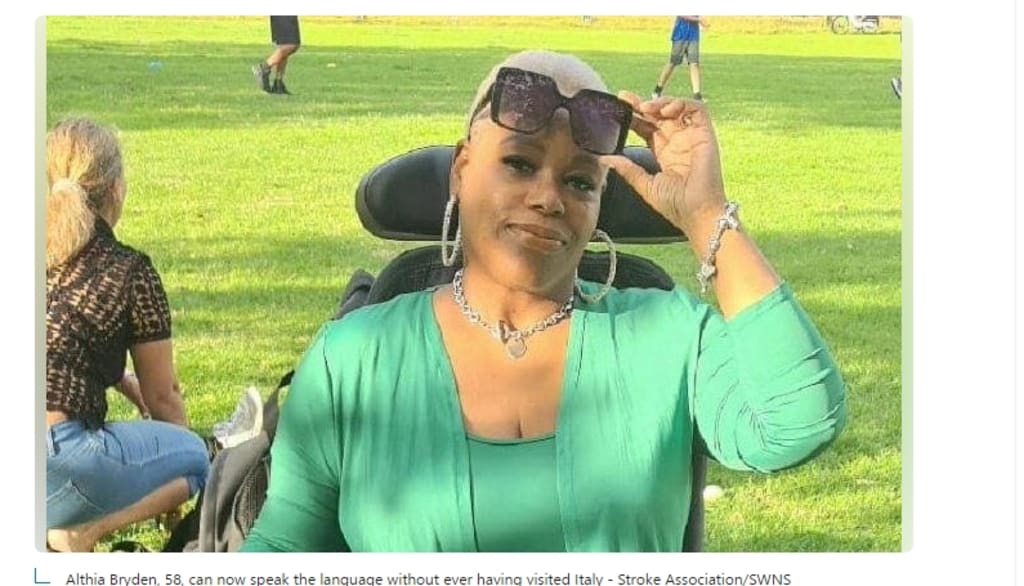
Despite never having been to Italy, a British woman claims that a stroke gave her an Italian accent and the capacity to speak the language.
After a stroke brought on by a carotid web—a shelf-like structure in the neck that can stop the blood supply to the brain—58-year-old Althia Bryden was discovered unconscious by her husband Winston one evening.
Mr. Bryden phoned an ambulance right away after seeing his wife "staring and unable to talk," calling it "terrifying." For nine days, the grandmother of two stayed in the hospital.
After three months of being unable to talk, Mrs. Althia woke up on July 30 with an Italian accent and the capacity to communicate after being readmitted to the hospital for surgery to remove the carotid web to use the language's words.
She is said to have foreign accent syndrome, a rare medical disease that creates the appearance of a foreign accent in speaking, even if the person has not learned it.
In an unexpected way "I thought I would never be able to talk again for three months following my stroke," said Mrs. Althia of Highbury, North London. I thought I was only a shadow of the person I used to be. When a nurse visited my hospital bed to perform a routine check after my carotid web surgery, I suddenly started talking. She appeared just as surprised as I did.
"First of all, I was shocked that I was speaking, but I also didn't recognize my voice sound.” She claimed that hospital employees and physicians crowded around her bed to listen to her speech.
"We all got more perplexed the more I talked," she said. "Before my stroke, they asked me if I had an Italian accent, and they told me that I did. I was confused in the chaos of it all."As the days passed, it became evident that I had a strong Italian accent and that I was unable to regulate my speech patterns. To my surprise, I can also speak Italian, which is a language I had never learned or used before.
"A marvel of medicine "In the middle of a conversation, I will unknowingly use an Italian word that is the equivalent of what I'm attempting to say in English. "My brain simply translates the English word into Italian; I have no idea that I'm about to do it."
Mrs. Althia continued by saying that because none of the medical professionals had ever seen foreign accent syndrome before, they considered her to be "a bit of a medical marvel," which made her appreciate how uncommon the ailment is.
She said it was "really hard" to live with the illness following her stroke. "I don't feel like myself with this foreign accent, so I usually wake up in the mornings hoping that my old voice will return.
Even when I'm thinking, I can hear the accent in my head," she added. "When people ask me where I'm from, I have to tell them the story of how I got this accent over and over again. It's a story I have to tell to others more often too."
Some patients can also benefit from solving mental puzzles or jigsaw puzzles, which can strengthen brain connections, increase short-term memory, and improve dexterity.
Neural pathways and analytical thinking can be enhanced via brain teasers like Sudoku, crossword puzzles, learning a new language, cognitive brain training on apps, and conversing with others, which enhances communication and reduces social isolation.
David Werring is the British & Irish Association of Stroke Physicians' president-elect and a neurology professor at University College London (UCL). He asserts that the adage "use it or lose it" applies to cognitive abilities. "Look for something fun to do. That might be reading or solving puzzles. Even though it may be difficult following a stroke, depending on the kind of stroke, anything that tests the brain is probably beneficial. Don't forget your relaxing pastimes.
When it comes to stroke recovery, leisure activities are frequently neglected. Previously enjoyed hobbies and interests become less popular. However, there are therapeutic advantages to leisure, such as improved well-being and mood enhancement.
About the Creator
Keep reading
More stories from Francis Dami and writers in Families and other communities.
Wise~Guys
— Look Behind what's in Front of You ~ Make Good Choices — Hey, So how you Doin'..! Made~Men — Mobster Movies romanticise a distinctive, elegant appearance, impeccable attire style, along with the 'Families' expressive lingo. Making their 'Bones' gave them Panache — with vintage fedoras, tailored pin-striped suits, mirror-polished wing-tip shoes adorned with tassels; with their 'Gun Moll' gorgeous dates on their arms.
By Jay Kantor18 days ago in Families
Kids Beds Suitable for Smaller Bedrooms: Smart Comfort Without Crowding
Not every child has a large bedroom. In many homes, space is shared or limited, which means every piece of furniture needs to be chosen carefully. A bed that is too big or bulky can make a small room feel cramped and uncomfortable.
By Shazad Khan3 days ago in Families



Comments
There are no comments for this story
Be the first to respond and start the conversation.