
A Story From Bernie's Mitten Maker
My Grandmother's Quilt

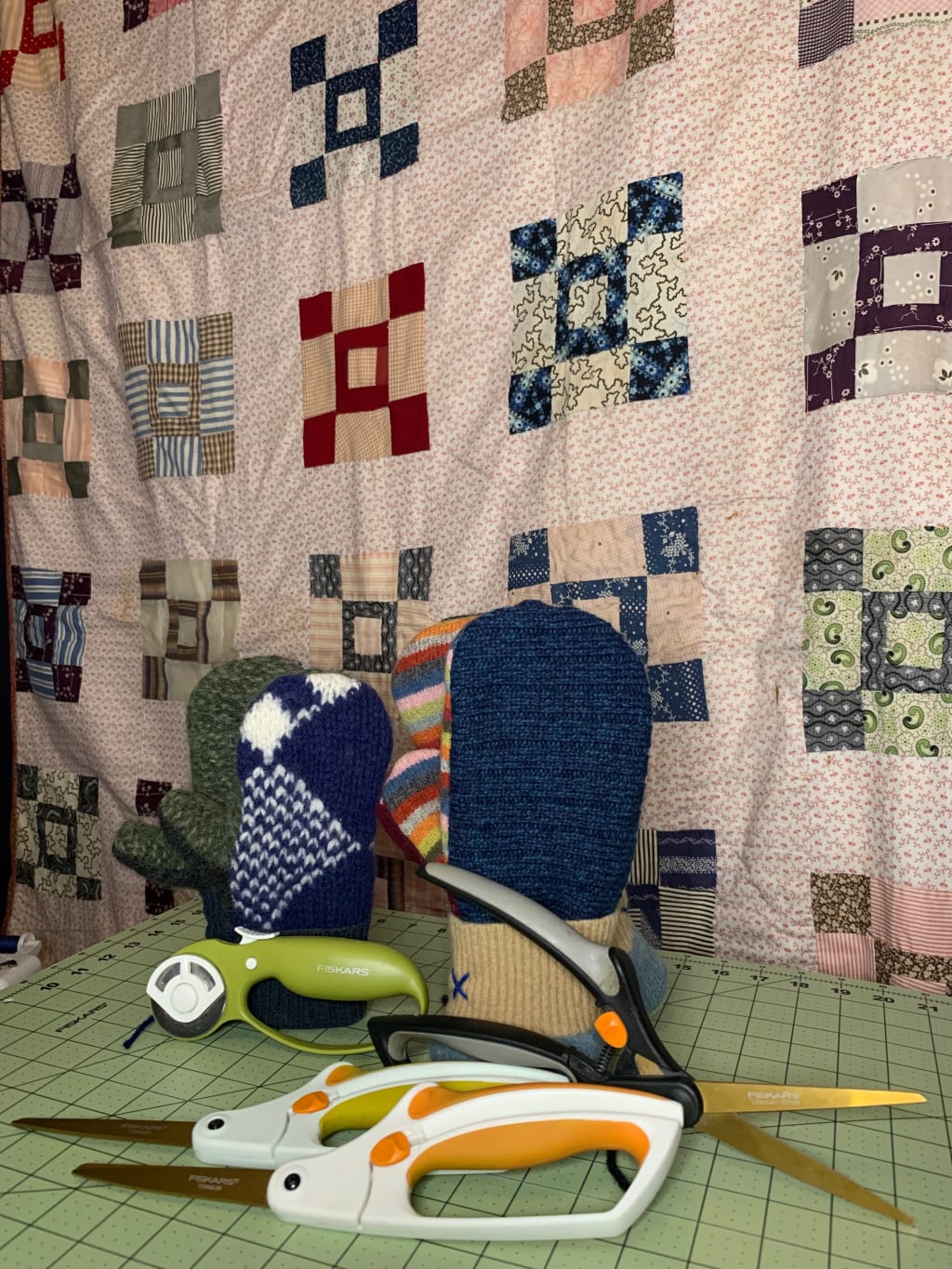
Most people know who I am because I made Bernie Sanders’s mittens; you know, the ones from the memes? Yes, I made those iconic mittens for Sanders four years ago because he’s my favorite senator. I used my Fiskars to cut up an old moth-eaten sweater and the Singer sewing machine my mother gave to me on my twelfth birthday to sew the pieces together in the shape of a mitten. But this story isn’t going to be about the mittens. Everyone has already heard that story. Long before I made those mittens, I made something far more important to me. This is the story of my grandmother’s quilt.
It was in the summer of 2001 when I went down into the basement of my mother’s house on a hot, humid day, looking for fabric to make a quilt. I had just completed my first year of Teach for America, teaching high school English in rural North Carolina. My girlfriend and I had broken up, and so, with no summer plans, I headed home to Maine to help my mom, who was recovering from surgery. Settled into my old twin bed, with the summer stretching out before me, I had nothing to do and my mother was not up for adventure.
The fabric box had sat under the workbench, perched on a pair of two-by-fours, since we moved to the house in 1985. It was originally a large TV box. Over the years I had mined its contents for various school projects and costumes for plays. I was thinking that if I could find enough fabric, I might be able to get started on a quilt that day. I had just dug out my old sewing machine, and it sat waiting for me on the dining room table. It was a simple Singer given to me when I was twelve by my mother- who was an accomplished seamstress. I suspect she gave it to me in part so that I would stop tinkering with hers. The layers of fabric in the box were like a time capsule. There were scraps from the two Halloweens I dressed as a clown. There was some blue and brown fabric from the year my brother was Robin Hood. My favorite fabrics were the psychedelic, neon patterns out of which my mom had made her bell bottoms in the 70s.
There was a clump of fabric at the bottom of this box that had been there for so long, the weight of all the other fabrics had compressed it into a solid block. I pulled it up like a hunk of sod from the garden. The years of fluctuating moisture in the basement had stuck the fabrics together so that they were stiff and bound. I brought the pile under the florescent light of the work bench and realized that it wasn’t simply stuck together: it was sewn. I unfolded it to reveal an unfinished quilt face. The fabrics were cut into small rectangular and square pieces and stitched together by hand. It was a collection of many colors of cotton fabric. There were floral prints and solids, pinks and navy blues. It looked like pieces from every homemade dress I’d see in family photos and reminded me of the patterns on my grandmother’s cooking aprons and the brown stripes of my grandfather’s button-down shirts.
Time had not been kind to this piece; it had many stains and in two places appeared to have cigarette burns, which was odd because no one in my family smoked. It was larger than a twin sized bed quilt, but not quite big enough for a full-sized bed. The quilt blocks were lined with a grid of antique white panels adorned with tiny dark red flowers. The stitching was even and careful. I wondered what sort of school or Girl Scout project had prompted my mother to hand stitch such an intricate quilt and why she hadn’t finished it. I carried it upstairs into the sweltering living room where my mom lay on the couch, beneath a ceiling fan, reading.
“Mom, look at this cute quilt I found. Did you make this?”
“Let me see it.” My mother put down her book and lowered her reading glasses to inspect the fabric. “I didn’t make this, no, my grandmother made it a long time ago for my mother. Where did you find it?”
“It was in that old fabric box in the basement.”
“Ugh—I’ve been meaning to bring that box to the dump. The last time the basement flooded it got wet and everything inside it is gross.”
“Well, this quilt isn’t gross. I mean, it’s dirty, but it could be cleaned. Can I take it and finish it for you?”
“No. I have been meaning to finish that. I want to do it.”
“Mom! It was in a box you just said you planned to throw away! How long have you had this quilt face? Thirty years? If you were ever going to finish it, you would have already done it. Come on, I’m bored. Let me finish it, and I will give it to you for Christmas.” My mother reluctantly agreed.
Though I had every intention of finishing the quilt that summer, I worked on it for only one day, then put it down and forgot about it until I was packing up to drive back to North Carolina at the end of the summer. I figured once I started teaching in the new school year, I would be too busy for sewing, but I had a little space available in my car, so I tossed in my sewing machine and the quilt, just in case.
The humidity seemed to drip down the walls as I returned to the cabin I shared with my friend and fellow teacher, Tara. The rental was on a small, polluted lake right off Route One; the highway that went directly to Raleigh. There were about ten other houses on the dirt road which stretched halfway around the water. The makeshift neighborhood was situated between an abandoned mobile home park to the north and an active mobile home park to the south. Packs of stray dogs ran alongside the highway, in and out of the culverts, shamelessly mating on the side of the road. The owners of the cabin named it the La-Li Lodge, and only rented to Teach For America Teachers because: “You people are the only ones who pay your rent on time.”
Despite its creepy location, the La-Li Lodge had an expansive deck overlooking the lake with stairs leading down to the water. I spent hours on that deck playing cards with Tara or grading papers beneath the pine trees. We bought a hammock and adorned the space with potted plants and strings of lights. It was a little oasis in an otherwise destitute corner of the town of Franklinton, North Carolina.
My second year of teaching began, and I jumped right back into my lesson planning. I went to the football games (something I never did at the high school I attended), tutored students after school, and generally felt that I was about one hundred and fifty percent more prepared than I’d been the year before. I was teaching a slate of classes from freshman to senior English. My students ranged from fourteen to eighteen years old. Though I was twenty-three, I appeared to be the same age as many of them. Sometimes people would come to the classroom looking for the teacher, and they would look around for a good long time before asking a nearby student if the teacher had stepped out of the room for something.
“She’s right there,” they would say, pointing at me. I never told the students how old I was because I feared they wouldn’t respect me if they knew I was so close to their age. It felt strange that they called me “Miss.” I felt like I was pretending to be an adult.
I was just about to make flight arrangements for a return trip to Maine for Thanksgiving when the unimaginable occurred. I first learned that a plane had crashed into the World Trade Center on September 11, from a group of my colleagues huddled together in the teacher’s room. Their faces had expressions of shock and horror and I overheard them frantically talking about the crash. When I passed by, one of them asked if I had heard the news. It was so astonishing to me that when I got back to my classroom, I turned on the TV and fiddled with the bunny ears until the picture came in clearly. Stunning images appeared on the screen. Just moments before I was able to tune in, another plane had crashed into the other tower of the World Trade Center. Anxious news reporters tried desperately to keep up with the unfolding events. They would begin to tell us about one thing and suddenly be interrupted with breaking news about something else. There was confusion and chaos everywhere around them. One thing became clear, this was not an accident.
Shortly after my next class began, the first tower collapsed as we sat watching, in wide-eyed disbelief.
“Where are those buildings Miss?” one of my students asked. “Is that near here?”
“No,” my eyes began to sting at the realization of how many people had just died. “It’s in New York City. It’s a seven-hour drive from here.”
“You cryin’ miss?” I wiped away a hot tear from my cheek.
“Yes.”
We were glued to the TV screen all morning. I had carefully prepped lesson plans for the week, in a unit plan that left little wiggle room for spontaneity, but I let them all go. How does one continue to teach during a national tragedy? People were jumping to their deaths from the buildings. Terrified pedestrians were running for their lives. I almost couldn’t bear to watch the images, but I also couldn’t shut it off. We watched as the second tower crumbled to the ground. There were reports that another plane crashed in Pennsylvania and another into the Pentagon. I couldn’t help but wonder what was next. I was the teacher, but in that moment, I was also just a scared kid standing in the back of my classroom, weeping.
When I finally got to the privacy of my car on September 11, 2001, I cried all the way home. Thousands of people had died in one day. I couldn’t stop thinking about their families. These were mothers, fathers, spouses, and children. The grief and confusion over what had taken place was everywhere. It was a loss was too huge to comprehend. The attack on our country became the new focus of all our conversations. It was the undercurrent of every lesson I taught. All plans for holiday travel were shelved. When Thanksgiving rolled around, Tara drove home to Eerie to be with her family, and I was left at the La-Li Lodge for my first holiday alone.
I dug the quilt out of my closet and laid it out on the living room floor. The hard work of piecing together the quilt face was done. Not wanting to ruin the integrity of it by quickly finishing it on my sewing machine, I decided to complete it with hand-stitching, the way it had been started. I drove to Bernina’s World of Sewing in Raleigh to seek some guidance on whether or not I should try to clean it before I finished it, and what materials to use for the binding and backing. The quilt had a lot of antique pink hues. A kind older lady looked up the pattern in one of her quilting books and dated the design to the 1910s or 20s. That sounded about right. My grandmother was born in 1922. She discouraged me from washing it because it was so old and delicate and might fall apart in the process.
“The dirt is a piece of the charm,” the woman said to me in her Southern drawl. “It’s part of the story this quilt tells.” She slid her fingers over the cigarette burns and hand stitched squares. “You know, if you want to maintain the integrity of the quilt, you could buy all cotton fabrics and batting, that’s what they would have used back then, before synthetics were invented.” She helped me pick out a pretty dusted rose color for the edging and several yards of 100% cotton material for the batting and backing. I realized as I left the store, that her suggestion to use all cotton tripled the cost of my materials, but I decided not to worry about it. It was my entertainment for the week- paid for by the equivalent of my entertainment budget for three months.
My mentor teacher, Zelma Williams, invited me over for Thanksgiving dinner with her family, but aside from that one meal, I spent the rest of the week alone, painstakingly finishing the quilt by hand. I laid out the off-white cotton backing on the living room floor and placed the batting down on top of it. Then I laid the quilt face down on the top. I used my Fiskars to carefully cut the backing and batting to the exact shape of the quilt face and pinned the three layers together. Stitching by hand left my finders battered and raw. At least the springs on my Fiskars saved me some trouble when it came to cutting the long pieces of pale pink fabric I used for the binding. The finished product was so perfect and delicate that I feared it would not fare well on a bed that someone actually slept in.
When Christmas rolled around, I drove back home to Maine and we prepared to visit my grandmother. She was spending Christmas in a rehab hospital, recovering from a fall.
“Mom,” I asked, “would you mind if I gave that old quilt that I finished to Grandma instead of to you? It might really cheer her up.”
“I think that’s a great idea, Jen. She is very excited to see you.” I was excited to see her too.
My Grandma’s name was Helen, and I was her only granddaughter. My grandpa died of Parkinson’s disease when I was young. At family holiday gatherings, my brother and all the boy cousins would retreat after dinner to play video games. My mom and her sisters would command the kitchen, laughing and talking so fast no one could get a word in, and my uncles would drink scotch and talk about whatever middle-aged men talked about in the 80s . . . politics? Running marathons? Computer programming? Who knows? Usually that just left Grandma and me sitting at the empty dinner table or cuddled up on the couch to talk about my life and my friends. Sometimes she would tell me stories or recite poetry to me. She knew many poems by heart, and there was always a sparkle in her eye as she said the seemingly endless lines.
She lived alone in a red ranch-style house in Guilford, Vermont. Before my grandpa died, he used to take me fishing up the dirt road at a little place where a stream dumped out of a culvert and rounded out a cold-water pool. We called it the Fish Dish. We would sit on top of that culvert and catch trout after hungry trout with crickets we’d hunted down in the fields behind my grandparents’ house. When we got home with a basket of mostly dead fish, my grandmother would cut their heads off, no matter how tiny they were, and gut them with skill. Her childhood on a dairy farm in Lake Placid, New York in the 1920s and 30s had left her with the grit of a pioneer women and a no-nonsense approach to life. She ate all her meals with the fine silver inherited from my grandfather’s family, because she believed that nice things should be used; and no brook trout was too small to throw in the frying pan for dinner.
Grandma always made me feel like I was the most important person in the room. She asked great questions and would remember details from my responses for years. She was still asking about friends I had brought home for Easter my freshman year of college, and I wasn’t even in touch with them anymore. I had grown especially close to her during my college years in her home state of Vermont. When I was twenty, we started working on a project together to type up my grandfather’s letters from WWII. He was a battalion surgeon on the front lines as the allied forces advanced across France and Germany, forcing the Germans to surrender. He and my grandmother were married just two months before he was gone for over two years. They wrote to each other every day, and, while her letters to him never returned from the war, his letters to her were saved in a shoe box in the closet for almost sixty years. The thin air mail paper they were written on was disintegrating with time. My grandmother had announced one Christmas a few years before she fell, that if anyone wanted to read the letters, they should do it now before they were gone forever. That was when I volunteered to type them for her.
What followed was a collection of weekends, summer vacations, and college breaks spent in her sunny living room; my grandmother lying on the couch, reading to me the daily events of her one true love as he narrated the war for her in letters numbered one to five hundred eighty, and me sitting at her card table, diligently typing every word. At times she would stop reading and insert little stories of what happened to this person, or what happened to that souvenir he mailed home to her. There were whole paragraphs she had blacked out with permanent marker or cut out with scissors.
“No one needs to read the mushy stuff,” she would say.
“But Grandma, that’s the best part!”
“I know,” she would grin, “and it was private.” That was that. There was no arguing with Grandma.
For a fiercely independent woman like my grandma, being confined to a hospital bed for Christmas was especially disheartening. Despite this, she smiled and was gracious to the attendants who moved in and out of her room on Christmas Eve as we gathered at her bedside and tried to pretend that we were having fun. I wished we were the sort of family that would sing carols together and laugh about the days of yore, but we just sat awkwardly in clunky chairs with plastic cushions and made small talk.
When it was time to open presents, I saved the quilt for last. Wrapped in brown paper packaging and tied with a red bow, it looked like a gift that might have been under a tree in the 1920s. I gently placed it on her lap. The present looked bulky and large in front of her shrinking frame. She carefully opened the package and unfolded the quilt.
“Do you recognize that?” I asked.
“A little,” she responded, “but I can’t quite place it.”
“Isn’t that the quilt your mother made for you, Mom?” asked my mother. Grandma unfolded the quilt a bit more, and her eyes welled up.
“No. I remember how I know this quilt.” She ran her hands over the top, her papery thin skin patting the seams of the quilt squares. “I haven’t seen it in years. My mother didn’t make this for me.” There was a long pause. “The quilt was made for me by my grandmother, but she died before she had a chance to finish it. See, these are cigarette burns. She was a smoker and died when I was very young.” She paused again to unfold the quilt a bit more and marvel at the neatly finished binding.
“I found it in Mom’s basement, and I finished it for you.”
“Yes, you did.” She had a faraway look in her eyes as if she was trying to remember something. Then she said with nostalgia, “My mother never got around to finishing it, and I thought maybe one day I would finish it, but I never did.”
“I think I found it when you moved out of the house in Brattleboro and into the country house in Guilford after I got married,” my mother said. “You let me have it, and I thought I would finish it!”
We joyfully discussed the fact that this quilt had been passed down through five generations of women in our family who all intended, at some point, to finish it. At last, I found it in a box marked for the dump eighty years after it was started by my great-great grandmother and completed it in the lonely post-9/11 Thanksgiving I spent in North Carolina.
“It was started by my grandmother and finished by my granddaughter!” my grandma would proudly say after she returned home from the hospital. She displayed the quilt on the bed where I always slept, which also happened to be the bed most visible to anyone walking down the hall. It was the source of much conversation and delight for my grandma in her final years. Its creation and completion were like the quilt face and quilt backing of her life, and the stuff in between was a journey of a thousand little stitches of chance and intention intertwined with love.
I do believe that my grandmother’s quilt is the greatest gift I have ever given. It brought such joy to someone I treasured. After my grandmother died, I hung the quilt in my sewing room, where it is visible to anyone who enters our home. When I hold that quilt, I think about the women in my family, the creative, brilliant, procrastinating, women whose hands held it before me. The same hands that wore my engagement ring; the same hands that cut the fabric and stitched it together piece by piece. The same hands that folded the quilt and put it in a box, thinking one day that they would finish it.
So you see, when the world noticed the mittens I made and deemed them worthy of ten million memes, I had a very good laugh. I’m sure the mittens will be the story people ask about for years to come. But an even better story is hanging in my craft room and was eighty years in the making. My grandmother’s quilt is the best thing I have ever made.
About the Creator
Keep reading
More stories from writers in Families and other communities.
In the End, Family Is Everything
"Family is not always about blood. It is about the people who choose to stand beside you when life becomes difficult." In a world that moves too fast, where everyone is chasing something — success, money, recognition — there is one place where we can still return without needing to prove anything.
By Zakir Ullaha day ago in Families



Comments
There are no comments for this story
Be the first to respond and start the conversation.