
2125: A Glimpse Into the Future of Earth
The Clock Ticks Forward

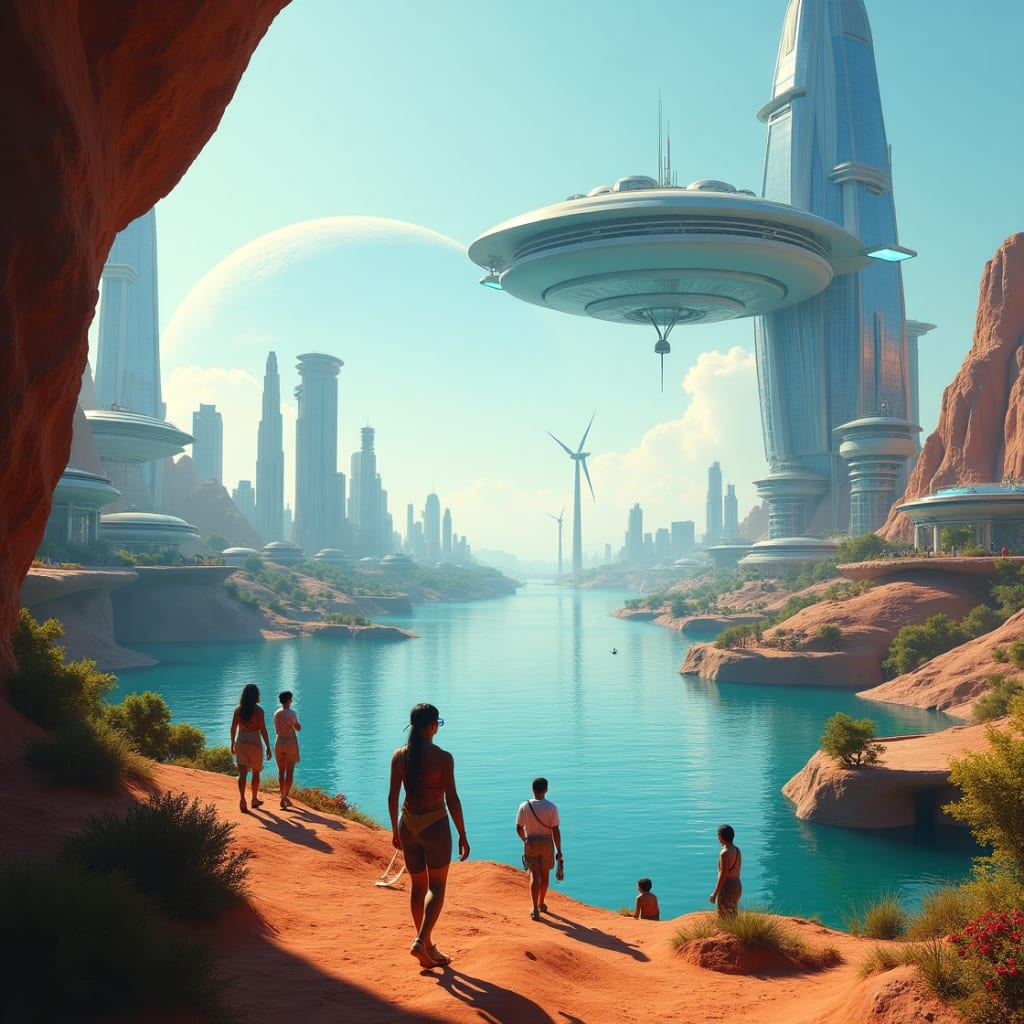
Does anyone think that how the world will be after100 years?
Lets discuss it today....
A hundred years ago, in 2025, the world stood at a crossroads. Climate change loomed large, artificial intelligence was just finding its feet, and humanity was beginning to seriously imagine life beyond Earth. Now, in the year 2125, Earth is nearly unrecognizable—but not in the apocalyptic way many once feared. It is a world shaped by innovation, adaptation, and profound change. This is a glimpse into our possible future.
Technology: When Imagination Became Infrastructure
In 2125, artificial intelligence is not just a tool; it is a collaborator. AI systems now co-govern cities, analyze planetary climate patterns in real time, and provide personalized education to every child, regardless of geography. Holographic communication is commonplace—meetings, classrooms, and even concerts often happen via immersive 3D projections.
Personal devices no longer resemble smartphones. Instead, most humans have neural interfaces that connect their thoughts directly to the global data network. Language barriers are a relic of the past—translation is instantaneous and seamless.
Space: Earth is Not Our Only Home
Mars is no longer science fiction. Permanent settlements dot its surface, supported by AI-managed biospheres and solar power arrays. The Moon hosts a major scientific outpost and an interplanetary shipping hub. A space elevator, completed in 2103, revolutionized off-world transport, drastically reducing the cost of space travel.
For the first time in history, children are being born in space—and the term “Earthling” has taken on new meaning.
Climate: The World We Saved (Just in Time)
Climate change brought humanity to the brink in the mid-21st century. Rising seas swallowed coastlines, and extreme weather became the norm. But global cooperation—sparked by desperation—finally took root.
By 2080, carbon emissions had dropped to near-zero, thanks to widespread fusion energy, solar farms in orbit, and advanced carbon-capture forests genetically engineered to thrive in diverse environments. Cities now float, adapt, or migrate.
Earth’s atmosphere is slowly healing. Some species lost forever, but many ecosystems—thanks to synthetic biology—have found new balance.
Society: Redefining What It Means to Be Human
The definition of "human" has expanded. With brain–machine integration, enhanced cognition, and biological modification, many now refer to themselves as post-human. Lifespans have extended dramatically—living to 130 is typical, and the first generation of people expected to reach 150 has already been born.
Families are more fluid. Some are composed of AI companions, cloned siblings, or community-style parenting networks. Physical presence is optional in many relationships; emotional depth often comes through shared dream-simulations or memory exchanges.
Work, Wealth & Purpose
In a world run largely by automation, traditional jobs are rare. Universal Basic Contribution (UBC) systems reward people not for productivity, but for creativity, empathy, and community building. Art, mentorship, and care work are among the most valued forms of contribution.
Money has evolved into a mix of decentralized digital currencies tied to sustainability indices, not GDP.
Ethics & Consciousness
With AI entities gaining legal personhood in many nations, debates about rights, identity, and morality have intensified. If an artificial mind can feel and dream, should it be treated as a citizen? What does it mean to be "alive"?
Simultaneously, brain-uploading—once a fringe theory—is now in pilot testing. Some humans have chosen digital afterlives, living as code within vast virtual worlds, visited by their loved ones in simulated form.
Conclusion: The Future Was Always Ours to Shape
The world of 2125 is neither a utopia nor a dystopia. It is complex, fluid, and deeply human—however that term is now defined. The last century was one of immense risk, but also radical hope. Humanity learned, sometimes painfully, that technology alone cannot save us—but collaboration, empathy, and vision can.
The future wasn’t something we waited for. It was something we built.
About the Creator
Hamid Khan
Exploring lifes depths one story at a time, join me on a journy of discovery and insights.
Sharing perspectives,sparking conversations read on lets explore together.
Curious mind passionate, writer diving in topics that matter.
Keep reading
More stories from Hamid Khan and writers in Families and other communities.
AI Replacing Jobs: What You Can Do About It
Whatsup GUYS. Lets have so e modern discussion.... In the last few years, artificial intelligence (AI) has transformed from a futuristic buzzword into a powerful force reshaping industries. From chatbots answering customer queries to robots assembling products, AI is replacing jobs at an unprecedented pace. A 2024 report by McKinsey predicts that by 2030, up to 800 million jobs could be affected by automation globally.
By Hamid Khan8 months ago in Families
In the End, Family Is Everything
"Family is not always about blood. It is about the people who choose to stand beside you when life becomes difficult." In a world that moves too fast, where everyone is chasing something — success, money, recognition — there is one place where we can still return without needing to prove anything.
By Zakir Ullah3 days ago in Families
Hottest in the Office
Dear Rafi, You’re very distracting to work around. For the first second I saw you the other day, I thought you were some type of executive. It took a moment to realize no, you were just the new guy, dressed up for the job he wants. Be still, my heart.
By Gabriel Shames3 days ago in Pride


Comments
There are no comments for this story
Be the first to respond and start the conversation.