

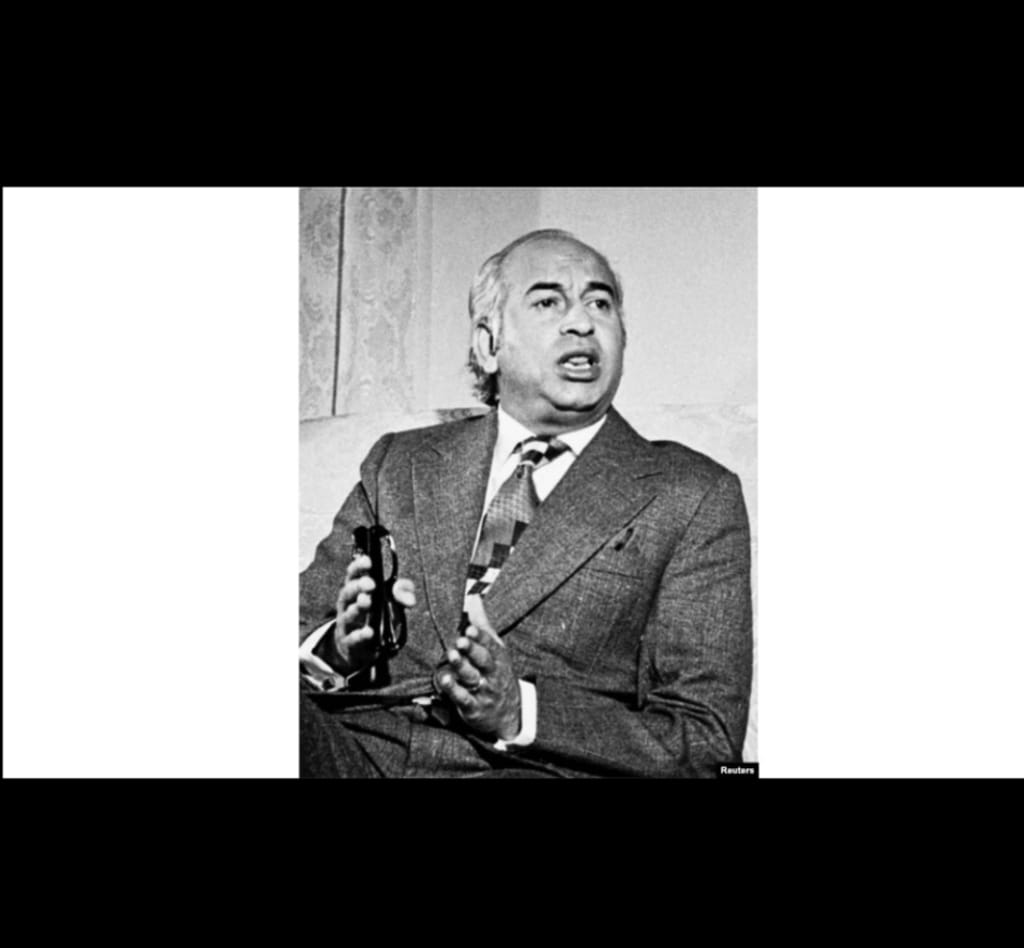
Zulfiqar Ali Bhutto was a prominent Pakistani politician who played a significant role in shaping the country's political landscape in the 20th century. He was born on January 5, 1928, in the city of Larkana, Sindh, which is located in present-day Pakistan. He came from a wealthy and influential family, with his father being a prominent politician and landowner in the area.
Education and Early Career
Bhutto received his early education from a local school in Larkana and later attended Cathedral High School in Karachi. He then went to the United States to pursue his higher education, where he studied at the University of Southern California and the University of California, Berkeley. He received a degree in law from the University of Oxford in the United Kingdom in 1952.
After completing his education, Bhutto returned to Pakistan and started his career as a lawyer. He quickly gained a reputation as a skilled and astute lawyer and became involved in the country's politics. In 1958, he was appointed as the youngest member of the Pakistani delegation to the United Nations.
Political Career
Bhutto's political career began in earnest in 1960 when he was appointed as Pakistan's Minister of Commerce under the government of President Ayub Khan. He was instrumental in negotiating the country's trade agreements with other nations and helped to modernize Pakistan's economy.
In 1963, Bhutto resigned from his position in protest against Ayub Khan's policies and joined the opposition movement. He founded the Pakistan People's Party (PPP) in 1967 and became its first chairman. The PPP's aim was to create a socialist and democratic society in Pakistan, with an emphasis on the rights of the common people.
In the 1970 general elections, the PPP won a resounding victory and Bhutto became the country's first democratically elected Prime Minister. He immediately set about implementing his party's agenda and introduced several progressive policies, such as land reforms and the nationalization of key industries.
Bhutto's tenure as Prime Minister was not without controversy, however. He was accused of suppressing political dissent and rigging the 1977 elections in his favor. This led to widespread protests and a military coup led by General Zia-ul-Haq.
Trial and Execution
Bhutto was arrested on charges of conspiracy to murder a political opponent in 1977 and was subsequently tried and sentenced to death. His trial was widely criticized by the international community, with many countries and organizations calling for clemency.
Despite these appeals, Bhutto was hanged on April 4, 1979, at the age of 51. His execution was met with widespread protests and condemnation, both in Pakistan and around the world. Many people believed that Bhutto was the victim of a political vendetta and that his trial was flawed.
Legacy
Despite his controversial legacy, Zulfiqar Ali Bhutto is widely regarded as one of Pakistan's most important and influential leaders. His policies and vision for a socialist and democratic society continue to inspire many people in Pakistan and beyond.
Bhutto's daughter, Benazir Bhutto, went on to become Prime Minister of Pakistan twice, following in her father's footsteps. She was also assassinated in 2007, just a few months after returning to Pakistan from self-imposed exile.
Today, Bhutto's legacy is celebrated by many in Pakistan, particularly among the country's left-leaning political parties. His vision of a progressive and democratic society continues to be a source of inspiration for many people around the world, and his name remains synonymous with political courage and leadership.Zulfiqar Ali Bhutto was a Pakistani politician who served as the country's Prime Minister and founded the Pakistan People's Party. He was known for his progressive policies, such as land reforms and the nationalization of key industries. He was also controversial and was executed after being convicted of conspiracy to murder a political opponent.
About the Creator
Keep reading
More stories from Anwaar Ahmed Abbasi and writers in Education and other communities.
E-Invoicing as a Catalyst for Digital Taxation and Business Efficiency in this Digital Era
Introduction In today’s rapidly evolving digital economy, businesses and governments are increasingly turning to technology to improve efficiency, transparency, and compliance. One of the most significant developments in this transformation is electronic invoicing, commonly known as e-invoicing. E-invoicing refers to the generation, exchange, validation, and storage of invoices in an electronic format between suppliers and buyers, often through government-mandated platforms or standardized systems.
By Bobby Yadava day ago in Education
Innovation Without Compassion: How the Absence of Empathy Undermines Modern Healthcare
Healthcare innovation promises efficiency, accuracy, and expanded access to care. New technologies, digital platforms, and streamlined systems continue to reshape medicine. However, when innovation moves forward without empathy, it often fails the very people it intends to serve. Patients feel disconnected, clinicians feel overwhelmed, and organizations struggle to achieve meaningful results.
By Mark Bouzyk4 days ago in Education



Comments
There are no comments for this story
Be the first to respond and start the conversation.