
You’re Genetically Related to a Banana (No, Seriously! Here’s Why)
Discover the Surprising DNA Connection That Links You to Your Morning Snack – and What It Means for Life on Earth"
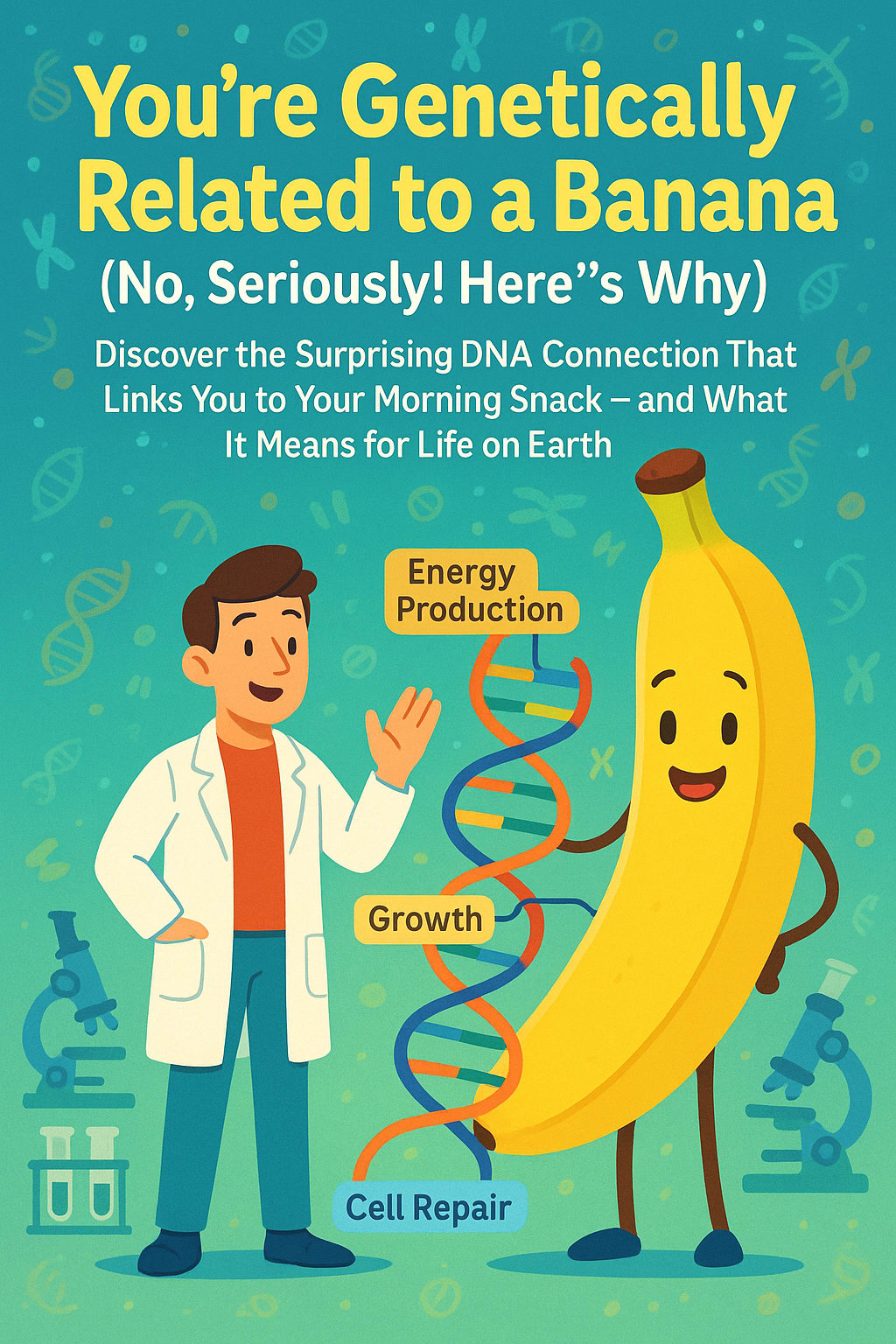
You walk into the kitchen, peel a banana, and take a bite. It’s sweet, a little mushy, and maybe even a bit awkwardly curved. But here’s a mind-bending twist: you share roughly 50% of your DNA with that banana. That’s right—half of the genetic recipe that makes you you is also found in the fruit you’re snacking on.
Before your brain short-circuits, don’t panic. You’re not about to sprout leaves or crave soil. The “50% DNA match” isn’t literal (thankfully). But it is true—and it’s one of the most fascinating, misunderstood facts in biology. Let’s peel back the layers (pun intended) and explore why this quirky connection exists.
1. What Does “Sharing DNA” Even Mean?
DNA is like a digital blueprint for building life. Every living thing—from humans to bacteria to bananas—has DNA. But here’s the twist: all DNA uses the same “language”. It’s made of four chemical letters (A, T, C, G) that form genes, which tell cells what to do.
When scientists say we share DNA with bananas, they don’t mean our genes are exactly the same. Instead, we share similar genes that code for basic life functions. Think of it like this: a Ford and a Ferrari both use engines, wheels, and gas, but they’re not the same car. Similarly, humans and bananas share genes for things like:
Making energy in cells (mitochondria).
Building proteins.
Growing and repairing tissues.
These genes are ancient—older than plants, animals, or even the dinosaurs. They’re the “user manual” for all life on Earth.
2. Why 50%? Isn’t That a Lot?
At first glance, 50% seems shocking. After all, bananas are yellow, squishy, and don’t binge-watch Netflix. But here’s the deal: most DNA isn’t unique to a species. A chunk of it is “conserved” across species because it’s essential for survival.
Imagine baking a cake. Every baker needs flour, sugar, and eggs—those are the “conserved ingredients.” But the frosting, sprinkles, and flavorings (the unique DNA) make each cake different. Similarly, humans and bananas share the “basic ingredients” for life, but our unique genes give us brains, opposable thumbs, and a love for social media.
3. The Evolution Connection
This isn’t a coincidence. Life on Earth shares a common ancestor—a single-celled organism that lived billions of years ago. Over time, species evolved in different directions, but they kept the core DNA that worked. Think of it like a family tree: you and your cousins might look different, but you all share Grandma’s freckles.
Bananas split from our evolutionary path early (around 1.5 billion years ago!), but they kept the “family recipes” for basic biology. That’s why banana genes can teach us about human diseases, like cancer or Alzheimer’s. Scientists study banana DNA to understand how our genes work—and sometimes break.
4. “So… Does This Mean I’m Part Banana?”
Nope! Sharing 50% of DNA doesn’t make you a banana-human hybrid. It just means we’re cousins on life’s family tree. Here’s a fun fact: you also share about 50% of your DNA with a strawberry and 60% with a fruit fly. The percentage depends on how far apart species are evolutionarily.
The key takeaway? DNA similarities show how interconnected all life is. From bananas to bacteria, we’re all riding the same biological wave.
5. Why This Matters (Hint: It’s Cool)
Okay, so bananas aren’t human. But this DNA overlap has real-world perks:
Medical research: Studying banana genes helps scientists develop drugs for human diseases.
Agriculture: Understanding shared DNA helps breed pest-resistant crops.
Perspective: It reminds us that we’re part of a vast, ancient web of life—not separate from it.
Next time you eat a banana, remember: you’re snacking on your distant cousin. And if that makes you giggle, you’re not alone.
Conclusion: Embrace Your Inner Banana
The idea that humans and bananas share DNA isn’t just a fun fact—it’s a reminder of life’s unity. From the tiniest microbe to the tallest redwood, we’re all built from the same genetic toolkit. So go ahead, enjoy that banana. You’re not just eating fruit; you’re reconnecting with your roots (literally!).
About the Creator
Keep reading
More stories from Maaz Ahmad and writers in Education and other communities.
Speak Fearlessly: How to Conquer Public Speaking Anxiety and Master New Languages
Imagine standing at the edge of a busy stage, your heart pounding like a drum. The crowd waits, silent, as your mind goes blank. The microphone feels like a heavy weight in your hand. This isn’t a nightmare—it’s the fear of public speaking, a dragon that lurks in the hearts of millions. Now, picture another scenario: you’re abroad, trying to order coffee in a language you’ve studied for months. Your tongue trips over unfamiliar sounds, and embarrassment creeps in. What do these two fears have in common? Both stem from the fear of judgment. But don’t worry—this dragon can be tamed. Here’s how to slay it.
By Maaz Ahmad10 months ago in Motivation
The Meaning Behind the Rules: What a Law Explains in Society
A law explains how people should behave within a society and what consequences may follow when they ignore those rules. Governments create laws to guide actions, protect rights, and maintain order. Because communities include people with different interests and values, clear rules help prevent conflicts and confusion. Therefore, laws serve as written standards that explain what society expects from its members.
By Juan Monteverde6 days ago in Education
Rockwell International Corp: A Legacy of Innovation in Aviation and Aerospace
The aviation and aerospace industries have evolved through the work of several pioneering manufacturers that introduced groundbreaking engineering technologies. One of the most influential companies in this field was Rockwell International, an American industrial giant that contributed significantly to aircraft manufacturing, defense systems, and space exploration.
By Beckett Dowhan2 days ago in Education


Comments
There are no comments for this story
Be the first to respond and start the conversation.