
William O'Neil How to Make Money in Stocks
William O'Neil

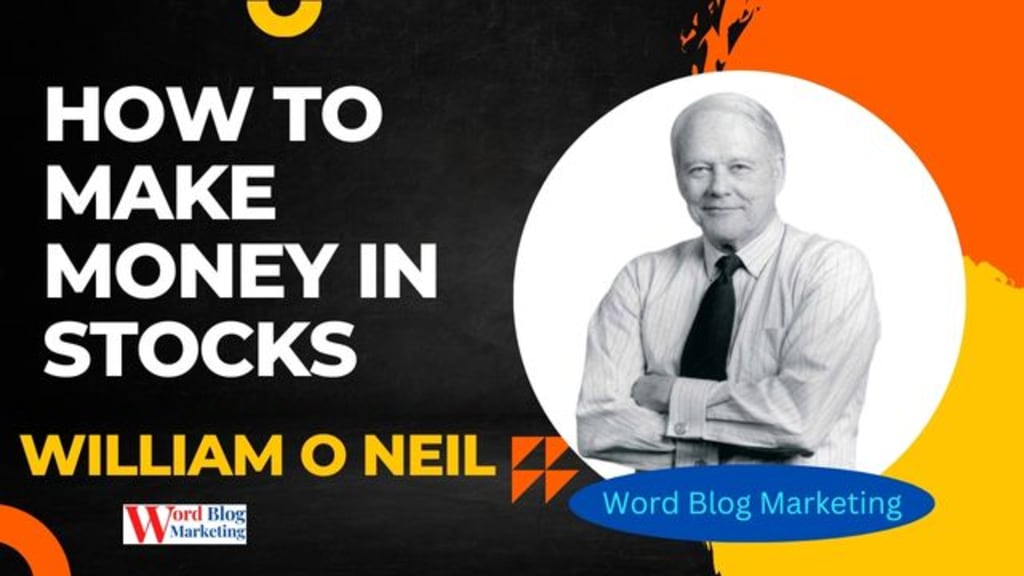
William O'Neil is a well-known investor and author who is best known for his book "How to Make Money in Stocks." In this book, O'Neil offers a number of strategies and techniques for identifying and investing in stocks that have the potential to generate strong returns.
Which is a popular guide to investing in the stock market. In the book, O'Neil outlines a proven approach to stock market investing based on his own experience and research.
1.What is William O'Neil's book about?
William O'Neil's book "How to Make Money in Stocks" is a guide to investing in the stock market. In the book, O'Neil outlines a proven approach to stock market investing based on his own experience and research. The book covers a range of topics, including how to identify promising companies, how to analyze financial statements, and how to develop a diversified portfolio. It also includes advice on how to manage risk and protect your investments. Overall, the book is designed to help readers understand the stock market and make informed investment decisions.
2. The different types of stocks
There are several different types of stocks that companies can issue, each with its own unique characteristics and risks. The below are some of the popular stock types:
1.Common stock: This is the most common type of stock and represents ownership in a company. Common stockholders have the right to vote on important company matters and may receive dividends if the company generates profits.
2.Preferred stock: Preferred stock is a type of stock that has a higher claim on a company's assets and earnings than common stock. Preferred stockholders may receive fixed dividends, and they may have the right to convert their shares into common stock.
3.Warrants: Warrants are securities that give the holder the right to purchase a specific number of shares of common stock at a specified price within a certain time period. Warrants are often issued along with bonds or other securities to make them more attractive to investors.
4.Rights: Rights are securities that give the holder the right to purchase additional shares of a company's stock at a discounted price. Rights are often issued to existing shareholders to prevent dilution of their ownership stake in the company.
Overall, the type of stock you choose will depend on your investment goals and risk tolerance. It's important to carefully research and understand the characteristics of each type of stock before making any investment decisions.
3.How to read a stock chart
Reading a stock chart can help investors understand the historical performance of a particular stock and make more informed investment decisions. A stock chart is a graphical representation of a stock's price over a specific period of time, and it typically includes the following elements:
1.Price: The vertical axis of a stock chart represents the stock's price. The price is plotted at regular intervals (e.g., daily, weekly, monthly) to show how the stock has performed over time.
2.Time: The horizontal axis of a stock chart represents time. The time intervals can be set to display the stock's performance over a specific period (e.g., 1 year, 5 years, 10 years).
3.Trend lines: Trend lines are used to show the overall direction of a stock's price. A rising trend line indicates that the stock's price is generally increasing, while a falling trend line indicates that the stock's price is generally decreasing.
4.Support and resistance levels: Support and resistance levels are points on the stock chart where the stock's price has had difficulty breaking through in the past. A support level is a price at which the stock has found significant buying interest and tends to bounce off of, while a resistance level is a price at which the stock has found significant selling pressure and tends to struggle to break above.
To read a stock chart, start by identifying the overall trend of the stock's price. Look for rising or falling trend lines and note any significant support or resistance levels. Then, analyze the stock's performance over specific time periods (e.g., 1 month, 3 months, 6 months) to see how it has performed and identify any potential buying or selling opportunities. It's important to remember that past performance is not necessarily indicative of future results, so it's important to consider other factors, such as the company's financial health and industry trends, when making investment decisions. Read more
About the Creator
yogesh markam
Hello friends, I am Yogesh Markam, I am blogger .
Keep reading
More stories from yogesh markam and writers in Education and other communities.
How to Make Money in Stocks PDF
Investing in stocks is one of the most rewarding and simplest investments you can make. However, there are a few things you need to know before you can get started, how to make money in stocks pdf. This article will explain them.
By yogesh markam3 years ago in Education
Leading Beyond Limits: The Role of Executive Leadership in Achieving Organizational Excellence
In today’s dynamic and competitive business landscape, organizations are constantly pursuing not just growth but excellence. While growth reflects success in the marketplace, true organizational excellence is measured by sustainability, innovation, culture, and impact. At the core of this transformation is executive leadership—a force that guides businesses beyond short-term wins toward long-term significance.
By Yeasha Sobhan4 days ago in Education
How Business Coaching Helps Founders Scale With Clarity and Control
Business coaching assists founders to scale since hustle and reactivity are substituted with structure, systems and strategic leadership. Strategic coaching provides clarity in the marketing, operations, leadership, and decision-making roles of the business, eliminating the need to use the owner as the bottleneck, instead enabling the business to expand without havoc, burnout, or firefighting.
By Alice Adamsabout 18 hours ago in Education




Comments (1)
STOLEN OR LOST CRYPTOCURRENCY RECOVERY. I would really consider myself to be one of the very few lucky ones as I was able to have my funds recovered from this scam Binary option brokers, although it was through unethical means as far I am concerned but what can I care after how my hard-earned funds where taken from me, these guys are the best in less than 7days all my funds including bonuses had been recovered. send a mail to “HIGHJACKTECH ART GEE MAIL DOT COM” 101 N BRAND BLVD. 11TH FLOOR GLENDALE CA 91203