
Why the First Computers Were Built with Light Bulbs
The build Up
The advent of electronics can be traced back to the invention of the light bulb, but perhaps not in the way you might expect. Early light bulbs, made of a carbon filament enclosed in a glass bulb with a vacuum inside, provided a crucial observation for the development of electronics. Thomas Edison noticed that over time, the glass inside the bulb would become discolored, turning yellow and eventually brown, but only on one side. This peculiar phenomenon led to a significant breakthrough in the field of electronics.
The heated filament inside the light bulb emitted not just light and heat, but also electrons. This process, known as thermionic emission, had been independently discovered by other scientists earlier. However, it was after Edison's observation that this emission of electrons from a hot filament became widely known as the "Edison effect." The emitted electrons, in the absence of obstruction due to the vacuum inside the bulb, were attracted to the positive wire connected to the filament. As a result, most of these electrons would whiz past the wire and collide with the glass, causing it to discolor on the positive side.
Building upon this observation, John Ambrose Fleming patented a device in 1904 that resembled Edison's light bulb but with a crucial addition—a second electrode. By charging this additional plate positively with respect to the filament, electrons could be accelerated across the gap, completing the circuit. When the plate had a slightly negative charge relative to the filament, it repelled electrons, preventing the flow of current. Fleming called this device a "thermionic diode," and it was primarily used for detecting radio signals and converting alternating current to direct current.
Researchers soon realized that positioning the filament in the center with the second electrode, or anode, as a surrounding cylinder improved the efficiency of electron capture and allowed for larger currents. This innovative design led to the creation of the first practical vacuum tube device, which served as the model for subsequent vacuum tubes that would dominate the electronics industry for several decades.
During the early 1900s, the main challenge in electronics was amplification. The range of radios was limited due to the lack of reliable equipment to boost weak signals. Similarly, telephone calls could only span a maximum distance of 1300 kilometers, as the signals became too faint beyond that point. Although a rudimentary form of amplification called a relay had been developed for telegraph operations, it was incapable of amplifying complex analog signals.
In 1906, Lee de Forest made a groundbreaking addition to the diode by introducing a third electrode into the bulb. This electrode, known as the grid, consisted of a sparse wire mesh positioned between the filament (cathode) and the anode. This new device, called a triode, allowed for a large potential difference between the anode and cathode, while the number of electrons that flowed between them was controlled by the voltage applied to the grid. A slightly negative charge on the grid repelled electrons, preventing their flow to the anode. Conversely, a slightly positive charge attracted electrons, allowing them to pass through the grid and accelerate toward the anode. This characteristic enabled high-frequency amplification due to the rapid response to small voltage changes.
The invention of the triode was a significant milestone. Vacuum tubes powered radios, televisions, and various other electronic devices. The ability to amplify signals over long distances was made possible by vacuum tubes. Claude Shannon's 1937 thesis drew a connection between electric circuits and Boolean algebra, a branch of mathematics that deals with logical operations. Shannon demonstrated that electric circuits could represent mathematical statements, and with a few switches, these circuits could be realized in the real world.
George Stibitz, in 1937, constructed the first digital calculator using relays. This calculator could add2-bit binary numbers and was built using a relay, an electromechanical switch commonly used in telegraphy. Stibitz's calculator had two inputs, which were either open (representing 0) or closed (representing 1), and the output was indicated by two light bulbs. This calculator, known as the Model K, laid the foundation for the digital age.
Stibitz's device, which used Boolean operations represented by electric circuits, demonstrated the equivalence between mathematical statements and electronic circuits. By combining switches and relays, logical operations such as AND and exclusive OR (XOR) gates could be implemented. This breakthrough enabled the construction of logic circuits that could perform complex operations based on binary inputs.
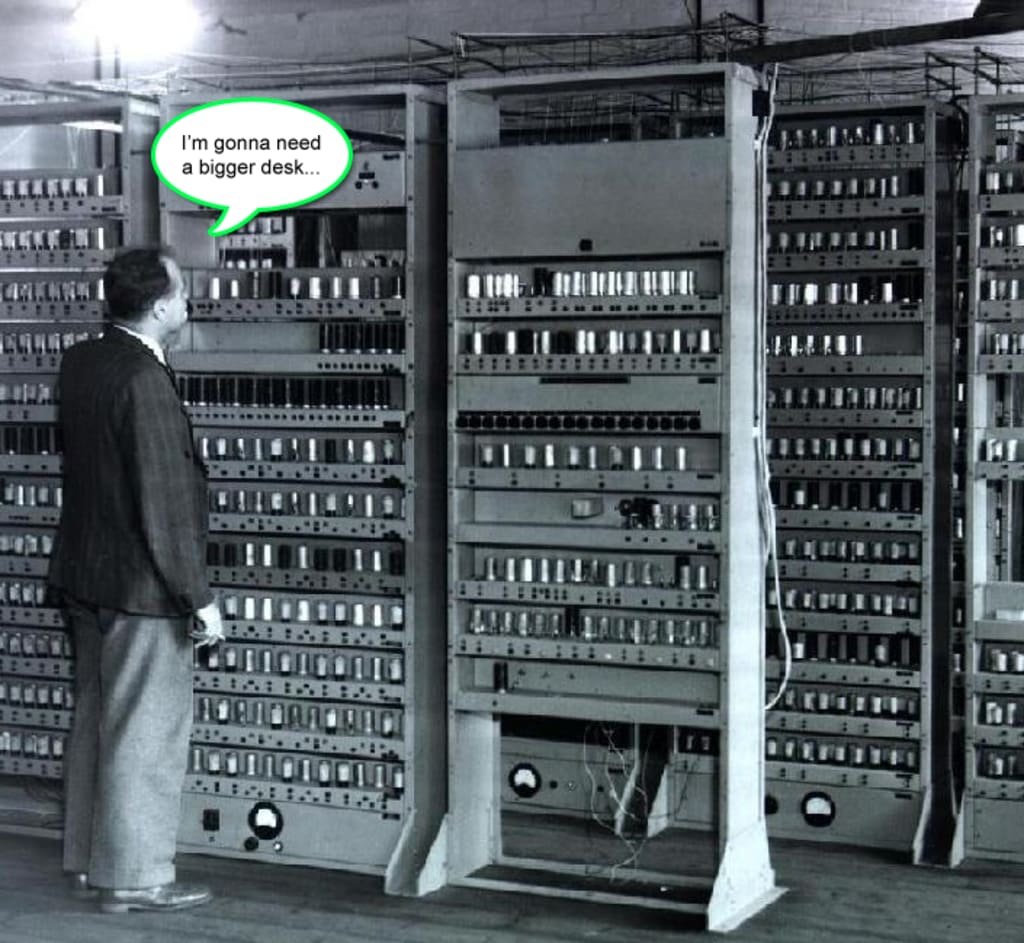
Vacuum tubes continued to revolutionize electronics, and in the late 1930s, they became instrumental in the development of early computers. These computers, known as "tube computers," utilized vacuum tubes to perform calculations and store data. However, vacuum tubes were large, power-hungry, and prone to failure, limiting the scalability and reliability of early computers.
Nevertheless, the invention of the triode and subsequent developments in vacuum tube technology laid the foundation for the field of electronics and the evolution of computers. The transition from vacuum tubes to transistors and eventually integrated circuits marked a significant advancement in computer technology, leading to the development of the modern computers we use today.
In conclusion, the observation of the Edison effect in light bulbs, coupled with subsequent innovations in vacuum tube technology, paved the way for the development of electronics and early computers. These early breakthroughs in understanding the behavior of electrons and their manipulation in vacuum tubes laid the foundation for the digital age and propelled the advancement of computing technology.
About the Creator
Keep reading
More stories from Oladeji Showunmi and writers in Education and other communities.
Physics: A Journey Through the Unknown
Physics encompasses a vast range of topics, from galaxies in space to subatomic particles. It can be challenging to understand how these subjects are interconnected if you're not already familiar with physics. In an attempt to provide clarity, I present to you the map of physics.
By Oladeji Showunmi3 years ago in Education
Understanding the Quiet Shift: What You Need to Know About the Move Toward Value-Based Healthcare
A significant transformation is unfolding in the healthcare industry, yet many people outside the field may not fully realize its impact. This quiet shift is the transition from volume-based care, where providers are paid for the number of services they deliver, to value-based healthcare, where reimbursement depends on quality, outcomes, and patient satisfaction. This evolution is reshaping how providers deliver care, how patients experience treatment, and how the entire system measures success. As healthcare becomes more complex and costly, value-based care offers a more sustainable, patient-centered path forward. Understanding what this shift means is essential for anyone interested in the future of healthcare delivery.
By Evan Weiss St Louis5 days ago in Education
Common Lies on Resumes and How Employers Find Them Out
Your CV should tell the tale of your work life. This is the paper that tells a possible employer who you are before you even go to an interview. Some people who are applying feel like they have to lie or even make things up because of the pressure. It might seem like a good idea to correct a few things that aren't quite perfect, but employers are getting better at finding them.
By Novelty Diplomaabout 17 hours ago in Education
📢 Raise Your Voice Thread: 03/05/2026
Our “Raise Your Voice Threads” are hosted most alternating Thursdays at 12PM ET to offer creators more avenues to uncover exceptional stories on Vocal. As we are continuously searching for fresh creators and inspiring stories, this thread provides an opportunity to exchange and discuss the stories that have moved and motivated us on Vocal.
By Raise Your Voice by Vocala day ago in Resources



Comments
There are no comments for this story
Be the first to respond and start the conversation.