
Why SLA Discipline Is the New Competitive Advantage in B2B Outsourcing
SLA discipline has quietly become one of the most powerful competitive advantages in modern outsourcing, even though it is rarely marketed as such.


Have you ever worked with an outsourcing partner who technically met the SLA, yet the problem still landed on your desk?
I’ve spent close to ten years in B2B digital marketing, mostly with companies that scale fast and feel operational strain early. At some point, almost every team reaches the same moment: leads pile up, follow-ups slip, internal teams stretch thin, and outsourcing enters the conversation. More often than not, I get pulled in to help evaluate options and sanity-check decisions.
On paper, things usually look solid. SLAs are defined. Costs are optimized. The pitch sounds right.
And for a while, it works.
Until pressure shows up - a campaign launch, a seasonal spike, a deadline that won’t move. That’s when “within SLA” starts to feel very different from “handled well.”
In this article, I’ll share:
- Why most outsourcing models look fine at first
- Where they quietly break under real pressure
- What SLA discipline actually looks like in practice
- And how B2B teams can evaluate partners more realistically
Not from theory, but from patterns I’ve seen repeat over years of real decisions.
Why Outsourcing Looks Fine at First
Most outsourcing decisions don’t start badly. In fact, they usually start with relief.
Someone finally has a plan. Capacity is coming. Costs are under control.
I’ve sat in enough evaluation calls to hear the same line repeated almost every time:
“As long as SLAs are clearly defined, we’ll be fine.”
On paper, that logic makes sense.
Vendor decks show coverage models, response-time guarantees, and escalation paths. Procurement sees savings. Leadership sees scale. Everyone signs off feeling responsible.
And in the first few weeks, nothing breaks.
That’s the part no one talks about.
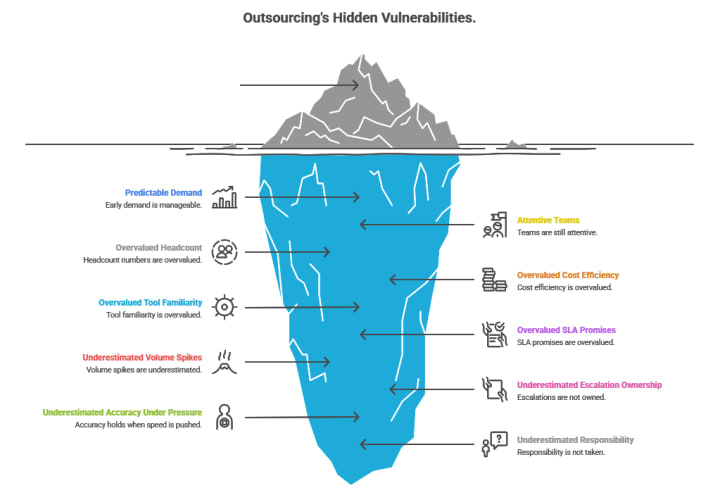
Early performance almost always looks good because early demand is predictable. Volumes are manageable. Exceptions are rare. Teams are still attentive.
Industry data backs this up. According to multiple outsourcing benchmarks, service-level degradation most often appears after the first demand spike, not during onboarding. The problem isn’t intent - it’s exposure.
Here’s what usually gets overvalued early on:
- Headcount numbers
- Cost efficiency
- Tool familiarity
- SLA promises in isolation
And here’s what gets underestimated:
- What happens when volume doubles unexpectedly
- How escalations are owned, not routed
- Whether accuracy holds when speed is pushed
- Who takes responsibility when “within SLA” still fails the business
I’ve watched teams celebrate a smooth first quarter - only to scramble when the first real test arrives.
Which raises the real question:
If outsourcing only works when things are calm, does it actually work at all?
That’s where the cracks begin.
Where Things Start to Crack Under Pressure
The real test of an outsourcing model doesn’t happen during steady weeks.
It happens when something spikes.
A product launch goes live.
Admissions open.
Orders surge.
Reporting deadlines collide with customer demand.
That’s when I’ve seen the tone of conversations change.
Here’s what pressure exposes very quickly:
- Queues that were manageable suddenly stack
- Escalations move sideways instead of upward
- Accuracy drops quietly as speed becomes the priority
- Updates arrive “on time,” but too late to be useful
Industry data reflects this pattern. Studies on outsourced operations consistently show that error rates and resolution delays increase most sharply during peak demand, not because teams don’t try - but because workflows weren’t built to stretch.
From my own experience, this is where internal teams get stuck in the middle. They’re explaining issues upward while chasing answers downward. The vendor points to SLA compliance. The business feels the impact anyway.
And the worst part?
No one can point to a single failure.
Everything is technically working.
So the question becomes uncomfortable, but necessary:
If SLAs hold but trust erodes, what are they actually protecting?
This is the moment where outsourcing relationships either mature or quietly start to unravel.
And it’s where SLA discipline stops being theoretical and starts being visible.
Hitting the SLA vs. Owning the Outcome
The first real warning sign usually doesn’t come in a meeting. It shows up in small moments.
10:12 a.m.
An internal Slack message: “Any update on the vendor side?”
11:40 a.m.
A follow-up email. Polite. Still calm.
2:05 p.m.
The update arrives. It’s technically on time. It also doesn’t move anything forward.
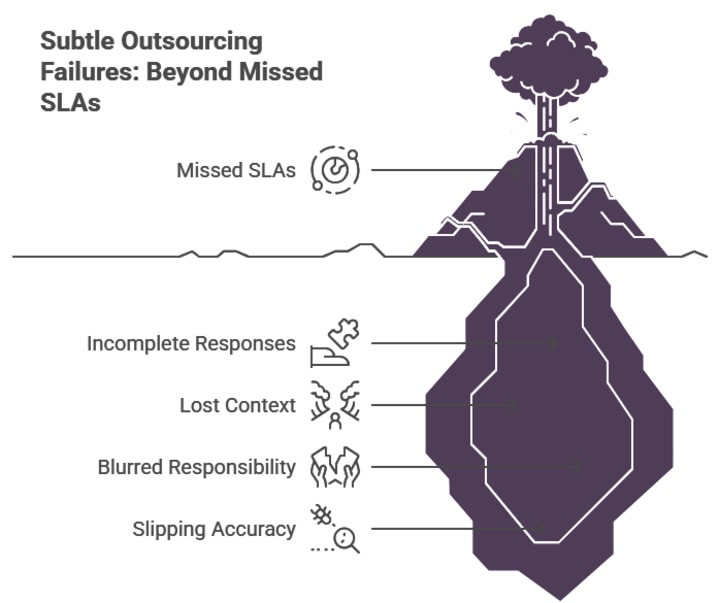
I’ve been on both sides of this, managing campaigns, launches, and demand spikes while depending on outsourced teams to keep things flowing. What stood out over the years wasn’t missed SLAs. It was how often teams hid behind them.
According to industry benchmarks, nearly 60% of operational escalations during peak periods aren’t caused by missed response times, but by incomplete or non-actionable responses. That tracks with what I’ve seen. Speed gets measured. Usefulness doesn’t.
When pressure hits, three things tend to happen at once:
context gets lost, responsibility blurs, and accuracy quietly slips. Internal teams start compensating, rewriting updates, chasing clarifications, filling gaps that shouldn’t exist.
At that point, outsourcing hasn’t failed loudly.
It’s failed subtly.
And that’s the most dangerous kind.
Because nothing is broken enough to fix, yet everything is slightly harder than it should be.
That’s when I started paying less attention to whether SLAs were met, and more attention to what actually happened after the response landed.
That distinction changes how you see outsourcing entirely.
Where SLA Discipline Actually Becomes a Competitive Advantage
By this point, the pattern should feel familiar.
Outsourcing doesn’t usually collapse in obvious ways. It doesn’t announce failure. It just starts adding friction - small delays, vague updates, extra follow-ups, until internal teams quietly absorb the cost.
What changed for me over the years wasn’t just how I looked at vendors, but how I looked at my own expectations.
I stopped asking, “Did they meet the SLA?”
And started asking, “Did this make our job easier today?”
That shift matters.
Because SLA discipline isn’t about perfection. It’s about predictability. It’s about knowing that when volume spikes, deadlines tighten, or visibility increases, the system holds. Not because someone is checking a clock - but because responsibility is built into how work gets done.
The most reliable partners I’ve seen don’t talk much about SLAs once things are live. They focus on outcomes. They surface problems early. They escalate before being asked. They understand context without needing it re-explained.
A lot of my thinking around SLA discipline has been shaped over the past year while working closely with teams at IBT, a Dubai-headquartered BPO operating across the Middle East. Since joining in July 2024, I’ve had the chance to work across different internal functions, and it’s been one of the few environments where long-held outsourcing myths get challenged daily. Seeing how escalation ownership, compliance-first workflows, and outcome-driven KPIs actually play out at scale has sharpened how I now evaluate outsourcing decisions - and what I no longer take at face value. That kind of discipline doesn’t show up in proposals.
It shows up over time.
And in B2B environments where trust, compliance, and reputation compound slowly, that consistency becomes a competitive advantage that’s very hard to replace once you’ve experienced it.
Which brings us to the practical questions most teams ask next.
What should you look for? What should you test? And where do most outsourcing relationships still go wrong?
That’s where the FAQs help clarify what matters, and what doesn’t.
Frequently Asked Questions
What does SLA discipline actually mean in B2B outsourcing?
SLA discipline goes beyond meeting response-time targets. It reflects how consistently a vendor owns outcomes under pressure. From my experience evaluating outsourcing partners, disciplined teams escalate early, preserve accuracy during volume spikes, and deliver updates that enable decisions. Industry data shows operational failures usually stem from weak escalation of ownership, not missed SLA clocks.
Why do outsourcing relationships fail even when SLAs are met?
Because SLAs measure timing, not usefulness. I’ve seen teams meet response SLAs while still blocking internal progress with incomplete updates. Industry benchmarks indicate most peak-period escalations arise from low-quality responses, not late ones. When accuracy, context, and accountability degrade, “within SLA” becomes operationally meaningless.
How can B2B teams evaluate SLA discipline before signing a vendor?
Beyond contracts, test real scenarios. Ask how vendors handle demand spikes, incomplete information, and cross-team escalations. In practice, disciplined partners describe workflows, not just metrics. From experience, vendors who can explain what happens when SLAs are at risk tend to perform better under real operational stress.
Why do regulated industries prioritize SLA discipline more than others?
In sectors like education, manufacturing, healthcare, and finance, delays or inaccuracies create compliance and reputational risks. Industry studies show regulated environments reward predictability over speed. Having worked with teams in these spaces, I’ve seen SLA discipline function as risk control, ensuring documentation accuracy, audit readiness, and escalation clarity when the stakes are highest.
Is SLA discipline more important than cost efficiency in outsourcing?
In the long run, yes. Cost savings erode quickly when internal teams compensate for weak vendor discipline. From repeated outsourcing evaluations, the most expensive failures weren’t budget overruns-they were trust failures during peak demand. Industry data consistently links operational resilience and retention to disciplined service delivery, not lowest-price models.
About the Creator
Mushavvirkhan Balooch
I love bridging the GAP between IT & BUSINESS through relevant tech Integration to mobile, web, and software application development solutions.
Keep reading
More stories from Mushavvirkhan Balooch and writers in Education and other communities.
2023 & Beyond: 5 Effective Ways to Increase Event Ticket Sales!
Is the dwindling number of ticket sales keeping you up at night? In the rapidly evolving event landscape, traditional ticket-selling methods are losing their charm, putting a dent in the revenue of many event organizers.
By Mushavvirkhan Balooch2 years ago in Journal
Before the Bell: Daily Pre-Market Steps That Drive Consistent Trading Wins
In daily trading, the difference between consistency and chaos often comes down to what happens before the session starts. The most reliable traders don’t wait for the bell to decide what to do—they use the early hours to map out a plan, filter distractions, and establish a tactical approach to the day.
By Agast Mishra7 days ago in Education
Image-to-text technology, also known as Optical Character
Image-to-text technology, also known as Optical Character Recognition (OCR), has transformed the way we interact with visual information. It allows machines to extract text from images, enabling various applications across multiple industries. From digitizing printed documents to reading text from scanned images, OCR plays a vital role in making printed content accessible, editable, and searchable. The need for such technology has grown exponentially with the increasing reliance on digital data and the rapid shift from physical to digital content in nearly all sectors of life. As the digital world continues to expand, image-to-text technology has paved the way for more seamless workflows, enabling businesses and individuals alike to save time, effort, and resources.
By Alexander Jackson4 days ago in Education
Getting Serious About Comedy (Part I)
If I were asked to remark on my life and the childhood that paved some road leading me to this point, I would have to say something about all the funny people who surrounded me for the last 26,872 days (and counting). Somewhere along that road, I became a big fan of laughter and the comedy that spawns it – and, I mean not only my own laughter, but the laughter of others, some of which I have actually been responsible for inducing.
By John Oliver Smith7 days ago in Humor




Comments
There are no comments for this story
Be the first to respond and start the conversation.