
Why Most AI Marketing Playbooks Fail Before They’re Used
AI marketing playbooks are everywhere.
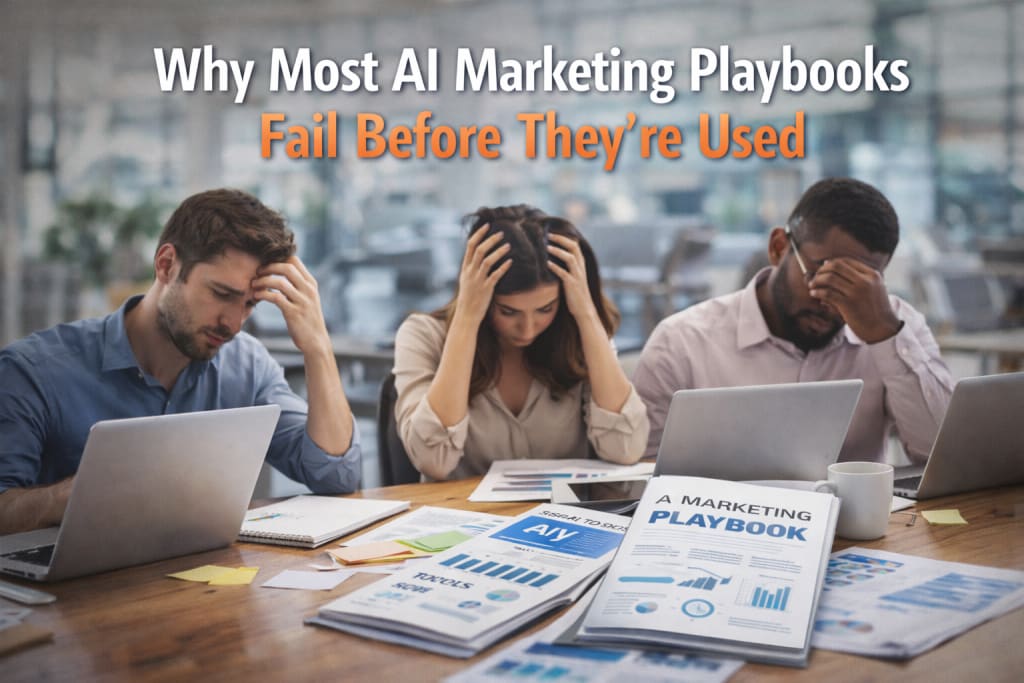
AI marketing playbooks are everywhere.
Frameworks. Templates. Notion docs. Prompt libraries. Slide decks explaining how AI will “transform” marketing teams.
And yet, in many organizations, those playbooks sit untouched after the initial rollout.
The problem isn’t that marketers don’t care about AI. It’s that most AI playbooks are built in a way that makes them easy to create—but hard to use.
1. They’re Built Around Tools, Not Work
Most AI playbooks start with a list of tools:
- Use ChatGPT for content
- Use Midjourney for visuals
- Use automation for reporting
But marketers don’t wake up thinking about tools. They think about tasks:
- Planning campaigns
- Writing content
- Analyzing performance
- Responding to stakeholders
When a playbook isn’t mapped to real workflows, it feels theoretical. Teams don’t know when to use AI, why it helps, or how it fits into their day-to-day work.
A usable playbook starts with workflows first—and introduces AI only where it removes friction.
2. They Assume Everyone Has the Same Skill Level
Another common mistake is assuming the entire team has the same comfort level with AI.
In reality:
- Some people experiment daily
- Some are cautious but curious
- Some are overwhelmed or skeptical
Most playbooks fail because they don’t meet people where they are. They either oversimplify and feel useless, or they go too deep and feel intimidating.
Good playbooks allow progressive adoption. They provide simple starting points and optional depth—so people can grow into AI use without pressure.
3. They Don’t Define Quality or Accountability
AI makes it easy to generate output. What it doesn’t define is quality.
Without clear standards, teams struggle with questions like:
- Is this good enough to share with a client?
- How much editing is expected?
- Who owns the final decision?
When quality expectations are unclear, people either over-edit everything or avoid AI altogether.
Effective playbooks clearly state:
- What AI can draft vs. what humans must finalize
- Where review is required
- Who is accountable for outcomes
Without this clarity, trust breaks down fast.
4. They Ignore the Reality of Burnout
Ironically, many AI playbooks are sold as productivity boosters—but end up increasing pressure.
When AI is positioned as a way to “do more,” teams feel expected to produce more output in less time. The result is faster burnout, not better performance.
The most successful teams use AI to:
- Reduce repetitive work
- Create breathing room
- Protect focus and energy
Playbooks that ignore workload design and team capacity are doomed to fail, no matter how advanced the tools are.
5. They’re Created Once and Never Revisited
Marketing changes constantly. AI changes even faster.
Yet many playbooks are treated as one-time deliverables. Once published, they’re rarely updated, reviewed, or improved based on real usage.
A playbook that isn’t evolving quickly becomes irrelevant.
High-performing teams treat their AI playbook as a living system:
- Updated based on feedback
- Refined as workflows change
- Adjusted as tools improve
Usage drives improvement—not the other way around.
What Actually Makes an AI Playbook Work
AI playbooks that get used share a few common traits:
- They are tied to real marketing workflows
- They focus on capacity, not just speed
- They define quality, ownership, and boundaries
- They respect human judgment
- They evolve over time
Most importantly, they’re built to support people—not impress leadership.
Final Thought
AI marketing playbooks don’t fail because AI is overhyped.
They fail because they’re designed for documentation, not execution.
The teams that succeed with AI don’t chase perfect frameworks. They build simple, practical guidance that fits how work actually gets done—and refine it as they go.
If your AI playbook isn’t being used, that’s not a tooling problem.
It’s a design problem.
About the Creator
Vipul Gupta
Vipul is passionate about all things digital marketing and development and enjoys staying up-to-date with the latest trends and techniques.
Keep reading
More stories from Vipul Gupta and writers in Education and other communities.
Why Data Readiness and Data Quality Are Critical When Applying AI in Life Sciences
AI promises breakthroughs in drug discovery, diagnostics, genomics, and lab automation. Yet in Life Sciences, the effectiveness of AI has very little to do with the model and everything to do with the data feeding it.
By Vipul Gupta3 months ago in FYI
Why Mississippi Small Businesses Are Finally Taking Their Websites Seriously
For many years, having a website in Mississippi was more about appearance than performance. It was something businesses created simply so they could say they had an online presence. A basic page with a phone number, a short description, and maybe a photo was often considered enough.
By Jhones Bennabout 18 hours ago in Education


Comments
There are no comments for this story
Be the first to respond and start the conversation.