
Why English Is Hard to Learn (and Why It’s Easier Than You Think)
Is English hard to learn? Explore grammar, vocabulary, and pronunciation challenges—plus reasons why English can be easier than you think.

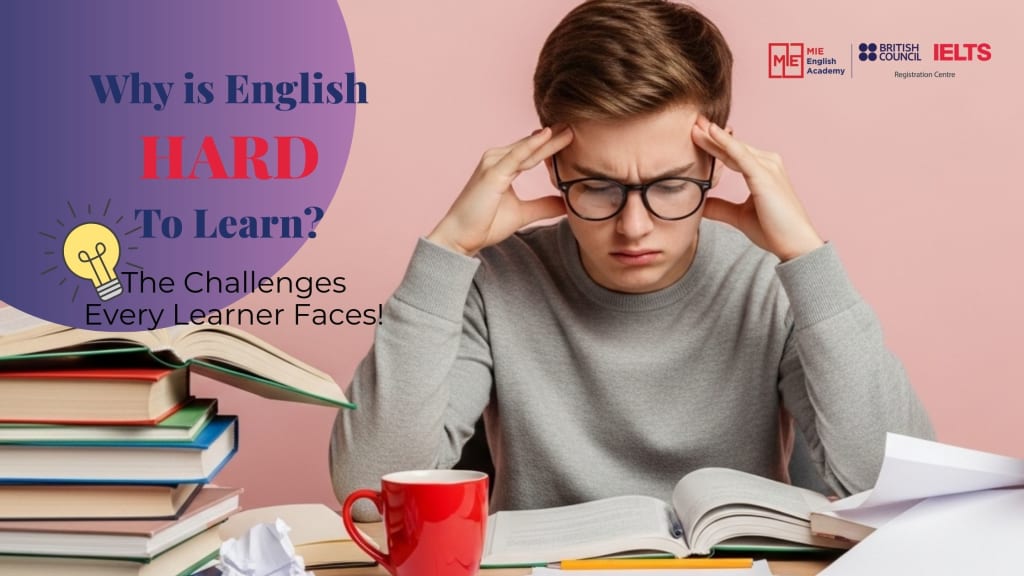
English is the most widely spoken second language in the world, yet many learners still ask: “Why is English so hard to learn?” The truth lies somewhere in the middle. English has its share of irregular grammar, tricky pronunciation, and countless exceptions. At the same time, it avoids some of the biggest challenges found in other languages, such as gendered nouns or complex verb conjugations.
This article looks at both sides—why English feels difficult and why it may actually be easier than expected. By understanding these perspectives, students can approach English with confidence and a clearer learning strategy.
Why English Is Hard to Learn
1. Grammar Rules and Irregularities
English grammar is often unpredictable. While rules exist, they come with exceptions that frustrate learners.
Irregular verbs: Words like go → went or eat → ate don’t follow simple patterns. Hundreds of such verbs must be memorized.
Verb tenses: English uses multiple tenses—simple, continuous, perfect—that often confuse beginners. For example, the difference between “I have eaten” and “I ate” is subtle but important.
Articles: Choosing between a, an, and the is hard for speakers of languages without articles.
Phrasal verbs: Expressions like “pick up,” “give in,” or “run into” carry idiomatic meanings unrelated to the words themselves.
2. Vocabulary Challenges
English has one of the largest vocabularies of any language. This richness brings both flexibility and complexity.
Multiple meanings: Words like run can mean “operate,” “flow,” or “escape,” depending on context.
Synonyms: English has dozens of words that seem similar but carry different tones (big, large, huge, gigantic). Choosing the right word is often tricky.
Borrowed words: English borrows heavily from Latin, French, and Germanic languages. As a result, words often have irregular spellings and pronunciations.
3. Pronunciation and Spelling
Perhaps the most famous difficulty in English lies in its spelling and pronunciation.
Inconsistent spelling: Though, through, tough, cough, and bough all sound different despite similar spelling.
Silent letters: Words like knight, island, or plumber hide letters that aren’t pronounced.
Vowel sounds: English has many vowels, and each can be pronounced differently depending on the word (move, love, stove).
Stress and intonation: Stress can change meaning: record (noun) vs. record (verb). Intonation also shifts the message in conversation.
4. Dialects, Idioms, and Slang
English has multiple dialects across countries. British, American, and Australian English differ in vocabulary and accent. Even within one country, regional speech can sound unfamiliar. Idioms and slang add another layer of challenge. Phrases like “under the weather” or “break the ice” don’t mean what they literally say.
Why English Is Easier Than You Think
Despite its irregularities, English avoids some major challenges learners face in other languages.
1. Simple Verb Conjugations
Compared with Spanish or French, English verbs are straightforward. Only the third-person singular adds an “-s”:
I walk
You walk
He/She walks
We walk
They walk
That’s a lot simpler than memorizing dozens of verb endings.
2. No Gendered Nouns
In German, French, or Hindi, nouns are assigned masculine, feminine, or even neutral gender. In English, a book is just a book—no extra grammar rules to remember.
3. Resources Everywhere
English is the most studied second language in the world. Learners have endless resources: YouTube channels, apps like Duolingo, podcasts, movies, and online dictionaries. This makes self-study much easier than for less widely taught languages.
4. Constant Exposure
English dominates international business, technology, science, and entertainment. Even if it’s not the first language in your country, chances are you see or hear English every day through music, films, websites, or social media. This passive exposure speeds up learning.
The Real Barrier: Perception and Practice
Often, learners think English is “too hard” because they compare it to their native language. But remember—your first language felt difficult at first too. You just had years of constant exposure as a child.
Another barrier is the fear of mistakes. Many students avoid speaking because they don’t want to sound wrong. In reality, mistakes are a vital part of the process. Each error is a step toward improvement.
With regular practice, English becomes less intimidating. Fluency grows not by chasing perfection but by speaking, listening, reading, and writing a little every day.
Practical Tips to Make English Easier
Practice speaking daily: Talk for five minutes in English about your day, even if it’s just to yourself.
Watch with subtitles: Movies and TV shows help with listening and pronunciation. Repeat sentences for practice.
Read aloud: Reading news articles or books out loud builds rhythm and confidence.
Keep a journal: Write short daily notes in English. Focus on consistency, not perfection.
Learn phrases, not just words: Expressions like “at the end of the day” are more natural than single vocabulary items.
FAQs
1. Is English hard to learn?
Yes and no. English grammar and pronunciation are irregular, but compared to languages with complex verb systems or gendered nouns, English is simpler.
2. Why does English feel confusing?
Because it has many exceptions, borrowed words, and idiomatic expressions. Learners often expect strict rules, but English works more on patterns and usage.
3. How can I make English easier?
Practice consistently. Exposure through movies, books, and daily speaking makes English more natural over time. Focus on communication, not perfection.
Conclusion
So, is English hard to learn? The honest answer is that it depends on perspective. English is challenging because of its irregular grammar, tricky pronunciation, and vast vocabulary. Yet it is also easier than many languages thanks to its simple verb system, lack of noun genders, and global presence.
The key is not to fear mistakes but to embrace them as part of learning. With daily practice and the right mindset, English turns from a difficult subject into an enjoyable skill—one that connects you to the world.
About the Creator
MIE English Academy
Prepare smarter, speak better, and step confidently into your global future. We are a dynamic and rapidly growing educational institute founded in 2024, with its headquarters in Dhaka and additional branches across the Bangladesh.
Keep reading
More stories from MIE English Academy and writers in Education and other communities.
IELTS Registration in Bangladesh: Complete Guide with MIE English Academy
Bangladeshi students and professionals see IELTS as a gateway to global study and career opportunities. Whether aiming for admission into a top university or applying for migration, IELTS is often the first step. The challenge begins not with the test itself but with registration. Many candidates feel uncertain about documents, payments, and choosing the right test type. MIE English Academy offers a clear path, making IELTS registration simple and stress-free. With the right guidance, every student can focus on preparation instead of paperwork.
By MIE English Academy5 months ago in Education
Co-Parenting in the Digital Age
Co-Parenting in the Digital Age: Shared Circles, Alerts, and Neutral Tech Tools Modern co-parenting requires a modern toolkit. Beyond shared calendars, technology offers powerful ways to foster cooperation, ensure consistency, and prioritize your child's safety. The right digital approach can reduce conflict and create a more stable environment for everyone.
By Olivia Martinez4 days ago in Education
The Devil's Cut
“Comrade, finally you’re awake.” The voice was smooth, sensual. A flickering incandescent bar was all that lit the white, sterile room. All Vladimir remembered was everything going black. He tried to move his arms and found them strapped to the gurney.
By Matthew J. Fromm4 days ago in Fiction




Comments
There are no comments for this story
Be the first to respond and start the conversation.