
Why Are Neutrinos Called “Ghost Particles”?
Neutrinos are among the most mysterious particles in the universe. They pass through planets, stars, and even your body in enormous numbers every second — yet almost never leave a trace. Because of this strange behavior, scientists often call them “ghost particles.” But why exactly do neutrinos deserve this eerie nickname? What makes them so elusive, and why are they so important to modern physics and astronomy? In this article, we’ll explore what neutrinos are, why they’re called ghost particles, how we detect them, and what they reveal about the universe — all explained in simple, easy-to-understand language.

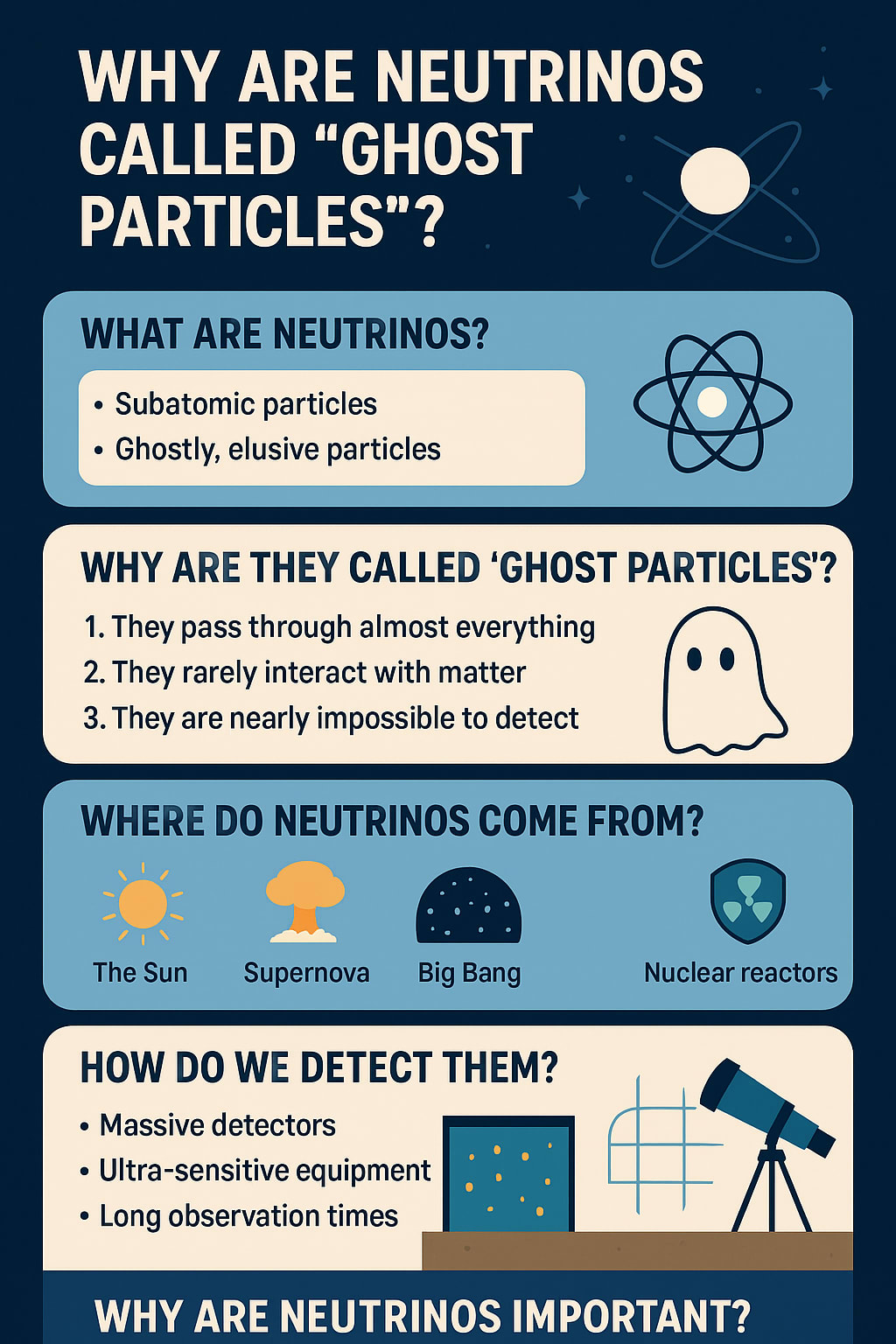
What Are Neutrinos?
Neutrinos are subatomic particles that belong to the family of elementary particles, meaning they are not made of smaller components (as far as we know).
They were first proposed in 1930 by physicist Wolfgang Pauli to solve a mystery in nuclear physics: energy seemed to disappear during radioactive decay. Neutrinos were introduced as invisible particles carrying away the missing energy.
Basic Properties of Neutrinos
• They have no electric charge
• They have extremely small mass
• They interact very weakly with matter
• They travel at nearly the speed of light
Because of these properties, neutrinos are incredibly difficult to detect — a key reason behind their ghostly reputation.
________________________________________
Why Are Neutrinos Called “Ghost Particles”?
The nickname “ghost particles” comes from three main characteristics:
1. They pass through almost everything
2. They rarely interact with matter
3. They are nearly impossible to detect
Let’s break these down one by one.
________________________________________
1. Neutrinos Pass Through Almost Everything
Every second, trillions of neutrinos pass through your body — right now — without you ever noticing.
They can travel through:
• Earth
• Oceans
• Buildings
• Human bodies
• Entire stars
Most neutrinos pass straight through the entire planet without colliding with a single atom.
To put this into perspective:
• A neutrino could pass through a wall of lead one light-year thick and still have a good chance of coming out the other side.
This ability to move through matter almost as if it doesn’t exist makes neutrinos seem like ghosts passing through walls.
________________________________________
2. Neutrinos Interact Extremely Weakly with Matter
Neutrinos are affected by only:
• Gravity
• The weak nuclear force
They do not interact via:
• Electromagnetic force (no electric charge)
• Strong nuclear force (which holds atomic nuclei together)
The weak nuclear force has an extremely short range, meaning neutrinos must come very close to another particle to interact — and that rarely happens.
Why This Matters
Most particles we detect (electrons, photons, protons) interact easily with matter. Neutrinos, however, can pass through huge amounts of material without leaving evidence.
This near-invisibility is one of the strongest reasons they are called ghost particles.
________________________________________
3. Neutrinos Are Extremely Hard to Detect
Because neutrinos interact so rarely, detecting them requires:
• Massive detectors
• Ultra-sensitive equipment
• Long observation times
Even then, scientists might detect only a handful of neutrino interactions out of billions passing through.
Neutrino Detection Is Like…
Imagine firing a bullet through the entire Earth and expecting it to hit a single grain of sand. That’s roughly how unlikely neutrino interactions are.
This extreme elusiveness makes neutrinos feel more like spectral visitors than ordinary particles.
________________________________________
Where Do Neutrinos Come From?
Neutrinos are produced in enormous numbers across the universe.
Major Sources of Neutrinos
1. The Sun
Nuclear fusion in the Sun produces vast numbers of neutrinos. These solar neutrinos reach Earth in about 8 minutes, traveling directly from the Sun’s core.
2. Supernova Explosions
When massive stars explode, they release an enormous burst of neutrinos — far more energy than visible light.
In fact, during a supernova:
• 99% of the energy is released as neutrinos
3. The Big Bang
Some neutrinos were created just seconds after the universe began. These cosmic neutrinos are among the oldest particles in existence.
4. Nuclear Reactors
Human-made nuclear reactions also produce neutrinos, which scientists use to study neutrino behavior.
5. Black Holes and Neutron Stars
Extreme cosmic environments generate high-energy neutrinos that help scientists probe the most violent events in the universe.
________________________________________
Types of Neutrinos
Neutrinos come in three known types, also called “flavors”:
1. Electron neutrino
2. Muon neutrino
3. Tau neutrino
One of the strangest discoveries in physics is that neutrinos can change flavor as they travel — a phenomenon known as neutrino oscillation.
Why This Is Important
Neutrino oscillation proves that neutrinos have mass, even though it is incredibly small. This discovery challenged the Standard Model of particle physics and earned a Nobel Prize in Physics (2015).
________________________________________
How Do Scientists Detect Ghost Particles?
Despite their ghost-like nature, scientists have developed ingenious ways to detect neutrinos.
1. Underground Detectors
Neutrino detectors are often built:
• Deep underground
• Under ice
• Under water
This shields them from other particles and cosmic radiation.
2. Massive Detection Tanks
Some detectors contain:
• Thousands of tons of water
• Liquid scintillators
• Antarctic ice
When a neutrino occasionally collides with an atom, it produces a tiny flash of light — which sensors detect.
Famous Neutrino Observatories
• Super-Kamiokande (Japan)
• IceCube Neutrino Observatory (Antarctica)
• Sudbury Neutrino Observatory (Canada)
These facilities are among the most sensitive scientific instruments ever built.
________________________________________
Why Are Neutrinos Important to Science?
Despite being hard to detect, neutrinos are incredibly valuable to scientists.
1. They Reveal the Inside of Stars
Light cannot escape the dense core of stars easily, but neutrinos can. By detecting neutrinos, scientists can study what’s happening inside the Sun and distant stars in real time.
2. They Travel Undisturbed Across the Universe
Neutrinos are not scattered by dust, gas, or magnetic fields. This means they carry pure information from their sources.
3. They Help Explain the Universe’s Evolution
Neutrinos played a key role in:
• The formation of galaxies
• The behavior of early cosmic matter
• The balance of forces after the Big Bang
4. They Challenge Existing Physics
Neutrinos don’t fit neatly into current theories. Their tiny mass and oscillation behavior suggest there may be new physics beyond the Standard Model.
________________________________________
Are Neutrinos Dangerous?
Despite passing through your body in vast numbers, neutrinos are completely harmless.
• They rarely interact with atoms
• They don’t damage cells
• They don’t cause radiation sickness
In fact, you are far more affected by everyday sunlight than by neutrinos.
________________________________________
Why the “Ghost” Name Fits Perfectly
Neutrinos earn the title “ghost particles” because they:
• Move silently through matter
• Leave almost no trace
• Are everywhere yet unseen
• Carry messages from distant cosmic events
Like ghosts, they exist all around us — but only reveal themselves under special conditions.
________________________________________
Neutrinos and the Future of Physics
Neutrino research is one of the most exciting frontiers in modern science. Future discoveries may help answer big questions such as:
• Why does matter exist instead of antimatter?
• What is dark matter?
• Are there hidden dimensions or new forces?
• How did the universe evolve after the Big Bang?
Some scientists believe neutrinos may hold the key to understanding the deepest secrets of reality.
________________________________________
Conclusion: The Universe’s Most Mysterious Messengers
Neutrinos are called “ghost particles” not because they are supernatural, but because they defy our intuition about matter. They pass through the universe almost untouched, carrying information from places light cannot reach.
Invisible, elusive, and abundant, neutrinos remind us that the universe is far stranger — and more fascinating — than it appears.
As technology improves, these ghostly particles may one day help unlock answers to the greatest mysteries of existence.
About the Creator
Keep reading
More stories from shahkar jalal and writers in Education and other communities.
How Does the Universe End? 5 Scientific Scenarios (Explained)
1. Big Freeze (Heat Death): The Most Likely Ending What Is the Big Freeze? The Big Freeze, also known as Heat Death, is currently the most widely accepted scientific theory for the fate of the universe. According to this scenario, the universe continues expanding forever — but that expansion eventually leads to a cold, dark, and lifeless cosmos.
By shahkar jalal3 months ago in Education
Rich, Enthralling Historical Fiction
Historical fiction occupies a special place in literature, blending documented events with imaginative storytelling to bring the past vividly to life. It allows readers to step into vanished worlds, experience forgotten customs, and witness pivotal moments through the eyes of characters who feel real and emotionally complex. When done well, historical fiction is not merely entertainment—it becomes a bridge between history and humanity, revealing how ordinary lives are shaped by extraordinary times. One of the defining strengths of historical fiction is its ability to humanize large historical events. Wars, revolutions, and social upheavals often appear in textbooks as timelines and statistics. Fiction, however, transforms them into personal stories of love, loss, fear, and resilience. Through carefully crafted characters, readers gain insight into what it might have felt like to live during the French Revolution, the Roman Empire, or colonial Asia. This emotional connection deepens understanding in a way pure historical records cannot. Research is the backbone of compelling historical fiction. Skilled authors immerse themselves in archives, letters, and cultural studies to recreate accurate settings—what people ate, how they dressed, how they spoke, and what they believed. The success of the genre depends on this balance between fact and imagination. Readers trust that while characters may be fictional, the world they inhabit is truthful. This authenticity allows the narrative to educate without feeling like a lesson. Many celebrated novels have demonstrated the genre’s power. Works such as War and Peace and The Name of the Rose combine meticulous historical detail with philosophical depth and gripping plots. More contemporary novels like The Book Thief show how historical fiction can be accessible to modern audiences while still addressing profound themes of morality, survival, and identity. What makes historical fiction truly enthralling is its narrative scope. These stories often span years or even generations, capturing social change over time. A single family’s journey can mirror the transformation of an entire nation. Through this lens, readers see history not as distant and fixed, but as fluid and shaped by countless individual decisions. The genre reminds us that history was once the present, lived by people who hoped, doubted, and dreamed just as we do today. Another key appeal lies in rediscovering marginalized voices. Traditional historical records frequently overlook women, minorities, and the poor. Historical fiction offers a way to reimagine their perspectives, giving depth to those who were often silenced. By placing such characters at the center of narratives, writers challenge dominant historical interpretations and broaden our understanding of the past. The emotional richness of historical fiction also stems from its themes of continuity and change. Love stories set against war, friendships tested by political turmoil, and families divided by ideology resonate strongly because they echo modern experiences. Readers recognize themselves in characters from centuries ago, realizing that human emotions remain constant even as societies evolve. In today’s fast-paced digital age, the genre serves as a reminder of patience and reflection. Historical novels demand time—time to absorb complex settings and layered plots. This slow immersion contrasts with quick news cycles and offers a deeper form of engagement. Readers do not just consume information; they inhabit another era. Ultimately, rich and enthralling historical fiction is more than a retelling of the past. It is a dialogue between then and now. By blending factual foundations with imaginative insight, the genre preserves memory while encouraging empathy. It teaches that history is not merely a sequence of events, but a tapestry of human lives woven together across time. Through these stories, the past becomes present, and readers come away with a fuller understanding of both history and themselves.
By Fiaz Ahmed 6 days ago in Education




Comments
There are no comments for this story
Be the first to respond and start the conversation.